
Folklore in Film is reader-supported. When you buy through links on our site, we may earn a small affiliate commission.
The ending of The Green Knight isn’t ambiguous.
It’s actually pretty obvious what Gawain’s outcome is… if you know your folklore.
(And you stick around for the film’s post-credits scene.)
We’ll get into it.
I’m I. E. Kneverday and at the end of this essay I will be grading 2021’s The Green Knight on its folklorical accuracy.
Along the way, we’ll learn about the differences between the movie and its medieval source material.
We’ll uncover the meaning behind the fox, the giants, those runes, that pentacle, and the headless Saint Winifred.
And I’ll also do my best to ID all of the Knights of the Round Table…
…including the perpetually offscreen knight who has a seat waiting for him next to King Arthur, which is the film’s take on the Siege Perilous, or Perilous Seat.
Let’s take a look.
Pssst. You can watch a video adaptation of this essay right here. Text continues below.
What Is The Green Knight Based On?
“Look, see a [film] that holds more wonders than any since [the Arthurian legend film] was born.”
For realsies though, I think we need to go back to 1981’s Excalibur to find an Arthurian legend film that is of the same, well, caliber, as 2021’s The Green Knight.
Written and directed by David Lowery, the film adapts the anonymously written 14th-century chivalric romance, Sir Gawain and the Green Knight.
But to paraphrase Alicia Vikander’s Lady of the Castle:
When Lowery saw room for improvements, he made them.
Including setting the opening action on Christmas rather than New Year’s Eve like in the original poem.
Why Did Writer/Director David Lowery Change The Green Knight’s Setting From New Year’s to Christmas?
Yes, New Year’s Eve is a significant date, marking the turning of the year.
But Arthurian legend has always had this backdrop of Celtic paganism competing and/or commingling with Christianity.
And with the Christmas setting, I’d argue Lowery is able to better highlight these dueling spiritual systems.
Especially as he cuts between Dev Patel’s Gawain at Camelot’s Yuletide feast and Gawain’s mother (played by Sarita Choudhury) bringing forth the Green Knight with dark magic.
Speaking of which, does that happen in the 14th-century poem?
Not exactly.
Does Gawain’s Mother Summon the Green Knight in the Source Material?
See, the poem doesn’t mention Gawain’s mother at all.
Whereas in the movie, she is clearly meant to be Morgan Le Fay, sorceress supreme and Arthur’s half-sister.
But Lowery’s tweak here is again, very smart.
Who Is Gawain’s Mother? Meet Morgause, Morgan Le Fay’s Sister
Because in later Arthurian literature, including Thomas Malory’s 15th-century, Le Morte D’Arthur, Gawain’s mother is given as Morgause.
And Morgause is Morgan’s (and Arthur’s) sister.
Making Morgan Le Fay Gawain’s aunt.
So Lowery thought: why not just combine Morgause and Morgan and that way the film’s protagonist can have a direct connection to the story’s hidden antagonist.
An Emperor to The Green Knight’s Darth Vader.
(Note: Lowery wasn’t the first writer to combine Morgause and Morgan.)
What Is the Green Knight’s Identity in the Poem?
Now, in the poem, we don’t find out that Morgan Le Fay has been pulling the strings until the very end.
And at the same time, it’s revealed that the Green Knight is, in fact, the Lord of that castle where Gawain had stayed.
Here, I’ll let the Green Knight explain.
To quote a modern English update of the Middle English poem:
“I am called Bernlak de Hautdesert, through might of Morgain la Fay, who dwells in my house. Much has she learnt of Merlin, who knows all your knights at home. She brought me to your hall for to essay the prowess of the Round Table.”
Couple things to unpack here.
Who Is the Old Woman With the Blindfold in The Green Knight?
First: the old woman with the bandages wrapped around her eyes in the movie?
Yeah, that’s a nod to Morgan Le Fay living in the lord’s castle as established in the poem.
In the film, the sightless woman, played by Helena Browne, is effectively a conduit for Morgan Le Fay’s magical influence.
But the real big change here was separating out the characters of the Green Knight and the Lord.
The former is played by Ralph Ineson and the latter by Joel Edgerton.
Yes, the same Joel Edgerton who played Sir Gawain in 2004’s King Arthur.
What a terrific bit of casting here.
On rewatch, I did find myself wondering: could the Lord and the Green Knight still be one and the same in the film as they are in the poem?
After all, the Lord’s penchant for games is still on full display.
And when you think about it, his agreement with Gawain that whatever Gawain receives he has to then give.
It’s essentially the beheading game in reverse.
The Origin of the Green Knight’s Beheading Game: Bricrui’s Feast (Irish Mythology)
And just so we’re clear, the beheading game—challenging someone to take a swing at your neck on the condition that they then get to return to the blow—wasn’t invented by the anonymous author of Sir Gawain and the Green Knight.
It’s a folklore motif that dates back to at least the 8th century and the Irish story, Bricrui’s Feast.
Bricrui’s Feast features Cú Chulainn, one of Irish mythology’s most famous heroes, competing against two other Irish warriors, Lóegaire Búadach and Conall Cernach, for the champion’s portion of the titular feast.
It’s decided that the trio will venture to the abode of Yellow (hmmm) to seek out a towering knight called the Terror.
The Terror produces an axe and challenges the three warriors to the beheading game, but the only one brave enough to go through with it is Cú Chulainn.
And notably, the Terror, after replacing his severed head, doesn’t chop off Cú Chulainn’s head in return, but instead taps Cú Chulainn on the neck three times with the blunt-end of his axe.
The trio then travels to the castle of the Munster king, Cú Roí, who leaves them in the care of his wife Bláthnat—a figure Cú Chulainn is intimate with in a separate but related tale.
In this story, the challenge at the castle isn’t carnal temptation, but monsters that Cú Chulainn successfully fights off in the night.
And finally, the three heroes are welcomed to Emain Macha, the seat of power of the Ulster King, Conchobhar mac Nessa, but guess who keeps interrupting dinner on consecutive evenings?
The Terror.
(He’s back.)
The Terror challenges the warriors to another round of the beheading game and, once again, only Cú Chulainn is brave enough to go through with it.
And once again, The Terror returns the hero’s decapitating blow with a tap from the blunt edge of the axe.
Then, the Terror reveals himself to be none other than the aforementioned king Cú Roí, who is also a shapeshifting wizard.
That is a verrrry concise take on a long story, but the parallels to Sir Gawain and the Green Knight are obvious.
Including the ending.
Because in the poem, Gawain decidedly does not die.
And just as The Terror/Cú Roi declares Cú Chulainn worthy of the champion’s share of the feast, The Green Knight/Lord Bertilak will ultimately declare Gawain the “most faultless man on earth.”
Granted, Gawain’s path to glory is much less direct than his Irish counterpart’s.
Remember, Gawain flat out fails one of his knightly tests when he plays hide the girdle with the Lady Bertilak.
Did You Know An Illustration From the Original Sir Gawain and the Green Knight Manuscript Is Shown Onscreen in The Green Knight?
And in the film, just before Gawain arrives at the Lord’s castle, we get a quick flash, just a few frames, of a medieval-looking illustration showing a lady caressing a blonde fella in a bed with a green blanket.
That illustration, known as the Temptation of Sir Gawain by Lady Bertilak, is original to the 14th-century manuscript that preserved Sir Gawain and The Green Knight:
The British Library’s Cotton Nero A X/2, otherwise known as the Pearl Manuscript or the Gawain Manuscript.
How The Green Knight Story Ends: Poem vs. Movie
Anyway, after Gawain gives in to temptation, he makes things even worse by refusing to give Lord Bertilak the green girdle, as had been stipulated in their agreement.
He gives him the two kisses he’d received from Bertilak’s Misses, but not the girdle.
And that is why, when Gawain kneels in the Green Chapel, the Lord—in his Green Knight form—feints twice with the axe but the third time he does bring it down, drawing blood.
And I quote:
“Two blows I aimed at thee, for twice thou kissedst my fair wife; but I struck thee not, because thou restoredst them to me according to agreement. At the third time thou failedst, and therefore I have given thee that tap. That woven girdle, given thee by my own wife, belongs to me. I know well thy kisses, thy conduct also, and the wooing of my wife, for I wrought it myself. I sent her to try thee.”
The film does lose a bit of the spirit of the source material by removing the Green Knight’s personhood, portraying him more as a green monster.
A force of nature that can be called upon and/or conjured by a witch.
But I do have to give credit to Lowery for making this altered narrative and the logic behind it work.
Something he accomplishes by first putting the green girdle in the hands of Gawain’s mother.
That way, it’s not some random Lord in some random castle challenging Gawain to be a good dude, it’s his mom.
Pushing him like a baby bird out of the nest.
But at the same time, keeping tabs on him, in the form of a fox (more on that later).
And giving him a literal security blanket in the form of the girdle.
Gawain’s Security Blanket: What the Runes Mean in the Gawain’s Green Girdle in The Green Knight (2021)
The security is provided by three runes that Gawain’s mother carves into a piece of wood, which in turn is sewn into the girdle.
Historically, the Saxons would have introduced runes to Britain in the 5th century, so if we’re going to assume a traditional 6th-century time period for this Arthurian legend, it checks out.
But the implication would be that Gawain’s mother is using the language of and calling on the gods of Camelot’s vanquished enemies, the Saxons.
Which, to be fair, sounds like something Morgan Le Fay would do.
Those three runes, in order are:
Thurisaz, Thor’s rune, which symbolizes the protective nature of a thorn or giant.
Algiz, which represents the protective nature of either an elk with mature antlers or the elk sedge, which is a plant with notoriously sharp edges.
And Raido, which symbolizes the rolling wheel of a chariot, and, thus, travel.
So, taking all these meanings together, we can decipher this runic message as meaning:
“Be sure to drink your Ovaltine.”
Wait, no.
It’s more like “Safe travels.”
But apparently this enchantment doesn’t protect against muggers.
The Green Knight as a Coming of Age Film
Although, to be fair, that one was totally on Gawain for being so gullible and unfamiliar with the ways of the world outside of Camelot.
Thus, this is very much a coming-of-age film.
Joel Edgerton’s Lord even asks Gawain at one point:
“You’ll do this one thing, you return home a changed man, an honorable man? Just like that?”
And when Gawain answers in the affirmative, the Lord replies:
“Oh, I wish I could see the new you. But perhaps we will miss our old friend and our fun and our games.”
He’s teasing Gawain here for thinking that this idealized version of himself lies just around the corner.
That he will magically mature once this quest is complete.
Whereas in the poem…
Sir Gawain is already a fully mature badass knight who, on this particular journey, encounters “not only serpents, wolves, bulls, bears, and boars, but wood satyrs and giants.”
At no point is it mentioned that Gawain gets trapped or stripped of his arms during any of these encounters.
And yes, you better believe that this is the only mention of giants in the poem.
Are There Giants in the Original Green Knight Poem? Who Are Those Giants in the Movie?
So what’s the deal with these colossal wanderers in the film?
Was Lowery just expanding on the lore, i.e., making up this idea of migratory mega-humans?
And did he intend them to be real or was Gawain supposed to be hallucinating these things?
My two pence:
They’re real.
And they’re meant to be representations of Britain’s earliest inhabitants, who, according to Geoffrey of Monmouth’s 12th-century History of the Kings of Britain, were:
“Giants, and they full passing gross of wit, albeit of marvellous bigness and of strength beyond all telling.”
Britain’s human arrivals inevitably force the giants into caves and remote places, so what we’re seeing in the movie is potentially a result of that.
It’s the new human, technological order pushing out the older, mystical order.
A motif we see across folklores and mythologies including next door, with Irish mythology.
But I digress.
What’s the Significance of the Fox in The Green Knight?
The fox in The Green Knight…is all wrong.
Gawain’s mom is essentially possessing a fox here and using it as a mobile baby monitor.
As that fox she even warns Gawain not to get in that canoe and go down that stream, in what is perhaps the most Lord-of-the-Rings-ish shot of the movie.
Even though she actually does want Gawain to ignore her and choose the more difficult path.
And look, as a parent, I get it:
I am constantly oscillating between pulling my kids in close and pushing them out into the world.
None of that conflict, however, appears in the original poem.
In Sir Gawain and the Green Knight, the character of the fox only appears on the third day of Lord Bertilak’s hunt.
It does not talk. But the hunters do talk to it.
And I quote:
Then was it fine sport to listen to the hounds,
and the hallooing of the hunters.
There the fox was threatened and called a thief.
But Reynard was wily,
and led them astray over mounts.
Wait: who the heck is Reynard?
Uh, that’d be Reynard the Fox, the most famous fox in all of medieval literature.
Reynard the Fox Explained: Medieval Literature’s Most Famous Anthropomorphic Trickster
First appearing in the 12th-century, Reynard is traditionally depicted as an anthropomorphic fox who regularly tricks and outsmarts his nemeses.
Of course, foxes were known for their cunning and trickster status well before the Reynard branding.
And in the poem, the author is really just using the name Reynard as a synonym for fox (in French, fox = renard), an indication that the stories comprising the Reynard the Fox literary cycle were in wide circulation at the time of writing.
It’s also notable that the poem interweaves the fox hunt sequence with the Lady-Bertilak-seduces-Gawain sequence.
We’ve got an obvious parallel here. The predators becoming prey.
Now, in the movie, the Lord brings the still-living fox to Gawain in a bag.
Whereas in the poem, the Lord’s hounds take Reynard and “turn off his coat.”
Which means exactly what you think it means.
And then the Lord gives Gawain the fox’s pelt, per their previous arrangement that Gawain gets the choicest spoils of each day’s hunt.
Why Is the Headless Saint Winifred in The Green Knight Movie (When She’s Not in the Original Poem?)
As for the headless Saint Winifred…
She’s not in the original poem.
The 7th-century martyr lost her head to an aggressive suitor when she decided to become a nun rather than knock boots with the scumbag.
A well sprung up from the spot where Winifred’s head fell, and her great uncle, Saint Bueno, then reattached her head to her body and she came back to life.
Or so the story goes.
The movie strays considerably from this original hagiography.
With Winifred’s head ending up at the bottom of a spring rather than creating one.
And when Gawain restores said head, Winifred doesn’t come back to life, it’s sort of the opposite.
Her soul is finally able to rest.
Sooo why did Lowery include this sequence in The Green Knight?
Firstly, it’s a story about a person getting their head chopped off and reattached that’s set within a century of when most of the Arthurian legends are supposed to be set.
So thematically, there’s already some connective tissue there.
Poor choice of words.
But secondly and more importantly, Lowery uses this sequence to teach Gawain a lesson about what it means to be a knight.
Gawain had seemingly learned the wrong lesson from his encounter with Barry Keoghan’s scavenger.
That good deeds are always done in exchange for something.
Whereas, knights are meant to hold themselves to a higher set of standards.
Something we’ll learn about next.
The Significance of the Pentacle (Five-Pointed Star) in The Green Knight
The pentacle, or five-pointed star, is a symbol we see scattered throughout Camelot, including on Arthur’s necklace, on the floor in the middle of the round table, and on Gawain’s shield…
And Kate Dickie’s Queen Guinevere explains the significance of the star’s five points as she outfits Gawain with that shield.
“May the blessed virgin keep your five fingers strong,
Your five senses sharp,
May her five joys inspire you,
The five wounds of her son give you fervor,
And the five virtues of a knight light your way.”
The Five Virtues of a Knight (From Sir Gawain and the Green Knight)
Those five virtues, FYI, are listed in the source material as generosity, fellowship, purity, courtesy/chivalry, and piety.
The source material also gives us a more thorough explanation of the origin of the five-pointed star, or pentagle, and why Sir Gawain was considered worthy of wearing the symbol on his shield.
“The ‘pentangle’ was devised by Solomon as a token of truth.
It is called the endless knot
It well becomes the good Sir Gawayne,
a knight the truest of speech and the fairest of form.
He was found faultless in his five wits [or senses].
His trust was in the five wounds.
The image of the Virgin was depicted upon his shield.
In cleanness and courtesy he was never found wanting,
therefore was the endless knot fastened on his shield.
In the movie, this star-studded shield promptly gets destroyed, of course, courtesy (well not, courtesy) of one of Barry Keoghan’s scavenger companions.
“Hidden” References to the Medieval Source Material in The Green Knight (2021)
Speaking of Barry Keoghan’s character, he has this great throwaway line, when he’s telling Gawain about the battle:
“They say the king, he killed 960 all on his lonesome.”
Gawain, naturally, expresses disbelief.
But this type of clear exaggeration has a precedent in Arthurian legend.
For those who remember my video on Monty Python and the Holy Grail, I highlighted the following sentence from Malory’s Le Morte d’Arthur:
“That day King Arthur by himself alone slew with his sword Excalibur four hundred and seventy heathens.”
There’s also an earlier scene when Gawain gets recognized at the tavern, and a commoner is recounting the story he heard about Gawain’s Christmas grame.
And in his retelling:
“This boy slew the Green Knight. With his own axe, he lopped off the giant’s head, and now he drinks with us!”
The thing is though:
We all saw Sean Harris’s King Arthur give Gawain his sword, presumably Excalibur, and that’s the weapon he used to lop off the Green Knight’s squash. Not the axe.
But in the original poem…you bet your butt Gawain uses the axe.
So Lowery is showing how the version of events unfolding in his movie, could still have evolved into the original Sir Gawain and the Green Knight poem.
And I think…that’s pretty cool.
Finally, we need to talk about that empty seat.
The one Gawain briefly gets to sit in and presumably gets to sit in again when he returns.
And he does return.
The Ending of The Green Knight Explained
In case I haven’t made that clear yet, I don’t think the Green Knight kills Gawain at the end.
It’s possible that the knight’s finger stroke across Gawain’s neck is the return blow.
Or maybe after that he gives him a nick with the axe like in the poem.
The strongest piece of evidence for Gawain surviving is, of course, the end credits scene.
In which we see Gawain’s daughter picking up the crown.
A scenario only likely to occur if Gawain had first been crowned king.
Narrratively, it also just makes more sense that Gawain survives, because for all of his flaws, he does ultimately pass the test.
Gawain takes off the green girdle—something he doesn’t even do in the source material.
In the poem, he keeps it on when he faces the Green Knight, still expecting it to provide protection.
And then when Gawain returns to Camelot, it’s said that all of the Knights of the Round Table start wearing green sashes in his honor.
Speaking of those knights.
Roll call.
Knights of the Round Table Roll Call: Who Are All the Knights in The Green Knight (2021)?
The empty seat, the siege perilous, can really only belong to one of two people: Sir Galahad or Sir Percival.
Percival is the original Grail Knight but in later lore is replaced by Galahad.
So the film is set during this window of several years when one of these two knights is out searching for the Holy Grail.
And going by the lore, he will inevitably retrieve it before returning to his seat next to Arthur.
And with the Grail in Camelot, Arthur—and Guinevere—will regain their good health and, what’s more, the blight upon the land will be lifted.
This idea of the health of Arthur and the health of his kingdom’s land being connected sounds right.
But this is actually the distinguishing characteristic of a different character from Arthurian legend:
The Fisher King, or Maimed King, the last in a long line of Holy Grail guardians
1981’s Excalibur popularized the conflation of Arthur and the Fisher King.
And speaking of…
It’s possible Lowery is giving another nod to Excalibur here by keeping the seat next to Arthur open for….Sir Lancelot.
Because in that film Lancelot’s seat is regularly empty while he stays away from court, lest he be tempted to play hide the girdle with Guinevere.
But for my money, that empty seat in The Green Knight belongs to Sir Percival.
Why?
Because in the poem, it’s established A) that Lancelot is among the knights who wish Gawain farewell, and B) that the Knights of the Round table are “in their first age.”
Thus, we can conclude C) that Galahad, son of Lancelot, is not there—he’d either be too young, or not even born yet.
He wasn’t part of that first age of knights, regardless.
Counterpoint: some of these fellas do look like they’re on the older side.
But as a counterpoint to my counterpoint:
Being a Knight of the Round Table would probably age you quicker than other professions.
Returning to those knights who send Gawain off on his quest in the poem:
In addition to Sir Lancelot, we’ve got Sir Bors, Sir Lionel, Sir Mador, and Sir Ywain.
Or at least, those are the knights mentioned in the poem that Arthur Pyle did illustrations for in his 1903 book The Story of King Arthur and His Knights.
Sooo using the very scientific approach of comparing Pyle’s illustrations to the dudes on screen combined with what descriptions of these Arthurian knights we can find in the literature:
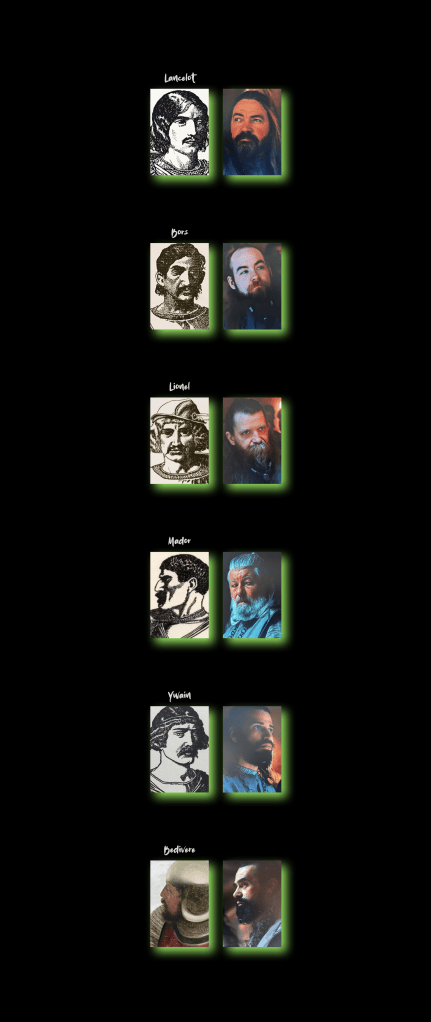
Lancelot is the dude with the red cheeks. He is described as having a ruddy face in the texts. But he’s also super well-groomed and put together, so I think this guy fits the bill.
Sir Bors is the younger brother of Sir Lionel, and they are both cousins of Sir Lancelot.
Look at this trio together, I think I nailed it. The famous cousin. The younger brother. And the older brother.
Sir Mador’s biggest claim to fame (shame?) incidentally is falsely accusing Guinevere of poisoning his cousin and I mean, with an accusatory glance like that, it has to be him.
Sir Ywain is Gawain’s cousin. And going strictly by age, I’m thinking this is our guy.
And I’d be remiss not to mention another Knight of the Round Table who gets namedropped at Gawain’s going away party: Sir Bedivere, one of Arthur’s earliest and most loyal companions.
But that doesn’t make him old.
Indeed, going by John Mulcaster Carrick’s 1862 oil painting, The Death of King Arthur, Bedivere’s beard was still black—or at least dark brown—at the time of Arthur’s death.
Meaning this must be our man.
Look, if I’m being honest, I’m not very confident in any of these, but it was a fun exercise.
I think Lancelot is sort of a sure thing because the camera does linger on him a bit.
If anyone knows David Lowery, please ask him how I did.
Folklorical Accuracy Grade for The Green Knight (2021)
As for its folklorical accuracy grade, how could I not give The Green Knight…an A+.
Even if I don’t agree with all of the changes Lowery made to the original chivalric romance, I can still appreciate the reasoning and folkloric logic, if you will, behind those changes.
Thanks for reading.
Fan of folk horror?
You might be interested in my short film Samhain, available over on the Irish Myths channel.
More the reading type?
Check out…
Neon Druid: An Anthology of Urban Celtic Fantasy
“A thrilling romp through pubs, mythology, and alleyways. NEON DRUID is such a fun, pulpy anthology of stories that embody Celtic fantasy and myth,” (Pyles of Books). Cross over into a world where the mischievous gods, goddesses, monsters, and heroes of Celtic mythology live among us, intermingling with unsuspecting mortals and stirring up mayhem in cities and towns on both sides of the Atlantic, from Limerick and Edinburgh to Montreal and Boston. Learn more…
Samhain in Your Pocket

Perhaps the most important holiday on the ancient Celtic calendar, Samhain marks the end of summer and the beginning of a new pastoral year. It is a liminal time—a time when the forces of light and darkness, warmth and cold, growth and blight, are in conflict. A time when the barrier between the land of the living and the land of the dead is at its thinnest. A time when all manner of spirits and demons are wont to cross over from the Celtic Otherworld. Learn more…
Irish Monsters in Your Pocket

In the Ireland of myth and legend, “spooky season” is every season. Spirits roam the countryside, hovering above the bogs. Werewolves lope through forests under full moons. Dragons lurk beneath the waves. Granted, there’s no denying that Samhain (Halloween’s Celtic predecessor) tends to bring out some of the island’s biggest, baddest monsters. Prepare yourself for (educational) encounters with Irish cryptids, demons, ghouls, goblins, and other supernatural beings. Learn more…
 Folklore in Film
Leave a comment