
Folklore in Film is reader-supported. When you buy through links on our site, we may earn a small affiliate commission.
For a movie titled King Arthur, you’d think it would feature a king named Arthur.
You also might expect that this King Arthur would be the film’s POV character.
And of course he’d be the biggest person on the poster…right?
Alas, this is not your typical Arthurian legend movie.
It’s not really an Arthurian legend movie at all.
We’ll get into it.
I’m I. E. Kneverday and at the end of this essay I will be grading 2004’s King Arthur on its folklorical accuracy.
Along the way, we’ll learn about dragon-shaped windsocks, Eastern European sword worship, Celtic wild men of the woods, and we’ll crack through the ice and get to the bottom of this whole frozen lake situation.
Let’s take a look.
Pssst. You can watch a video adaptation of this essay right here. Text continues below.
King Arthur (2004) Was Meant to Do for Arthurian Legend What Gladiator (2000) Did for Roman History
This movie…wasn’t supposed to be like this.
Just ask director Antoine Fuqua:
“When I first signed on to the movie it was to shoot an R[-rated] movie, and then halfway through it – that changed…
“I had to change a lot of my shooting style that I had set up because it just wouldn’t have been possible to do certain things and get a PG-13 rating,
“[T]onally, I had a whole different mindset.”
And while you can see hints of this different tone in the director’s cut of King Arthur…
There’s still an underlying issue:
The script.
Screenwriter David Franzoni’s previous gig had been a little movie called Gladiator.
In fact, he was the one who had conceived of the project after reading a book on the history of the gladiatorial games:
Those About to Die by Daniel P. Mannix.
And it’s clear that Franzoni followed a similar creative blueprint for his “very cool King Arthur piece, which aims more for history than myth.”
That’s how Franzoni described his still-in-progress screenplay for King Arthur in 2001.
The Book on Which 2004’s King Arthur Is (Kinda, Sorta) Based: From Scythia to Camelot
And at this point, he’d already found the history book that would be foundational to his story:
C. Scott Littleton and Linda A. Malcor’s From Scythia to Camelot: A Radical Reinterpretation of the Legends of King Arthur, the Knights of the Round Table, and the Holy Grail.
The book attempts to ground the Arthurian and Grail Quest traditions in folklore from the steppes of what are now Ukraine and Southern Russia.
An area once known as Scythia.
And there are two main components to this theory.
The first of which, incidentally, involves a major player from the movie Gladiator, the Roman Emperor Marcus Aurelius.
A Gladiator/King Arthur Crossover? Why the Roman Emperor Marcus Aurelius Should Have Been in King Arthur (2004)
You see, Marcus Aurelius was none-too-happy that the nomadic, Iranian-speaking Sarmatians were taking over Scythia.
But as master horseriders, it was easy to understand why.
So in 175, during the Marcomannic Wars, Aurelius defeated a major Sarmatian tribe known as the Iazyges.
But rather than, you know, killing them all, he forced 8 thousand Sarmatian calvarymen to serve in the Roman army.
And of these 8 thousand, 5,500 of them got sent where?
Britain.
And what was the name of the commander, or one of the commanders, anyway, who oversaw a legion of these Sarmatians in Britain?
Lucius Artorius Castus.
Lucius Artorius Castus: Did This Historical Roman Commander Inspire a Legendary King of the Britons?
Now, in a vacuum, this name Artorius means nothing.
Because there are thousands of names and words that sort of sound alike but have no etymological connection whatsoever.
My favorite example: shōgun and shotgun.
So the argument here isn’t merely that the name Artorius became anglicized as Arthur and thus this historical commander clearly inspired the legendary King Arthur…
It’s also that the culture and traditions of the Sarmatian calvarymen helped inspire the Knights of the Round Table.
Shiny Boys With Special Wind Socks: How the Sarmatians May Have Inspired the Knights of the Round Table
The Sarmatians in Britain belonged to heavy cavalry units known as Cataphracts.
The uniform consisted of head-to-toe armor, for man and horse.
Their primary weapon: a twelve-foot thrusting lancing known as a kontos.
To the local Britons in the 2nd-century, these shiny boys certainly would have stood out.
And with 5,500 of them coming ashore, it would have made a lasting impression.
Or so the argument goes.
The icing on the cake:
The Sarmatian Cataphracts carried wind-inflated military standards known as draco, plural: dracones:
They’re dragons, with their mouths open.
And which figure from Arthurian lore has a dragon not only in his heraldry but also in his name?
King Arthur’s father, Uther Pendragon.
It’s an intriguing parallel.
And I like that the special windsocks show up in the movie.
Even if they’re anachronistic because the filmmakers decided to set the movie not in the 2nd century when Lucius Artorius Castus was actually alive and in Britain but in the 5th century, when Roman presence on the island had dwindled, all so that the knights could battle the invading Saxons like they do in the oldest Arthurian legends.
When Is King Arthur (2004) Set? And Why?
Yeah you heard me correctly.
Despite Franzoni aiming “more for history than myth,” the movie still defaults to the myth for its time period.
Which narratively was a smart move.
Because if 2004’s King Arthur had been set in the late 2nd century, when, historically, Lucius Artorius Castus and the Sarmatians were in Britain, it would have highlighted a potential issue with the Scythia to Camelot hypothesis.
Which is that Artorius wouldn’t have been the “good guy” defending his country in such a scenario; historically, he was part of the invading force.
A real 2nd-century King Arthur, if there ever was such a figure, wouldn’t have been a Roman, he would have been a Brittonic a.k.a. Brythonic Celtic-speaking chieftain fighting off the Romans.
Which the movie sort of gives us with its interpretation of Merlin as a Pictish warlord—more on him later.
And it’s also insinuated in the movie that Arthur’s mother was herself a Pict.
So it seems like the filmmakers are trying to have their cake and eat it too.
Because despite their focus on these Sarmatian knights, Arthur is still a Romano-Britonnic warrior who proves himself in battle by defeating the Saxons—which is exactly how he’s depicted in the earliest legends.
Let us now move on to the second component of the argument set forth in From Scythia to Camelot:
Which is that mythology originating in the Eastern European Steppe directly influenced important Arthurian narratives.
Including having a hero pull a sword from a stone.
Tossing a sword into a body of water so a hero can die.
And questing for an enchanted drinking vessel.
Let’s tackle these one at a time.
Sword Worship on the Eastern European Steppe: Did Scythian Mythology Influence Arthurian Legend?
Herodotus tells us that in ancient Scythia, people built a huge, square-shaped shrine out of brushwood that had a ramp you could walk up and at the top was an iron sword.
The sword apparently represented a deity, which Herodotus equated with the Greek god of war, Ares.
That was in the 400s BCE. And if we flash forward eight hundred years to the 300s CE, there’s still sword stuff going on in the region.
To quote the Roman soldier and historian Ammianus Marcellinus, writing here in a totally fair and balanced manner about the Alani people, or Alans:
“Nor is there any temple or shrine seen in their country, nor even any cabin thatched with straw, their only idea of religion being to plunge a naked sword into the ground with barbaric ceremonies, and then they worship that with great respect, as Mars, the presiding deity of the regions over which they wander.”
Of course, the missing piece here, the thing that would really help prove that there’s a link between Scythian sword worship and the sword in the stone is, ya know, the stone.
But honestly, learning this does make me rethink the flashback scene in 2004’s King Arthur, where a young Arthur pulls a sword not from a stone, but from his father’s burial mound.
It now seems like that was a direct nod to the Alani practice of ceremonially plunging swords into the ground.
Even though, in the context of the actual movie, Arthur’s father is Roman, so that doesn’t really make sense.
Roman soldiers were rarely buried with their weapons. And swords weren’t traditionally used as gravemarkers.
The Nart Sagas: Precursor to the Lancelot-Grail Cycle?
Anyway, the more compelling evidence, I think, showing a link between Arthurian and Eastern European steppe legends, is the Nart Sagas.
These stories were collected in the North Caucasus region of what is now Russia, but it is widely accepted that the roots of many of these stories can be traced back to the Alans and the Sarmatians.
In fact, the Ossetians, one of the ethnic groups in the North Caucasus, are direct descendants of the Alans.
And in their tellings of the Nart sagas, one of the major heroes is Batraz, who is said to have skin as hard as steel.
Batraz also famously wields a lightning-bolt-emitting sword that must be tossed into the Black Sea before he is able to die.
This of course has a parallel in Arthur instructing his most loyal of knights, Sir Bedevere, to toss Excalibur into a lake so that he (Arthur) may pass on to Avalon.
The Nart sagas also tell of an enchanted drinking vessel, the Wasamonga cup a.k.a. the Nartyamonga, which never runs dry.
But, the vessel will only rise to the lips of those who speak the truth.
So yes, there’s another obvious parallel here to Arthurian legend—specifically the quest for the Holy Grail and the knights having to pass a purity test to gain access to it.
The problem, however, is that both the Lady of the Lake/Excalibur storyline, and the Grail Quest storyline, originated in medieval France—not Britain.
We have the 12th-century Frenchmen Chrétien de Troyes and Robert de Boron to thank for those innovations.
Ditto the introduction of Sir Lancelot and Sir Galahad, neither of whom appear in the earlier, British lore.
So assuming Sarmatian calvarymen brought super-early versions of the Nart sagas, or proto-Nart sagas, with them to Britain in the 2nd-century CE…
Why didn’t their watery sword and enchanted drinking vessel stories enter Arthurian lore there?
Why did it happen in France?
The authors of From Scythia to Camelot have an answer for this.
Alani / French Origins of the Name Lancelot? Alanus-à-Lot
In the 5th century CE, the Alans did a big field trip—nope that’s the wrong word.
And they ended up in what is now Brittany, France.
The name Lancelot? Yeah, I always assumed he got that name because he used his lance, a lot.
But according to Littleton and Malcor, the name might have originated as Alanus-à-Lot, meaning “Alan of the river Lot.”
And over time, Alanus-à-Lot (Alanus-à-Lot, Alanus-à-Lot) became Lancelot.
Is it a fun theory?
Yes.
Does the movie explore this theory at all?
No.
The film’s version of Lancelot turns him into just another Sarmatian.
And look, I get that name recognition is the point.
Overall this movie does a pretty good job of including the big name Knights of the Round Table.
Roll Call: Who Are the Knights of the Round Table in King Arthur (2004)?
In addition to Clive Owen’s Arthur, Ioan Gruffudd’s Lancelot, and Hugh Dancy’s Galahad, there’s Mads Mikkelsen’s Tristan, Joel Edgerton’s Gawain, Ray Winstone’s Bors, and Ray Stevenson’s Dagonet. Notably absent: Sirs Bedivere and Percival. Also Sir Kay.
But why not have a scene where Arthur and those other knights come across Lancelot and Galahad in the woods somewhere?
And maybe you do a little homage to the 1981 movie Excalibur and have Arthur and Lancelot fight.
And then they all become friends and when they ask the brave knight his name, he says, in a French accent: Alanus-à-Lot.
And Bors is like: Alright then, Lancelot.
And…scene.
Who Are the Woads in King Arthur (2014)? Meet the Picts
As for the woads.
They’re meant to be Picts, the native Brittonic/Brythonic Celtic-speakers of Northern and Eastern Scotland.
Not to be confused with the Goidelic/Gaelic Celtic-speakers of Western Scotland who came over from Ireland.
The term “woad” refers to the blue warpaint the Picts did historically wear.
And you bet your butt that the Picts did indeed fight the Romans.
And the Picts also fought the Saxons.
But at no point, as far as I can tell, did the Picts ever team up with Roman calvarymen and fight the Saxons together.
Was Merlin Scottish? A Pictish Take on the Welsh Wizard in King Arthur (2004)
Meanwhile, while Merlin, played here by Stephen Dillane, is traditionally associated with the legendary Welsh bard Myrddin Wyllt, or Myrddin the Wild, the movie transports him across Hadrian’s Wall to Scotland.
Which does have a folkloric precedent, it turns out.
Because according to the Annales Cambriae, a distraught Myrddin fled the Battle of Arfderydd in 573 CE, taking up residence in Scotland’s Caledonian Forest where he communed with nature and gained the gift of prophecy.
While the inclusion of the date here certainly gives this account an air of historicity, this is actually an example of the Celtic Wild Man of the Woods motif.
A motif that may have originated in Scotland with an earlier Wild Man, Lailoken.
What’s the Point of Pelagius in King Arthur (2004)? Freedom to Submit to a King?
Origins aside, by putting Merlin on the other side of the battlefield from Arthur for most of the movie, Arthur loses a critical advisor.
Because in the legends, that’s Merlin’s primary role. He’s not just doing magic, he’s helping Arthur make good decisions.
The movie fills this advisatory gap with Pelagius, a Christian theologian from Britain who, historically, was active between 390 and 418 CE.
Which sort of makes sense for this film’s mashed-up timeline because most of the action is set in 467 after Pelagius is dead.
But then again the historical Artorius preceded Pelagius by 200+ years so none of it really makes sense.
And while we could get into the weeds as to whether Artorius is interpreting Pelagius’s work correctly, let’s take it at face value that the main point here is freedom.
People should be free.
Which is why in the final seconds of the film everyone kneels down before Arthur and presumably he becomes their king.
Yay, freedom!
A Guinevere / Gwenddydd Connection? A Celtic Origin for an Arthurian Princess
As for the film’s blue-hued beauty, Keira Knightley’s Pictish warrior Guinevere…
There’s a Middle Welsh poem known as the The Apple Tree Stanzas, which alludes to Myrddin the Wild having a sister, who is a prophet in her own right.
And this powerful woman’s name is Gwenddydd.
And the original Welsh form of the name Guinevere was…Gwenhwyfar.
No, not the same.
But both have the same Brythonic Celtic root, Gwen, meaning “white.”
Where Is the Arthur, Lancelot, Guinevere Love Triangle in King Arthur (2004)?
As for the love triangle between Guinevere, Arthur, and Lancelot, which is central to the Lancelot–Grail Cycle, the movie reduces this to a few lustful looks on Lancelot’s part.
Then, Lancelot dies.
Can a Single Battle Scene Redeem an Entire Movie? The Frozen Lake Scene in King Arthur (2004)
Finally, the Internet is unanimous that for all of its flaws, 2004’s King Arthur is able to redeem itself with that frozen lake battle scene.
It demonstrates actual strategy on the part of the Knights of the Round Table, who force the invading Saxons, including Stellan Skarsgård’s Cerdic and Til Schweiger’s Cynric, toward the center of the lake, clustering them together.
It’s possible screenwriter David Franzoni drew inspiration from the historical Battle on the Ice, during which a prince clashed with a bunch of crusaders on a frozen lake.
Historically and archaeologically speaking, the ice never broke during that battle, but in later retellings you better believe there were shiny boys splish-splashing everywhere.
Also, it’s probably worth noting that the aforementioned Battle on the Ice that took place in 1242 on Lake Peipus, which forms part of the border between modern day Estonia and Russia.
So it has no connection to Arthurian lore whatsoever.
Still a good story though.
In his Divine Comedy, specifically in the Inferno, Dante talks about The Frozen Lake of Cocytus.
It’s the ninth and lowest circle of hell where people perpetually drown and…congeal, I guess… in a freezing lake.
But presuming the filmmakers took at least some inspiration from the landscapes they knew they would be filming in, the wild places of Ireland, England, and Wales…
Maybe they learned about the legends associated with the Welsh Llangorse Lake a.k.a. Llyn Syfaddan.
Which, according to the late 12th/early 13th-century historian, Gerald of Wales, was celebrated for its miracles.
And I quote:
“[The Lake] is sometimes seen by the inhabitants covered and adorned with buildings, pastures, gardens, and orchards.
“In the winter, when it is frozen over, and the surface of the water is converted into a shell of ice, it emits a horrible sound resembling the moans of many animals collected together.”
As someone who grew up ice-fishing in the wild places of Massachusetts, let me tell ya:
It doesn’t matter which lake or pond you’re on. The ice is always talking to ya.
And Gerald correctly concludes that there is a natural explanation for the noises.
He then goes on to describe the nearby mountains, which include:
“The Cadair Arthur, or the chair of Arthur, so called from two peaks rising up in the form of a chair, and which, from its lofty situation, is vulgarly ascribed to Arthur, the most distinguished king of the Britons.”
New theory: screenwriter David Franzoni wasn’t just reading From Scythia to Camelot, when he wrote this movie, he was reading the Itinerary and Description of Wales, first published in 1191.
Folklorical Accuracy Grade for King Arthur (2004)
As for its folklorical accuracy grade, I’m giving 2004’s King Arthur.
A… C-.
Thanks for reading.
Fan of folk horror?
You might be interested in my short film Samhain, available over on the Irish Myths channel.
More the reading type?
Check out…
Neon Druid: An Anthology of Urban Celtic Fantasy
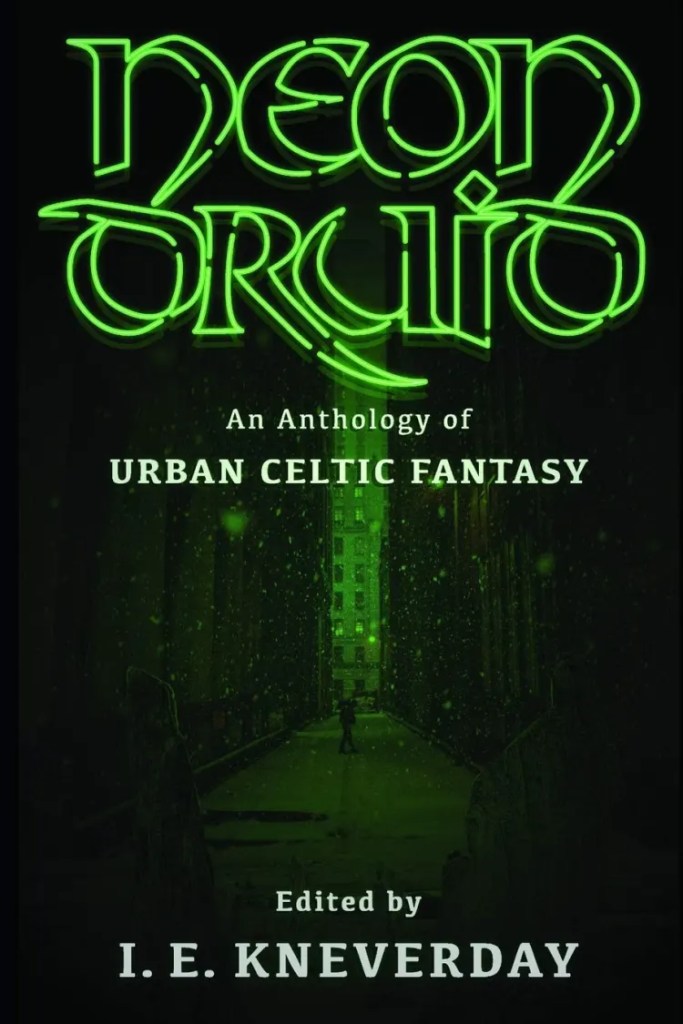
“A thrilling romp through pubs, mythology, and alleyways. NEON DRUID is such a fun, pulpy anthology of stories that embody Celtic fantasy and myth,” (Pyles of Books). Cross over into a world where the mischievous gods, goddesses, monsters, and heroes of Celtic mythology live among us, intermingling with unsuspecting mortals and stirring up mayhem in cities and towns on both sides of the Atlantic, from Limerick and Edinburgh to Montreal and Boston. Learn more…
Samhain in Your Pocket

Perhaps the most important holiday on the ancient Celtic calendar, Samhain marks the end of summer and the beginning of a new pastoral year. It is a liminal time—a time when the forces of light and darkness, warmth and cold, growth and blight, are in conflict. A time when the barrier between the land of the living and the land of the dead is at its thinnest. A time when all manner of spirits and demons are wont to cross over from the Celtic Otherworld. Learn more…
Irish Monsters in Your Pocket

In the Ireland of myth and legend, “spooky season” is every season. Spirits roam the countryside, hovering above the bogs. Werewolves lope through forests under full moons. Dragons lurk beneath the waves. Granted, there’s no denying that Samhain (Halloween’s Celtic predecessor) tends to bring out some of the island’s biggest, baddest monsters. Prepare yourself for (educational) encounters with Irish cryptids, demons, ghouls, goblins, and other supernatural beings. Learn more…
 Folklore in Film
Leave a comment