

Folklore in Film is reader-supported. When you buy through links on our site, we may earn a small affiliate commission.
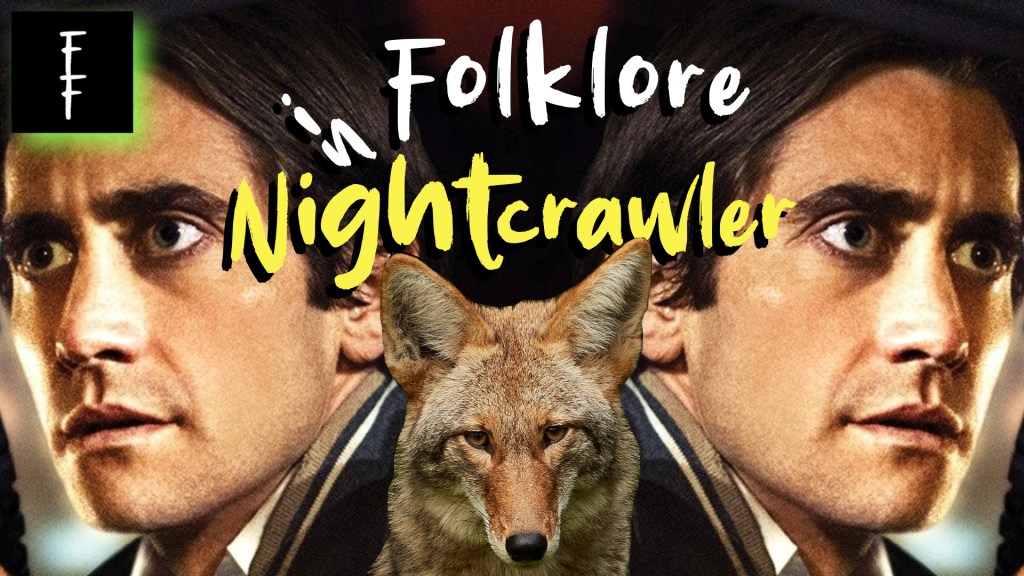
Nightcrawler star Jake Gyllenhaal famously dropped thirty pounds in an effort to make his character Lou Bloom “look like a coyote.”
But it turns out this coyote obsession runs deeper than just looks.
I’m I. E. Kneverday and at the end of this video I will be grading Nightcrawler on its folklorical accuracy.
Along the way, I’ll uncover how coyote folklore from indigenous American tribes, including the Algonquin, the Arikara, and the Lakota, may have helped inspire the Nightcrawler script.
And I’ll dig into the hidden meaning behind that distinctive name: Lou Bloom.
Let’s take a look.
Pssst. You can watch a video adaptation of this essay right here. Text continues below.
Becoming a Coyote: Why Jake Gyllenhaal Lost 30 Pounds for Nightcrawler
“I always thought Lou was a coyote. He looked like that.”
“Coyotes are starving, in a way…
“That hunger—that literal and figurative hunger—was a state that was really important for me to be in.”
That’s a direct quote from Jake Gyllenhaal on how he approached the character of Lou Bloom in 2014’s Nightcrawler.
And lest you think this was just some method acting mumbo jumbo, Nightcrawler’s writer/director Dan Gilroy agreed with his star’s assessment.
And I quote:
“[T]he character of Lou is like a nocturnal animal that comes down out of the hills at night to feed. Jake would call him a coyote. That’s sort of the symbolic animal; that’s why he lost all the weight because coyotes are always hungry.
“So [cinematographer] Robert Elswit and I were always looking at it as almost like an animal documentary. The landscape that the animal moves through is physically beautiful, even though that might not be the term that you would use to describe our film.”
Indeed, Gilroy gives a wink and a nod to this coyote nature documentary concept early in the film when a commercial for Bird’s Eye vegetables comes on Lou’s TV.
A commercial that features a family of howling coyotes.
On rewatch, it feels as subtle as a brick.
But admittedly, I didn’t notice the coyotes the first time I watched this movie.
Algonquin Folklore: How the Coyote Obtained the Fire From the Interior of the Earth
Of course, when we’re first introduced to Lou, he’s prowling around a construction site, at night, looking for materials he can steal.
When confronted by private security, welp, it doesn’t go so well for that security guard.
And Lou scores himself a new watch.
So from the get go, it’s established that Lou is a trespasser and a thief.
Characteristics that absolutely have parallels in coyote folklore.
Look no further than the Algonquin folk tale, How the Coyote Obtained the Fire from the Interior of the Earth.
Yes, as you might expect from the title, the coyote in this story performs a function similar to that of the titan Prometheus in Greco-Roman mythology.
In short, he steals fire from the gods and gifts it to humanity.
In long, a council of humans is planning this fiery heist and enlists the help of the “king of the coyotes” to infiltrate the underworld.
The coyote king finds the “dark mouth of the entrance under the mountains,” then uses his knowledge of the “habits of other animals” to sneak past the four guards.
The guards being a snake, a mountain lion, a panther, and a grizzly bear.
The coyote wisely times his trespass based on when these animals go to sleep, sneaking past each one in turn, then he steals the fire by way of a torch attached to his tail and high-tails it out of there.
Now, if you’re thinking to yourself:
This folktale is obviously meant to explain how the Algonquin people obtained the knowledge of fire-making, whereas Lou in the movie steals…stuff.
Including fencing, the aforementioned watch, a bike…
Remember that Lou is also a knowledge thief.
Arikara Folklore: The Coyote Becomes a Buffalo
From the moment he meets his first stringer or nightcrawler, Bill Paxton’s Joe Loder, who has made a career out of monitoring police scanners and rushing to the scenes of crimes and accidents to record the carnage, Lou starts following him.
Just instinctually, it seems, Lou follows him and eavesdrops, absorbing everything the guy is saying and doing.
Lou is so good at absorbing this knowledge that he begins nightcrawling on his own and, for better or worse, immediately develops a real knack for it.
And this ability to transform and reinvent himself is reminiscent of another Native American folktale, this one from the Arikara tribe.
The tale is titled The Coyote Becomes a Buffalo, and you’ll never guess what happens in it.
Okay, but the way it happens is pretty cool.
The coyote is hungry. And he sees grandfather buffalo, this big ole bull, eating grass.
So the coyote’s like hey, I’m starving, can you give me some food?
And the buffalo says, why don’t you just become a buffalo like me? Then you can eat all the grass you want.
The coyote agrees, and the buffalo says get ready: I’m going to charge straight into you, and as long as you don’t move, poof: you’ll be a buffalo.
The coyote moves the first two times but the third time he faces his fear and poof, he’s a buffalo.
Then the two grandpa buffalo and coyote-buffalo go and murder the bull buffalo, who’s been dominating all the cow buffalo.
Not for any altruistic but because they want the cows for themselves.
It’s a heartwarming story.
Much like the “romance” that plays out in Nightcrawler.
Arikara Folklore 2: The Coyote, the Girl, and the Magic Windpipe
And this brings us to another Arikara folktale, The Coyote, the Girl, and the Magic Windpipe.
Indulge me:
When you listen to the opening of this folktale, see if you can spot a connection between the titular “girl” and Rene Russo’s Nina.
“A long time ago there lived a beautiful girl who had her lodge in the center of the timber.
“She loved nobody, but she always had plenty of buffalo meat, and plenty to eat.
“One day as she was eating in her lodge the Coyote visited her.
“He saw that she had plenty of meat, so he made his home with her.
“Every day they had meat.
“The Coyote was now the girl’s errand man, and made fires for her and carried water for her.
“One day the girl was up early in the morning, and she said to Coyote:
“We are out of meat. I want fresh meat.”
Yeah.
As awful as that relationship is in the movie, Nina stays in it, in part, because she’s counting on Lou to deliver the, well, fresh meat.
To quote Joe Loder: “If it bleeds, it leads.”
Lakota Folklore: Iktomi and the Coyote
Of course, no analysis of Nightcrawler would be complete without a discussion of Lou’s understudy, Riz Ahmed’s Rick, and their complex relationship.
Here is where Lou embodies the trickster aspect of the coyote we see in folklore.
Specifically, in the Lakota folktale, Iktomi and the Coyote, the titular Iktomi comes across what he presumes to be a recently dead coyote.
Excited by the prospect of “nice fat meat,” Iktomi scoops up the coyote and carries it with him.
The coyote, who—twist!—is actually alive, smiles and has his eyes wide open as he enjoys the free ride.
Then when Iktomi tosses the coyote onto a fire, the coyote jumps out, kicking a bunch of embers at the man, burning him.
After putting out his own flaming fur, the coyote laughs at Iktomi and tells him the following:
“Another day, my friend, do not take too much for granted. Make sure the enemy is stone dead before you make a fire!”
Now, remember in the third act, when Lou tells Rick that the dude in the SUV is dead and that he should get over there and start filming?
That’s Rick falling into your classic (well maybe not classic) Iktomi and the Coyote-style trap.
Because we all remember what happens to Rick as a result of not confirming that the gunman is dead before shining that fire—I mean, camera light—in his face.
Am I reaching?
Of course I’m reaching. That’s what I do here.
How Coyote Characteristics Inspired the Folklore and the Film
Do I really think Dan Gilroy was familiar with these stories when he penned the Nightcrawler script?
No. I think it’s more likely that I’m able to find these similarities because both the script and indigenous folklore are drawing from the same well-known coyote characteristics.
Namely, coyotes are cunning. They’re happy to scavenge for food if necessary. And they tow the line between being social and solitary.
They’re more gregarious than foxes but less gregarious than wolves.
Similarly, while I’m tempted to describe Lou as a lone wolf, especially given his name (we’ll get into it), it’s obvious that he needs other people in order to accomplish his goals.
Despite the fact that, in his own words, Lou doesn’t like people.
Also, I was going to try to make a connection between Lou sort of miraculously being able to break through chains and locks (re: the construction site, the bike), without us ever seeing him do it on screen, and coyotes chewing off their limbs to free themselves from traps.
Is there something there? Like is Lou just offscreen gnawing through these chains?
I might just be overtired.
What’s in a Name? The Character Name Lou “Louis” Bloom Explained
Finally, we need to address Louis “Lou” Bloom’s name.
Why Lou?
Well in French, yes I’m still in France at the time of recording, loup, L-O-U-P, means wolf.
And of course the scientific name for a wolf is Canis lupus.
No, wolves and coyotes are not the same but they are closely related.
Then, we have Bloom, which immediately brings to mind Leopold Bloom, the protagonist of James Joyce’s novel Ulysses.
Which itself is an adaptation of Homer’s Odyssey.
Of course, in Nightcrawler, Lou goes on quite a journey.
What’s more, both Lou and Leopold are outsiders. And voyeurs. And, perhaps most strikingly, they’re both very hungry.
To quote the novel:
“Mr. Leopold Bloom ate with relish the inner organs of beasts and fowls. He liked thick giblet soup, nutty gizzards, a stuffed roast heart, liverslices fried with crustcrumbs, fried hencods’ roes. But most of all, he liked grilled mutton kidneys which gave to his palate a fine tang of faintly scented urine.”
With such appetites, the dude might as well be a coyote.
The (Folklorical) Problem With 2014’s Nightcrawler
My main criticism of Nightcrawler, from a folkloric perspective, is that Lou ultimately gets away with everything.
Don’t get me wrong, I think that is the right ending for the movie.
But in indigenous American folklore, there are dozens of stories in which coyotes are outsmarted and killed.
Such as in the Arikara tales, The Coyote and the Artichoke and The Coyote and the Rolling Stone.
That latter story concludes with the line:
“Because the Coyote is up to all kinds of mischief he is often killed, and this is why we so often find a dead Coyote on the prairies.”
So for a folklorical accuracy grade, I’m giving Nightcrawler…a B.
And if you enjoyed this essay please leave a like and comment “A friend is a gift you give yourself.”
Shout out to Robert Louis Stevenson.
Thanks for reading.
Fan of folk horror?
You might be interested in my short film Samhain, available over on the Irish Myths channel.
More the reading type?
Check out…
Neon Druid: An Anthology of Urban Celtic Fantasy
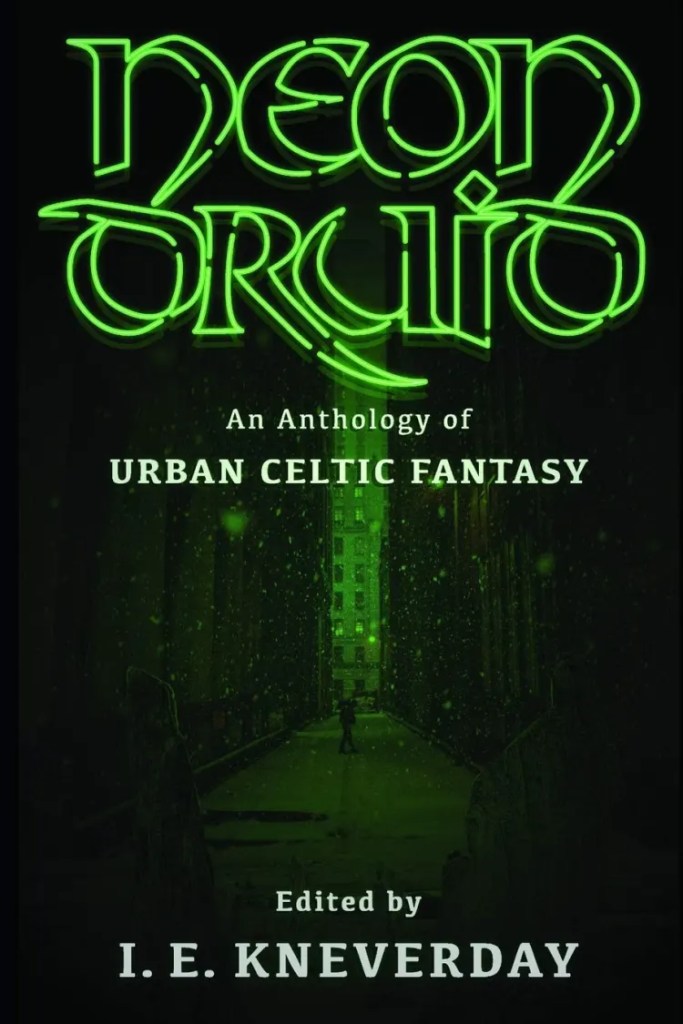
“A thrilling romp through pubs, mythology, and alleyways. NEON DRUID is such a fun, pulpy anthology of stories that embody Celtic fantasy and myth,” (Pyles of Books). Cross over into a world where the mischievous gods, goddesses, monsters, and heroes of Celtic mythology live among us, intermingling with unsuspecting mortals and stirring up mayhem in cities and towns on both sides of the Atlantic, from Limerick and Edinburgh to Montreal and Boston. Learn more…
Samhain in Your Pocket

Perhaps the most important holiday on the ancient Celtic calendar, Samhain marks the end of summer and the beginning of a new pastoral year. It is a liminal time—a time when the forces of light and darkness, warmth and cold, growth and blight, are in conflict. A time when the barrier between the land of the living and the land of the dead is at its thinnest. A time when all manner of spirits and demons are wont to cross over from the Celtic Otherworld. Learn more…
Irish Monsters in Your Pocket

In the Ireland of myth and legend, “spooky season” is every season. Spirits roam the countryside, hovering above the bogs. Werewolves lope through forests under full moons. Dragons lurk beneath the waves. Granted, there’s no denying that Samhain (Halloween’s Celtic predecessor) tends to bring out some of the island’s biggest, baddest monsters. Prepare yourself for (educational) encounters with Irish cryptids, demons, ghouls, goblins, and other supernatural beings. Learn more…


Leave a Reply