

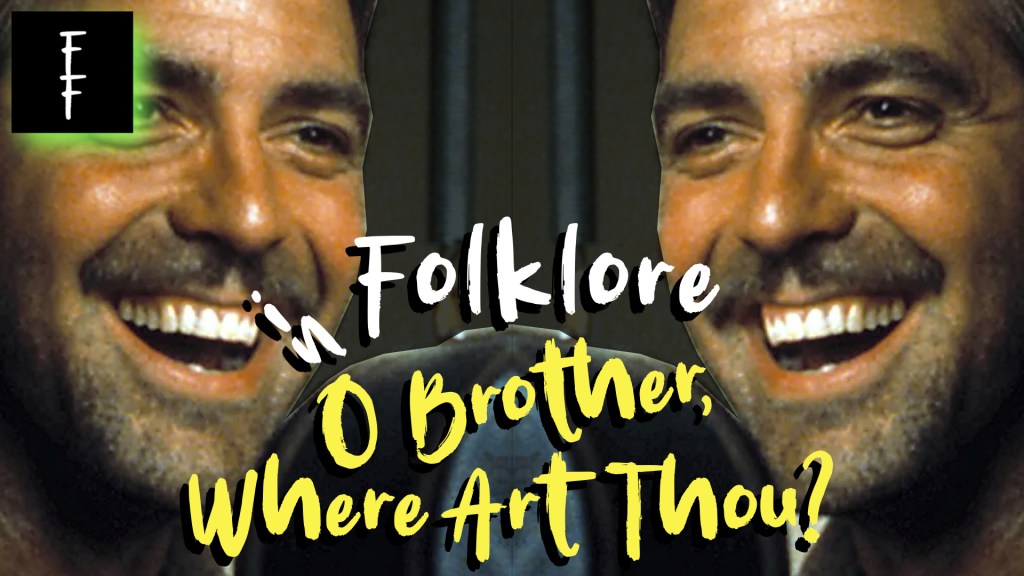
Folklore in Film is reader-supported. When you buy through links on our site, we may earn a small affiliate commission.
This question has been on a lot of people’s minds recently:
What’s the greatest Greek mythology movie of all time?
If the internet has taught me anything about evaluating films like these, the most important criterion is headwear.
What is our protagonist sporting on his dome and is it haberdashorically accurate?
Well, I’m pleased to let you know that in O Brother, Where Art Thou?, which is a loose adaptation of Homer’s Odyssey set in the Depression-era American South, George Clooney’s character Ulysses Everett McGill’s primary chapeau is…
Chef’s kiss.
The movie is set in 1937.
His vintage tweed flat cap, also known as a driving cap or ivy cap, was popular amongst working class American men throughout the 1930s.
So, therefore, this movie…is good.
And if you’re thinking to yourself:
What a silly way to evaluate a story that, while using a historical event as a jumping-off point, is very clearly a folktale.
I agree.
I’m I. E. Kneverday and at the end of this essay I will be grading O Brother, Where Art Thou? not on its historical or hatorical accuracy, but on its folklorical accuracy.
Along the way, we’ll invoke a muse, receive a prophecy from a blind prophet, have a feast, get reborn, cross paths with a traveling musician, listen to a lovely lullaby, catch a toad, escape from a cyclops, outshine some suitors, aaand narrowly escape death by way of deus ex machina.
Let’s take a look.
Pssst. You can watch a video adaptation fo this essay right here. Text continues below.
How Did O Brother, Where Art Thou? Get Its Title? Is It Referencing Shakespeare?
In the year 2000, the Coen brothers dared to ask:
What if The Odyssey, but America?
Okay, fine, it was a little more nuanced than that.
The film’s title is actually a reference to a 1941 film, Sullivan’s Travels, in which a famed comedy director sets out to create a serious adaptation of a Great Depression-set book, O Brother, Where Art Thou?
Not a real book.
Although the title sounds like a line out of Shakespeare’s Romeo and Juliet.
The title Sullivan’s Travels, meanwhile, is a riff on Jonathan Swift’s 1726 satire, Gulliver’s Travels, which sees an English adventurer visit many strange and distant lands.
Is O Brother, Where Art Thou? Based on Gulliver’s Travels?
I wonder if Joel and Ethan Cohen considered adapting that story, but found the Odyssey more compelling/easier to adapt.
I mean, in Gulliver’s Travels, you’ve got an island of giant people, an island of tiny people, an island of literal yahoos obsessed with shiny stones.
And while I’d love to sit here and tell you how O Brother, Where Art Thou?’s wealthy elite represent the giant Brobdingnagians.
And that the poor chain gang workers represent those little Lilliputians.
And that characters like Wash Hogwallop and George “Baby Face” Nelson represent the uncivilized Yahoos.
Buuut I don’t think that’s what the Cohen brothers were going for at all.
How We Know O Brother, Where Art Thou? Is Based on Homer’s Odyssey
This movie is a fairly straightforward Odyssey remake.
It tells us as much at the start.
And we get the opening lines of the actual Odyssey, right there on the screen:
“O Muse! Sing in me, and through me tell the story Of that man skilled in all the ways of contending, A wanderer, harried for years on end …”
Homer’s Source of (Divine) Inspiration: Muses in Greek Mythology
And right off the sledgehammer, we’ve got an invocation of the muse—a figure who’s responsible for divinely inspiring poets, musicians, and other artists.
In Greek mythology, there are nine muses, the most famous of which is Calliope (kuh-LIE-uh-PEE), mother of Orpheus and Linus.
Occasionally people confuse Calliope with Calypso.
But to be clear, Calypso is not a muse.
Calliope vs. Calypso: A Muse vs. The Odyssey’s Most Manipulative Nymph
Calypso is the nymph who imprisons Odysseus on the island of Ogygia for seven years.
Something we don’t see in O Brother, Where Art Thou?
Instead, the Cohen brothers start their story mid-escape from imprisonment.
Once free, our heroes Ulysses (that name, of course, is the Latinized form of Odysseus), Pete, and Delmar hitch a ride with a blind prophet who allegedly doesn’t have a name.
The Blind Seer in O Brother, Where Art Thou? Explained (He’s Tiresias)
The prophet tells the fellas that they will eventually find a treasure, but not the one they’re looking for, and that they’ve got a long, difficult journey ahead of them, and there’ll be lots of obstacles, but at some point, hey, they’ll see a cow on the roof of a cotton house.
Meanwhile, in The Odyssey, this character most certainly does have a name.
He’s Tiresias, the blind prophet of Thebes, famed for his clairvoyance and for spending seven years as a woman.
A little wrinkle here though:
In Homer’s Odyssey, Tiresias is a ghost.
Odysseus famously summons him from the underworld by way of sacrificing the finest ram in his flock, like ya do, and serving Tiresias its dark blood.
Then Tiresias gives Odysseus the following prophecy:
“Glorious Odysseus,
you ask about your honey-sweet return.
But a god will make your journey bitter.
I don’t think you can evade Poseidon,
whose heart is angry at you…But still,
though you will suffer, you may still get home,
if you will curb your comrades and your heart.
As soon as you’ve escaped the dark blue sea
and reached the island of Thrinacia
in your sturdy ship, you’ll find grazing there
the cattle and rich flocks of Helios,
who hears and watches over everything.
If you leave them unharmed and keep your mind
on your return, you may reach Ithaca,
though you’ll have trouble. But if you touch them,
then I foresee destruction for your crew,
for you, and for your ship. And even if
you yourself escape, you’ll get home again
late and grieving, in someone else’s ship,
after losing all of your companions.”
First off:
I thought Homer never used the word blue and that was a whole thing?
That it’s a wine-dark sea?
Second off, Poseidon, Greek god of the sea, storms, and horses, is well-represented in this movie.
We’ll talk about him more in a minute.
Was George “Baby Face” Nelson a Real Bank Robber?
Third off:
How about Tiresias’s warning not to mess with cattle?
That certainly gets paid off later in the movie, courtesy, well, not courtesy, of George “Baby Face” Nelson, who, for the record, was a real person and bank robber but who died before the movie takes place.
I also think the Cohen brothers, by having their blind seer allude to a cow on a roof, are paying homage to this imagery of Helios, Greek sun-personifier and cattle-owner, watching over everything.
Finally, both prophecies, the movie’s and the Odyssey’s, promise lots of suffering and an imperfect resolution to that suffering.
Where Is Circe’s Feast in O Brother, Where Art Thou? (at Wash Hogwallop’s House)
For Ulysses, Pete, and Delmar, the bad times start a rolling right away when Pete’s cousin Wash Hogwallop treats them to a feast…
…Before promptly ratting them out to the authorities.
And while Wash Hogwallop might seem like an odd stand-in for the enchantress Circe, daughter of Helios, the secret is in that name.
Hogwallop.
Because in the Odyssey, Circe that “dreadful goddess with lovely hair and human speech” puts out a feast for Odysseus’s crew, many of whom greedily gorge themselves.
But of course, Circe drugged the food and everyone who eats it gets turned into a pig, or hog.
Where Is the (Holy) Moly in O Brother, Where Art Thou? (It’s the Dapper Dan Hair Treatment)
And look, I know what you’re thinking:
In the Odyssey, the Greek goddess of wisdom Athena sends Odysseus a holy herb called moly (holy moly) by way of the messenger god Hermes, thus allowing him to resist Circe’s enchantments.
Where is that in O Brother, Where Art Thou?
O Brother, it’s there.
The Dapper Dan hair treatment is the moly.
But he runs out.
And at the store, they don’t have it.
And it’s 1937 rural Mississippi, so there are no instant deliveries, i.e. there is no Hermes operating here.
Hence, Ulysses complaining that the store is 2 weeks away from everything.
But look at me, getting ahead of myself.
Who Are the Lotus-Eaters in O Brother, Where Art Thou? (They’re Southern Baptists)
Because we need to talk about the Odyssey’s Lotus-Eaters, who, in the O Brother, Where Art Thou? universe, are likely Southern Baptists.
Yes, it’s possible they’re part of the pentecostal movement instead, which also did full-submersion baptisms in streams and rivers.
But in 1937, Baptists were the dominant body-dunkers in the region.
Regardless, Delmar is the first to get baptized, followed by Pete.
The former refuses to shut about it.
How he’s been saved.
How all of his sins and transgressions have been miraculously warshed away, and how neither God nor man had anything on him now.
“Come on in boys, the water is fine,” he implores his comrades.
Meanwhile, in the Odyssey, Odysseus sends a few of his sailors to go scope out an island where everyone eats a honey-sweet narcotic flower.
“…They left at once and met the Lotus-eaters,
who had no thought of killing my companions,
but gave them lotus plants to eat, whose fruit,
sweet as honey, made any man who tried it
lose his desire to ever journey home
or bring back word to us—they wished to stay,
to linger there among the Lotus-eaters,
feeding on the plant, eager to forget
about their homeward voyage.”
At first glance, you might not see a correlation between the baptism scene and the lotus-eater scene, but think about how Delmar changes.
After getting baptized, Delmar no longer wants to be associated with his criminal past.
He wants to forget it and live a new, godly life, disconnected from his past mistakes and obligations.
Just like how Odysseus’s sailors, after eating the lotus, are keen to abandon their commitment to Odysseus and their journey home so they can focus on living a new, much chiller life.
Wait, Is There a Blues Musician in The Odyssey? (Sort of!) Meet Demodocus
Now, call me a stickler for folklorical accuracy, but I don’t recall a blues musician ever popping up in the Odyssey.
The closest we get is the poet Demodocus, who sings about the horrors of the Trojan War, in which Odysseus had participated.
And the music makes Odysseus so sad, he has to hide his face because he keeps crying and crying.
Indeed, some might say that Odysseus is a man of constant sorrow.
as Tommy Johnson in O Brother, Where Art Thou a Real Blues Musician?
Of course, in O Brother, Where Art Thou?, we’re introduced to Tommy Johnson, who was a real Mississippi-born Delta Blues musician.
Did he actually sell his soul to the devil in exchange for guitar skills?
His brother claimed as much.
Buuut this same local legend is also attached to another Mississippi-born Delta Blues guitarist, Robert Johnson.
And ultimately the “man sells soul to devil” folklore motif (number 211 in Stith Thompson’s Motif-Index of Folk-Literature) has been around for centuries.
Making a Faustian Bargain: The “Man Sells Soul to Devil” Folklore Motif
In German folklore, we find the figure of Faust, who famously sells his soul in exchange for unlimited power, knowledge, and pleasure.
Hence the term, a Faustian bargain.
What’s interesting here is how the fictionalized Tommy Johnson describes the Devil’s appearance and tone, citing his whiteness, his empty eyes, and his big hollow voice.
And there’s the detail of the Devil’s traveling companion, a mean old hound.
Which leads us to Sheriff Cooley.
That’s who Johnson seems to be describing.
A dude who likes setting fires, hurting people, and saying things like “The law is a human institution.”
As for Sheriff Cooley’s bloodhound…
The Devil & Mephistopheles Went Down to Mississippi: Who Is Sheriff Cooley and His Hound in O Brother, Where Art Thou?
Fun fact: In the Faust legend, it’s not actually the Devil who makes the infamous deal, it’s the devil’s agent, Mephistopheles, who in Goethe’s telling of the tale first appears to Faust as what?
Aaaa dog. (Da bears)
It’s a poodle, but still.
Regardless, the Cohen brothers certainly intended Sheriff Cooley to be a devilish figure.
But narratively, he more closely resembles a different mythical mayhem-maker:
The Greek god Poseidon.
Who Is Poseidon in O Brother, Where Art Thou? (It’s Sheriff Cooley)
Through his manipulation of seas and storms, Poseidon makes it nearly impossible for Odysseus to return home.
He is constantly harassing him and his crew, and it takes an act of god—literally an act from Poseidon’s brother Zeus—for Odysseus to finally be free.
Likewise, in the movie, Sheriff Cooley relentlessly pursues our trio and is about to end their journey for good when an act of god—or from a story perspective, a deus ex machina—leads to them being saved.
Namely, the flood.
But wait a minute…
Who Is Zeus in O Brother, Where Art Thou? (It’s Pappy O’Daniel)
Where the heck is Zeus in O Brother, Where Art Thou?
Well, he’s right where he needs to be.
Running the show.
That’s Pappy O’Daniel.
Blasting his voice over the airwaves.
Zeus is King of the Gods; Pappy O’Daniel is the governor of Mississippi.
Granted, the real Pappy O’Daniel was the governor of Texas.
Also, there was no gubernatorial election happening in 1937, but hey, that’s history.
I’m here for the folklore.
I’m here to see Pappy O’Daniel up on that stage with the Soggy Bottom Boys so he can use his political power to pardon these fellas of their past crimes.
Zeus makes it possible for Odysseus to go home, Pappy O’Daniel makes it possible for Ulysses Everett McGill to go home.
Why Is Pappy O’Daniel’s First Name Menelaus in O Brother, Where Art Thou?
Granted, the fact that Pappy O’Daniel’s first name is Menelaus does give me pause.
Because in Greek mythology, Menelaus is Helen of Troy’s husband.
He is the one who drafts Odysseus to fight in the Trojan War in the first place and thus is responsible, in a way, for Odysseus’s plight.
So what the Cohen brothers are doing here is making a composite character who acts as both the cause of and solution to the story’s core problem.
O’Daniel, as governor, was responsible, in a way, for Ulysses Everett McGill getting put on that chain gang in the first place.
But at the end of the movie, O’Daniel is the one responsible for pardoning him.
Only, twist!
In the movie, Sheriff Cooley just straight-up ignores the law.
It’d be like Poseidon ignoring Zeus’s authority.
Quick aside:
Is it a coincidence that the two god-characters in the movie, Sheriff Cooley and Pappy O’Daniel, who represent Poseidon and Zeus respectively, both have Irish surnames?
Probably.
The Flood Scene in O Brother, Where Art Thou? Explained
Alas, the Cohen brothers don’t let Sheriff Cooley get away with his intended extrajudicial acts.
Hence, the flood.
And I think what’s happening here with this deus ex machina flood scene is that the Cohen brothers are symbolically wielding the power of the storyteller in order to save our heroes.
Who Gets the Name Homer in O Brother, Where Art Thou? (And Why?)
Because think about who gets the name Homer in this movie.
It’s the worst guy.
Or one of the worst guys.
(There’s a lot of them.)
The reform candidate Homer Stokes seems hellbent on inflicting pain on people—just like how Homer puts his characters through hell throughout the Odyssey.
The Return of Odysseus: His Disguise, His Stringed Weapon, Penelope, and Antinous
Odysseus does eventually return home in Homer’s story, after being away for two decades.
But when he gets there, there are all of these suitors waiting there trying to marry his wife, Queen Penelope.
Notably, however, none of these suitors possess the strength and technique required to string Odysseus’s bow.
Odysseus disguises himself as an old beggar and sneaks around testing people’s loyalties, before stringing the bow himself and reclaiming his throne.
The movie puts a musical spin on this part of the story.
We get Ulysses dressing up as an old guy and sneaking around, hoping to evaluate his wife Penny’s… not loyalty, let’s say, tolerance for him.
And the stringed weapon he picks up is the guitar.
Personal note: I like that they went with Penny instead of Penelope.
Why the Cohen brothers named her suitor Vernon T. Waldrip is beyond me.
Unless does Vernon kind of sound like Antinous? Vernon. Antinous.
In the Odyssey, Antinous is the most aggressive of Penelope’s suitors.
So why Vernon? Why not Anton? Or Anthony?
The Sirens Explained: Got to Sleep Little Odysseus
In the Odyssey, the crew famously clog their ears with wax while Odysseus himself gets tied to the mast of the ship so he can listen to the Sirens’ song without succumbing to its effects.
Circe had previously given Odysseus the heads’ up that the sirens would “beguile him with their clear-toned song.”
The movie deviates from the source material here by A) having the sirens look like women rather than bird monsters.
B) having three sirens rather than two.
And C) by having the sirens sing a lullaby as opposed to a more personalized tune meant to inflate the ego of the listener.
That being said, both groups of sirens are ill-intentioned.
In the Odyssey, the shore of their island is littered with the corpses and skeletons of men.
So yeah, these sirens are out for blood.
Meanwhile, in O Brother, Where Art Thou?, the sirens are out for the bounty on Pete’s head.
Or did they turn Pete into a horny toad?
Did The Sirens in O Brother, Where Art Thou? Turn Pete into a Horny Toad?
I think the toad thing there is two-fold:
First, this movie needed an animal transformation, or at least the suggestion of one, because as mentioned earlier, in the Odyssey, the enchantress Circe famously transforms some of Odysseus’s men into swine.
So this is a nod to that.
And it’s possible that part of the reason the Cohen brothers went with a toad instead of a pig is because toads have a deeper connection to witchcraft and magic in the American South.
However, and this brings me to point number two:
I think the main reason it’s a toad is because a toad can fit in a human hand.
And if you want to make a certain human character seem like he’s the size of a giant, capable of grabbing a person and squeezing them into a mush.
This was a stroke of folklorical genius.
Big Dan Teague as Polyphemus the Toad-Smooshing Cyclops
Get the audience believing or at least considering the possibility that this horny toad is our poor pal Pete.
Then bring in John Goodman’s eyepatch-wearing Daniel “Big Dan” Teague to serve as the film’s version of Polyphemus the cyclops.
And yes, I did notice when our heroes put on those white robes to blend in with the members of that “certain secret society,” it echoes Odysseus and his crew tying themselves to the undersides of the cyclops’s sheep, thus facilitating their escape.
I mean, first they drove a giant wooden stake into the cyclops’s eye, which also helped the situation.
Sooo why didn’t the Cohen brothers let the heroes of his movie blind their cyclops?
By which I mean, why does Daniel “Big Dan” Teague catch the flag, that flag, when it’s hurled at him like a projectile?
Why don’t the Cohen brothers let it hit its target?
I have thoughts. But I’d rather hear yours.
Folklorical Accuracy Grade for O Brother, Where Art Thou?
As for O Brother, Where Art Thou?’s folklorical accuracy grade:
I’m going with…bonafide.
Which translates to an A.
Thanks for reading.
Fan of folk horror?
You might be interested in my short film Samhain, available over on the Irish Myths channel.
More the reading type?
Check out…
Neon Druid: An Anthology of Urban Celtic Fantasy

“A thrilling romp through pubs, mythology, and alleyways. NEON DRUID is such a fun, pulpy anthology of stories that embody Celtic fantasy and myth,” (Pyles of Books). Cross over into a world where the mischievous gods, goddesses, monsters, and heroes of Celtic mythology live among us, intermingling with unsuspecting mortals and stirring up mayhem in cities and towns on both sides of the Atlantic, from Limerick and Edinburgh to Montreal and Boston. Learn more…
Samhain in Your Pocket

Perhaps the most important holiday on the ancient Celtic calendar, Samhain marks the end of summer and the beginning of a new pastoral year. It is a liminal time—a time when the forces of light and darkness, warmth and cold, growth and blight, are in conflict. A time when the barrier between the land of the living and the land of the dead is at its thinnest. A time when all manner of spirits and demons are wont to cross over from the Celtic Otherworld. Learn more…
Irish Monsters in Your Pocket

In the Ireland of myth and legend, “spooky season” is every season. Spirits roam the countryside, hovering above the bogs. Werewolves lope through forests under full moons. Dragons lurk beneath the waves. Granted, there’s no denying that Samhain (Halloween’s Celtic predecessor) tends to bring out some of the island’s biggest, baddest monsters. Prepare yourself for (educational) encounters with Irish cryptids, demons, ghouls, goblins, and other supernatural beings. Learn more…
 Folklore in Film
Leave a comment