
Folklore in Film is reader-supported. When you buy through links on our site, we may earn a small affiliate commission.
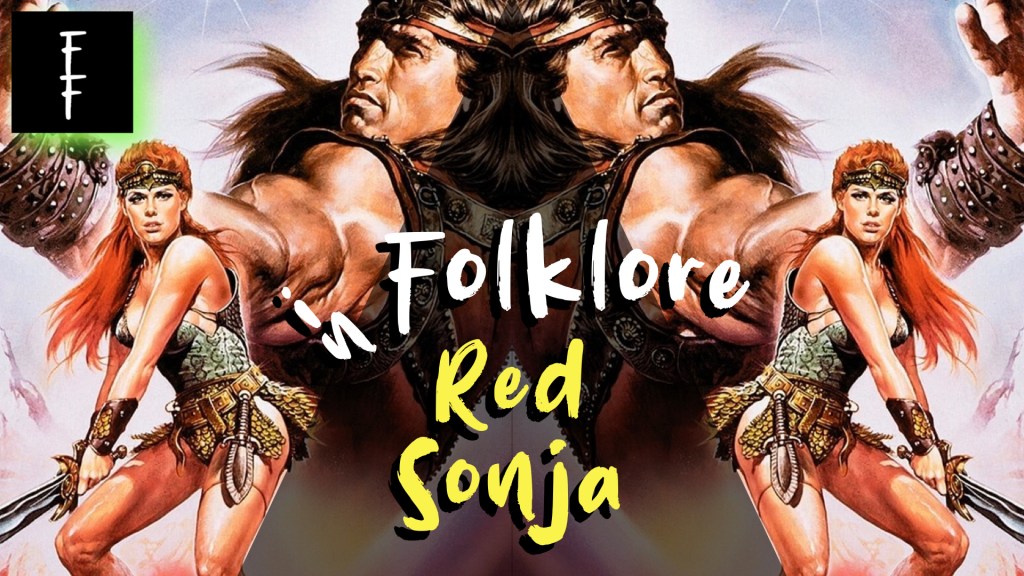
Come for the titular red-headed warrior woman (although Arnold’s bigger on the poster), stay for the Icthyan Killing Machine.
This is 1985’s Red Sonja.
A film that is very much of its times:
By which I mean the 1980s and the Hyborian Age.
And while less successful than the two Hyborian-set cinematic adventures that preceded it, Red Sonja does do some interesting things with folklore and mythology and, as we’ll see, with names.
One important character isn’t named at all, while another is given a name different from the one you might expect.
Pssst. You can watch a video adaptation of this essay right here. Text continues below.
A Tale of Three Red Sonjas: Movie Red Sonja vs. Comic Red Sonja vs. Howard’s Red Sonya
In the 1985 movie, Red Sonja is a sword-wielding warrior living in the Hyborian Age who teams up with a barbarian lord…
…who for legal reasons is definitely not named Conan. (He’s Kalidor. More on that in a minute.)
In the comics, Red Sonja—who debuted in 1973—is a chainmail bikini-clad, sword-wielding warrior living in the Hyborian Age who regularly battles alongside the actual, non-discount-bin Conan the Barbarian.
And she’s the ancestor of Mary Jane Watson. Because, redheads.
But in Robert E. Howard’s 1934 short story The Shadow of the Vulture, ostensibly the character’s first appearance, Red Sonya of Rogatino is a 15-century, Ukrainian-Polish, saber and pistol-wielding warrior.
And she’s the sister of the historical Roxelana, chief consort of the Ottoman Sultan, Suleiman the Magnificent.
What in the folklore is going on here?
Don’t worry, we’re going to unpack all of Red Sonja’s baggage—by which I mean literary baggage.
Because obviously I’m not going to talk about Brigitte Nielsen and Arnold Schwarzenegger’s on-set affair.
And at the end of this essay I will be grading Red Sonja on its folklorical accuracy.
FYI: I gave Conan the Barbarian an A and Conan the Destroyer a B+.
But first things first:
Is Arnold Schwarzenegger’s Lord Kalidor Actually Conan the Barbarian in the Movie Red Sonja (1985)?
Despite the movie’s title, Arnold gets top billing.
Like Jack Nicholson in 1989’s Batman.
But unlike Jack, Arnold was none too happy about his status in the film.
See, Dino De Laurentiis who had produced the first two Conan films, wanted to make a third.
And Arnold was contractually obligated to be in it.
There was just one little problem:
De Laurentiis lost the rights to the character.
But rather than absolve his star actor of his obligation to the trilogy, De Laurentiis had an idea.
An awful idea.
It was a wonderful, awful idea.
He brought back Conan the Destroyer-director Richard Fleischer and had screenwriters Clive Exton and George MacDonald Fraser pen a Hyborian-set Conan spinoff that didn’t include any characters named Conan.
But which absolutely featured a character, Kalidor, who bears more than a striking resemblance to him.
Now, as many people have pointed out, there is a precedent for Conan having an alias.
In Howard’s 1934 story, “Queen of the Black Coast,” Conan famously earns the name Amra, the Lion, while working as a pirate in the crew of Bêlit, the pirate queen.
And the thinking here is that while Conan is off on business trips—like at the beginning of Red Sonja, when he’s going to watch some priestesses destroy a talisman—he uses a traveling name.
In this case, Lord Kalidor.
Which could make sense, narratively.
It was established early in Conan the Destroyer that Conan’s reputation had spread.
And surely he became even more famous after saving the kingdom of Shadizar.
So, he realized that for his own safety, he needed to start keeping a lower profile.
Kalidor’s Literary Origins: The Legend of Sir Calidore (Book VI, The Faerie Queene)
As for the alias itself, Kalidor is named for Sir Calidore, Knight of Courtesy.
He’s the protagonist of Book VI of Edmund Spencer’s epic poem The Faerie Queene.
Published in 1596, the legend of Sir Calidore sees the titular knight intervene in all sorts of situations (including a lovers’ quarrel), performing random acts of chivalry before eventually falling in love himself.
He also defeats a monster, the Blatant Beast, which represents malice and slander, but notably, Sir Calidore doesn’t actually kill the monster.
But enough about Cone-ador.
I mean Kalinan.
I mean Kalidor.
This is Red Sonja’s movie.
Or rather, it was going to be, until a directive was given to expand Arnold’s role, which was originally intended to be little more than a cameo.
Apparently the crew was instructed to capture as much Arnold footage as possible. And…it shows.
And in case you were wondering, yes I did deliberately make the first part of this essay all about Arnold’s character rather than our titular hero as a meta commentary on the movie.
But not more.
Red Sonja’s Origin Story: From Historical Fiction to Comics to Screen
Red Sonja is this movie’s main character.
And of course the filmmakers gave her an origin story that respects her…oh Jesus Christ.
Who would have thought that a movie produced, written, directed, shot, edited, and scored by men (although I’m not sure that lost one matters so much) would result in the indelicate handling of such a tragic onscreen event.
Some would argue that what follows is further proof that these filmmaker dudes didn’t know how to write a compelling woman lead character.
Because instead of having Red Sonja’s natural, human drive for revenge fuel her desire to increase her strength (you know, like in Conan the Barbarian with the whole Nietzsche, will-to-power, do-everything-without-the-help-of-Crom thing)…
In this movie, an unnamed female deity-spirit-narrator just imbues our hero with a super strong sword arm.
But to be fair, which I always am, a lot of this is in the Red Sonja source material.
Not in Robert E. Howard’s material, mind you, but in comic writer Roy Thomas’s.
Thomas is the guy who plucked Howard’s Red Sonya of Rogatino from the early days of the Ottoman–Habsburg wars…
…combined her with another 16th-century “sword-woman” created by Howard, Dark Agnes de Chastillon…
…and set this new amalgamated character in Howard’s Hyborian Age.
And yes, the movie, to a large extent, lifted Red Sonja’s origin story directly from the comics.
WIth one notable exception:
In the comics, that female deity-spirit-narrator has a name.
How the Mythical Scottish Warrior Scáthach Is Totally Wasted in Red Sonja
Scáthach.
Although Sonja’s people, the Hyrkanians, also refer to her as the Red goddess.
In Irish mythology, or Gaelic mythology, I should say, Scáthach isn’t a goddess.
She’s something way cooler, in my opinion.
Scáthach is a Scottish warrior who runs a world-renowned martial arts academy out of the Dún Scáith, Fortress of Shadows, on what is believed to be the Isle of Skye.
She is the one who teaches Cú Chulainn, one of Ireland’s most celebrated mythical heroes, how to throw his most famous weapon: the Gáe Bulg, or belly spear.
Is it just me, or was this a huge missed opportunity?
Why give Sonja her strength and have her train with some dude, the imaginatively named Grand Master, when you already had a mythical character known for training great warriors right there.
Why not name her?
Why not call her Scáthach?
You could keep the goddess angle, too, that’s fine.
But instead of this one-and-done fairy godmother stuff, make her a real character who imparts divine wisdom, not divine power, and who teaches Red Sonja how to wield a sword.
Okay, rant over.
Time for a new rant.
The Talisman in Red Sonja Explained: Pandora’s Box Meets the Ark of the Covenant Meets the Omphalos of Delphi
What’s the deal with the talisman and those priestesses?
Don’t get me wrong. Visually, this scene is stunning.
And the high priestess Kendra does tell us that the God of Gods used the talisman to create the world and all things.
But now it’s grown too powerful and must be destroyed, lest it destroy the world.
Oh, right, and only women can touch it.
That’s quite the MacGuffin.
It’s giving Pandora’s Box, that infamous container from Greek mythology that unleashes suffering upon the world after being opened by a woman.
It’s giving Ark of the Covenant, that infamous container from Judeo-Christian mythology that nobody is allowed to touch, lest it kill you. In fact, don’t even look at it.
It’s also giving a bit of the ole Omphalos of Delphi, i.e. the Naval of the World, which according to Greek mythology is a stone artifact Zeus used to mark the center of the Earth, which he calculated with the help of two eagles.
It’s believed that removing the stone from Delphi, seat of the high priestess Pythia, the Oracle of Delphi, could result in humanity being disconnected from the divine.
The Red Sonja—Lord of the Rings Connection: Fiery Destruction and Giant Spiders
But for my money, the Red Sonja talisman’s closest literary equivalent is, of course, the one ring from Tolkien’s Lord of the Rings.
Think about it:
What happens when that dude touches the talisman?
He disappears.
And what are our protagonists trying to do with the talisman?
That’s right: Throw into some liquid hot magma.
If this connection alone doesn’t convince you that the filmmakers had Tolkien on the brain when making Red Sonja, consider exhibit B:
Queen Gedren’s giant pet spider.
This has got to be a reference to that monstrous arachnid from Lord of the Rings, Shelob, whom Gollum refers to as “Her Ladyship.”
As for Queen Gedren herself. Does she look familiar?
Queen Gedren’s Mythical Origins: the Irish Queen Medb, the Germanic Grendel, and the Greek Lamia
That’s Sandahl Bergman, who played Valeria in 1982’s Conan the Barbarian.
Her character here doesn’t have any direct links to folklore or mythology as far as I can tell, but her sacred item-stealing and dark wizard-employing made me think of Queen Medb.
In Irish mythology, Medb infamously initiates the events of the Táin Bó Cúailnge (or Cattle Raid of Cooley) by commanding an army of Connachtmen to steal a really special bull from an Ulsterman.
Medb also seeks the guidance of a druid who can see the future and he gives her a window into what she’ll be up against.
Spoiler alert: it’s Cú Chulainn.
Meanwhile, in the movie, Queen Gedren uses her wizard’s window to view her opponents in real-time.
No, it’s not a perfect parallel.
And while Medb is a Gaelic Celtic name, Gedren sounds more Germanic to my ears.
Speaking of which, the name Gedren isn’t too far off from Grendel, one of the three antagonists of the Old English Beowulf Saga.
The other two antagonists being a dragon, whom Beowulf fights in the dragon’s seaside lair (hmmm), and Grendel’s mother, who is a merewif or water-woman.
Not a mermaid, per se, but a humanoid, water monster-type creature.
And this is interesting because while researching which figures Queen Gedren might be based on, I came across Lamia from Greek mythology.
Lamia is a Libyan Queen who has an affair with Zeus, a fact Hera is none-too-happy out.
So she kills or otherwise gets rid of all of Queen Lamia’s children.
As a result of her grief, the queen’s face becomes disfigured.
And to quote Robert Graves’ 1955 The Greek Myths:
“Lamia took her revenge by destroying the children of others, and behaved so cruelly that her face turned into a nightmareish mask.”
Oh, right, and Lamia’s bottom-half can transform into a snake or serpent.
Or whatever the heck this is.
But most compelling of all is the detail that Zeus, who apparently feels bad about the whole situation to some small extent, gives Lamia the power to remove her eyeballs.
What a guy.
The Icthyan Killing Machine’s Mythical Counterparts: The Leviathan, Fáfnir, the Nāga
Now, I’m not saying the filmmakers took Lamia and split her into two characters to create Queen Gedren and the Icythian Killing Machine, the latter of which gets its eyes poked out, but I’m also not, not saying that.
There is of course the detail that the Icythian Killing Machine—that water-dwelling, dragon-like, some might say sea-serpent-like monster—is covered in metal scales or plating.
The most likely reason for this is…the 80s.
1981’s Clash of the Titans popularized the idea of putting mechanical beings in mythical settings.
While 1984’s Terminator —with none-other than Arnold Schwarzenegger in the title role—established that some robots are really hard to kill.
This strange alchemy is what led to Arnold delivering that classic line in 1985’s Red Sonja:
“I can’t kill it! It’s a machine!”
But assuming the filmmakers actually did some research here, their Icthyan Killing Machine may have been inspired by the Biblical Leviathan.
To quote Job 41:13-17:
Who can uncover its outer covering?
Who can penetrate to the inside of its armor?
Who can open the doors of its mouth?
Its teeth all around are fearsome.
Its back] has rows of shields,
shut up closely together as with a seal;
each one is so close to the next
that no air can come between them.
They lock tightly together, one to the next;
they cling together and cannot be separated.
And I’d be remiss not to mention that even the name Icthyan is a riff on the Greek Ichthys, meaning Jesus Fish.
Okay, no, that’s not a direct translation, but the word refers to that symbol.
There’s also Fáfnir from Norse mythology, a dwarf turned serpent or worm, which is the Germanic equivalent of a dragon.
In the Eddic poem Fáfnismál, Fáfnir is depicted as flightless, he dwells in water, and, to quote the serpent himself:
The fear-helm I wore | to afright mankind,
While guarding my gold I lay;
Mightier seemed I | than any man,
For a fiercer never I found.
This has been interpreted as Fáfnir wearing a super cool helmet essentially. The Helmet of Awe or the Helmet of Terror.
And later the hero Sigurth alludes to this metal armor when he calls Fáfnir a “[g]littering worm.”
Meanwhile, the monster’s neck frill resembles that of the Nāga—a dragon/water spirit/water serpent—that is venerated in Hindu and Buddhist tradition.
And it should be noted that metal sculptures of Nāgas can be found across Asia…and beyond.
Lord Brytag = Maleffort: Another Character Lifted From Book VI of The Faerie Queene
The last character who requires a little folkloric spotlight here is that @$$hole gatekeeper, Lord Brytag, who demands a “tender tribute” from Red Sonja.
Sooo she kills him.
The reason I draw your attention to this insignificant side-villain is because I think the filmmakers lifted him and his detestable tollbooth scheme from the aforementioned Legend of Sir Calidore, i.e. the sixth book of Edmund Spencer’s The Faerie Queene.
Let me set the scene:
News has reached the ears of the courteous Sir Calidore that people are having a hard time passing through the noblewoman Briana’s castle gate.
The problem:
Her seneschal, basically the dude who runs the castle, is making women cut off their hair and surrender it to him before they’re allowed to pass.
Men have to give up their beards.
That’s not cool.
And if you’re still equivocating, the dude’s name is Maleffort. He’s evil down to his etymology.
No, it’s not the same tribute that Brytag demands. The filmmakers have made it worse…as a callback I guess? Ehhh.
But the end result is the same: the hero kills the bad guy and the gate is opened.
But let’s face it, I also wanted to talk about Red Sonja’s Brytag scene because… that’s Pat Roach!
He played the evil wizard Toth-Amon in Conan the Destroyer.
He played Hephaestus, the god who builds the mechanical owl Bubo, in Clash of the Titans.
And he played henchmen in all of the good Indiana Jones movies.
Pop quiz, hot shot
Which leads me to one final question I want to propose to all of you before grading this metallic beast of a film.
How many actors from 1981’s Raiders of the Lost Ark can you identify in 1985’s Red Sonja, and who are they?
Leave your answers in the comments.
Red Sonja’s Folklorical Accuracy Grade
And now, for the folklorical accuracy grade.
I’m going with a solid…
B-.
There’s some good stuff in here.
But overall, I wanted more.
Not more exposition, but more exploration.
And more participation from folkloric figures. Namely, Scáthach.
Thanks for reading.
Fan of folk horror?
You might be interested in my short film Samhain, available over on the Irish Myths channel.
More the reading type?
Check out…
Neon Druid: An Anthology of Urban Celtic Fantasy
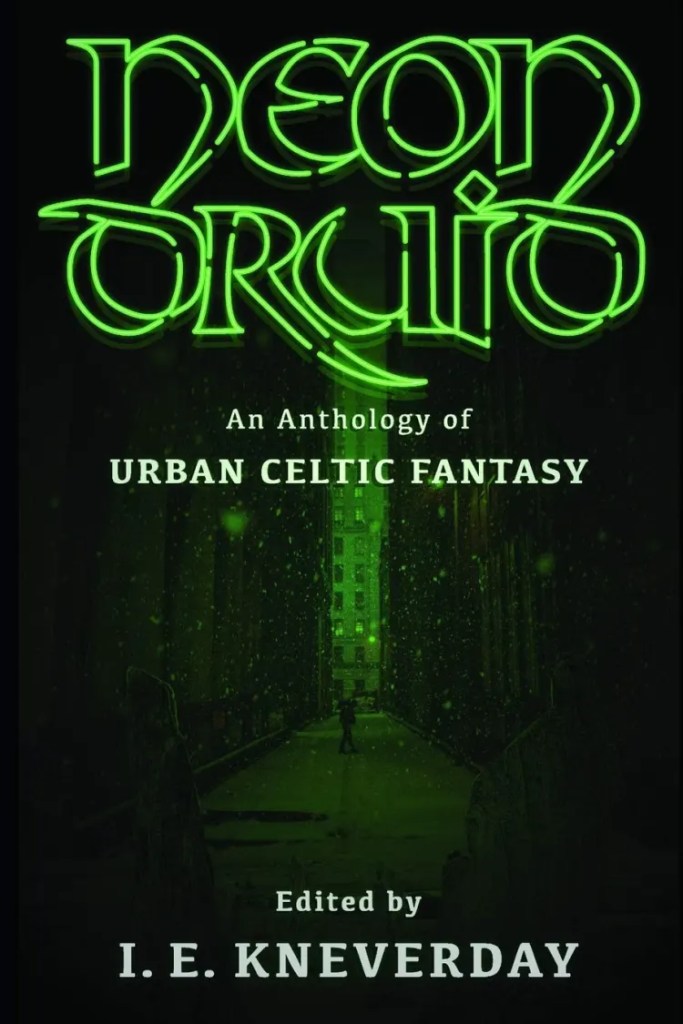
“A thrilling romp through pubs, mythology, and alleyways. NEON DRUID is such a fun, pulpy anthology of stories that embody Celtic fantasy and myth,” (Pyles of Books). Cross over into a world where the mischievous gods, goddesses, monsters, and heroes of Celtic mythology live among us, intermingling with unsuspecting mortals and stirring up mayhem in cities and towns on both sides of the Atlantic, from Limerick and Edinburgh to Montreal and Boston. Learn more…
Samhain in Your Pocket

Perhaps the most important holiday on the ancient Celtic calendar, Samhain marks the end of summer and the beginning of a new pastoral year. It is a liminal time—a time when the forces of light and darkness, warmth and cold, growth and blight, are in conflict. A time when the barrier between the land of the living and the land of the dead is at its thinnest. A time when all manner of spirits and demons are wont to cross over from the Celtic Otherworld. Learn more…
Irish Monsters in Your Pocket

In the Ireland of myth and legend, “spooky season” is every season. Spirits roam the countryside, hovering above the bogs. Werewolves lope through forests under full moons. Dragons lurk beneath the waves. Granted, there’s no denying that Samhain (Halloween’s Celtic predecessor) tends to bring out some of the island’s biggest, baddest monsters. Prepare yourself for (educational) encounters with Irish cryptids, demons, ghouls, goblins, and other supernatural beings. Learn more…


Leave a Reply