
Folklore in Film is reader-supported. When you buy through links on our site, we may earn a small affiliate commission.
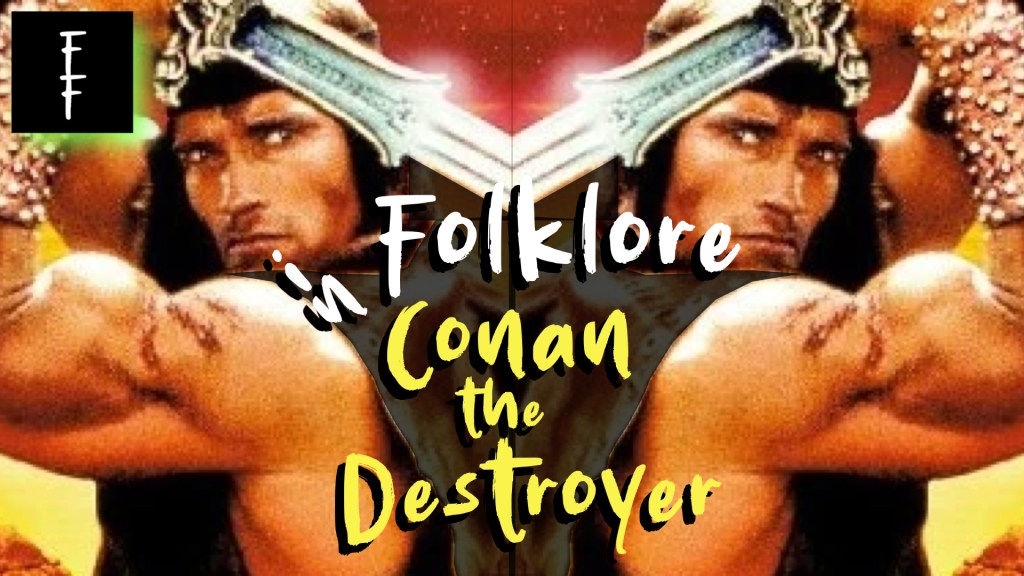
With a new Conan film on the horizon, it’s high-borean time we uncover the hidden folklore in the 1984 sequel, Conan the Destroyer.
First and foremost:
Is Dagoth the dreaming god a reimagining of the Syrian and Philistine deity Dagon?
Or does he represent the original Reclining Buddha?
We’ll get into it.
And what’s the deal with Toth-Amon’s castle?
Because despite the wiley and at times warty wizard bearing the names of two Egyptian gods, his crystalline island abode looks like something straight out of Irish mythology.
Pssst. You can watch a video adaptation of this essay right here. Text continues below.
Conan the Destroyer: King of Camp?
Conan the Destroyer provides a blueprint for how successive Conan films could have been made.
Buuut never were.
While 1982’s Conan the Barbarian introduced audiences to the character and his world, with its mashed-up mythologies, 1984’s Destroyer sends Conan on what amounts to an adventure of the week.
Hearkening back to the character’s pulp origins.
Screenwriter Stanley Mann and director Richard Fleischer certainly leaned into the campiness more in this one, giving us, for example, the iconic spinning Arnold.
But did this new direction affect the film’s folklorical accuracy?
I gave the original Conan an A in folklorical accuracy.
And I’ll be giving the sequel a grade at the end of this video.
But right now, I need to lie down.
Dagoth the Dreaming God: The Dagon of It All
Dagoth, the dreaming god, was invented for the Conan the Destroyer film.
True, Conan’s creator Robert E. Howard did mention a “Dagoth Hill” in his 1933 story “The Scarlet Citadel,” which is where the filmmakers got the name.
And it seems likely that Howard had been riffing on the name Dagon.
A name he would have been familiar with on account of his friend and contemporary H. P. Lovecraft having penned a story titled “Dagon.”
A story about a stranded mariner who encounters a “vast, Polyphemus-like, and loathsome” creature with “gigantic scaly arms” and a “hideous head.”
Of course, Lovecraft in turn had been pulling from mythology for his monster.
And I’m not just referring to his name-drop of everyone’s favorite cyclops, Polyphemus, from Homer’s Odyssey.
Although it is interesting that without his horn, Dagoth looks like he’s got an eye in the middle of his forehead.
But maybe there’s another explanation for that.
Which we’ll get to.
But to return to Lovecraft, his story concludes with the mariner connecting his aquatic creature encounter to the “ancient Philistine legend of Dagon, the Fish-God.”
Come to think of it, the film’s Dagoth does look a bit fish-like in his transformed state, with those finned arms and legs.
And lo and behold, if you open your Bibles to Judges 16:23 and 1 Chronicles 10:10 and 1 Samuel 5:2-7, we’ve got Philistines worshiping a god named Dagon.
I even talked about the biblical Dagon briefly in my video/essay on Raiders of the Lost Ark.
Outside of the Bible, we don’t find a ton of evidence for the ancient Philistines worshiping Dagon.
History and archaeology tell us that ancient Syria was the epicenter of Dagon’s cult, and those Dagonites, if you will, believed him to be a father-of-the-gods type of figure.
The Etymology of Dagon: Grain Grampa or Fish-Man?
While many etymologies for the deity’s name have been proposed over the centuries, including one that posits Dagon means “grain,” as in the life-sustaining food…
…the most popular one by far links the name Dagon to the Hebrew dag, meaning fish.
This was the jumping off point for Medieval “scholars” to declare, well, obviously this dude must have been part fish.
Was he top-half fish or bottom-half fish?
The answer?
No-halves-fish.
Because that’s not in the mythology.
Not in the Bible or anywhere else.
Even if Dagon’s name is etymologically connected to the word for fish, that doesn’t mean he’s a giant fish-monster.
And maybe the filmmakers knew that.
That’s why they didn’t go full fish-monster.
There are no gills. No scales.
He doesn’t go swimming.
And presumably André the Giant, who is the actor in the Dagoth suit, knew how to dog paddle.
The Design of Dagoth in Conan the Destroyer
Anyway, the design of Dagoth in Conan the Destroyer is still undoubtedly Lovecraftian in nature.
Just look at that face.
But in unused concept art designed for the film, Dagoth is finless and has more of an insectoid/Cthulhulian thing going on.
What Is a Dreaming God, Anyway? The Azathoth of It All
What’s more, if the filmmakers had intended Dagoth to be a fish-god, you think they would’ve made him a fish god.
And not Dagoth the dreaming god.
Not the god of dreams, mind you, like a Morpheus or a Somnus.
There’s an implication here that the god’s dreaming benefits humanity in some way, perhaps even generating or stabilizing reality.
Because if you wake him up, oopsie he might destroy the world.
Which sounds a lot like another one of H.P. Lovecraft’s characters, Azathoth.
Come to think of it, maybe Robert E. Howard took Dagon and Azathoth and smooshed them together to come up with his Dagoth Hill.
And we can take this a level deeper because it’s possible Azathoth—a name Lovecraft thought was hideous despite creating it—is itself a mashup of the Biblical character name Azazel (identified as a fallen angel the apocryphal Book of Enoch) and the Biblical location name Anathoth.
But I digress.
In the film, Conan is able to destroy the dreaming god by yanking off his horn and stabbing him a bunch of times.
That’ll usually do it.
The Reclining Buddha’s Influence on Dagoth (and His Statue Style)
Which is fitting given Dagoth the Dreaming God’s pose:
He’s reclining.
And which key figure from one of the world’s biggest spiritual traditions is depicted as reclining in the moments before his death?
The Buddha.
In fact, the oldest Reclining Buddha dates to 1,800 years ago.
And what, dear viewers, do many of these reclining buddhas have on their foreheads?
A single horn.
A teeny, tiny little horn.
Okay, fine, it’s not a horn.
It’s an urna, which is usually interpreted as a whorl of hair.
Symbolically, it’s akin to a third eye, in that it represents one’s ability to see beyond the mundane.
Hindu Mythology in Conan the Destroyer? The Varaha—Dagoth Connection
As for a god turning into a killer monster with a big horn sticking out of its head, Hindu mythology has got you covered.
Varaha is one of the ten primary avatars of the Hindu deity Vishnu.
He’s depicted as having the head of the boar and the body of a human.
And he famously kills demons with his boar-tusks.
Only, he doesn’t always have two of them.
In the Hindu epic Ramayana, Varaha is alluded to as “the single-tusked boar.”
So to recap:
Dagoth is a cosmic horror-inspired god-monster with a look and shall we say vibe linking him to Eastern spiritual traditions and a name linking him to Middle Eastern traditions.
It’s actually a pretty standard mash-up by Conan standards, I’d say.
Case in point:
Toth-Amon’s Egyptian Influences: Thoth and Amun
Before Dagoth is revealed to be the movie’s final boss, Conan must contend with the dark wizard Toth-Amon, played by wrestler and Indiana Jones henchman extraordinaire, Pat Roach.
He’s the propeller…feller in R aiders and the big guy in the mine in Temple of Doom.
Here he plays the guardian of a magical red jewel, the heart of Ahriman (more on that in a minute).
And the character takes his name from two Egyptian gods:
Thoth, the Egyptian god of wisdom and writing (amongst other things)—I talked about him in my video on 1999’s The Mummy.
And Amun, the Egyptian god of the air and, later, the sun.
And if you’re thinking to yourself:
Why the heck would a character named for these two Egyptian gods turn into an ape monster while protecting his true physical form behind a series of mirrors?
Surprisingly, there is a good answer for this.
While primarily thought of as being Ibis-headed, Thoth famously has the head of a baboon in some depictions.
As for Amun, his name means the hidden one, or invisible.
Put those together and…it’s sort of a strange pairing.
I’m not sure you needed to put those together.
But hey at least the most maligned sequence of the OG Conan film franchise has some sort of a basis in mythology.
The Heart of Ahriman: Because This Movie Needed Some Zoroastrianism
Same goes for the heart of Ahriman, named for the so-called demon of demons in Zoroastrianism.
Ahriman is seen as the embodiment of the evil or destructive spirit and the primary adversary of creative spirits.
So it tracks that his namesake jewel would unlock the thing that can bring about the world’s destruction.
Even Toth-Amon’s island abode and princess-snatching smoke-bird have parallels in the stories of old.
The Irish Folktale About a Prophecy That Leads to a Princess Being Imprisoned in a Crystal Tower on an Island (No, Seriously)
My first instinct here was that this scene was a loose interpretation of the Irish story Cian and Eithne, also known as the Birth of Lugh.
Which sees the Fomorian leader Balor of the Evil of Eye imprison his own daughter, the princess (of sorts), Ethniu, in a crystal tower on an island.
Only for her to be rescued by Cian, a.k.a. Scal Balb, of the Tuatha Dé Danann, Ireland’s divine tribe.
Side note: Cian is the son of the Irish god of medicine Dian Cecht and the brother of Miach, both of whom have big roles to play in the story of Nuada of the Silver Hand.
Anyway, Cian doesn’t break into the crystal fortress alone. He has the help of the formidable female druid Biróg (who is reimagined as a fairy familiar in later folklore).
And I’d be remiss not to mention that the whole reason Balor imprisons his daughter Ethniu in the first place is because of a druidic prophecy that foretold Balor’s future grandson would kill him one day.
Which does come to pass.
Where Does the Name Taramis Come From?
Meanwhile, in the movie, the scrolls of Skelos foretell that a maiden with a special birthmark will be able retrieve the aforementioned heart of Ahriman, thus granting her access to the Jeweled Horn of Dagoth.
And this maiden of course turns out to be Princess Jehnna, niece of Taramis, the queen of Shadizar.
A queen whose name appears to be a riff on Taranis, who is a Gaulish Celtic god of thunder.
The Romans equated Taranis with Jupiter.
And it’s possible the deity also has a connection to the Irish Tuirren and the Norse Thor.
The Smoke Bird/Dragon/Pterodactyl Spirit Explained: It’s a Gaelic Sluagh
As for Toth-Amon’s flying smoke bird spirit that abducts Jehnna…
Yeah, that also has a parallel in Irish folklore.
Or, Gaelic folklore, I should say.
Because the earliest speakers of the Gaelic, or Goidelic Celtic language took their stories with them to the Isle of Man and to Scotland.
Including, presumably, the story of the Sluagh na marbh: the host of the dead.
In folklore, the Sluagh is a big shadowy mass of unforgiven souls with bird-like characteristics and it’s infamous for scooping people up and carrying them to islands.
No, seriously.
To quote Celtic studies scholar James McKillop:
“They may approach from any direction but the east, usually taking crescent form, like a flight of grey birds. They are said to be able to pick up a person bodily and transport him long distances through the air from one island to another. Although they can rescue a man from a dangerous rock cleft, they usually bode no good to mortals. They may be seen after dark and are said also to injure cattle.”
A Critique of Conan the Destroyer: Fetch Quest vs. Folklore
At every turn, Conan the Destroyer surprised me.
Its campiest, pulpiest moments, the moments that maybe didn’t quite fit into the world established in the first film, at least had some sort of a basis in folklore and mythology.
My main critique of the film would be the fetch-quest nature of its plot.
Sure, having to retrieve a sacred item from a dangerous place is a popular folklore motif.
But having to retrieve one item so it can unlock the next item, so you can then stick that item in a statue’s head to awaken the final boss…
That’s not folklore.
That’s bad writing.
Folklorical Accuracy Grade for Conan the Destroyer
And all that being said, I think, in terms of folklorical accuracy grade, Conan the Destroyer deserves a…
B+.
But what do you think?
Leave your folklorical accuracy grade for Conan the Destroyer in the comments below.
Thanks for reading.
Fan of folk horror?
You might be interested in my short film Samhain, available over on the Irish Myths channel.
More the reading type?
Check out…
Neon Druid: An Anthology of Urban Celtic Fantasy
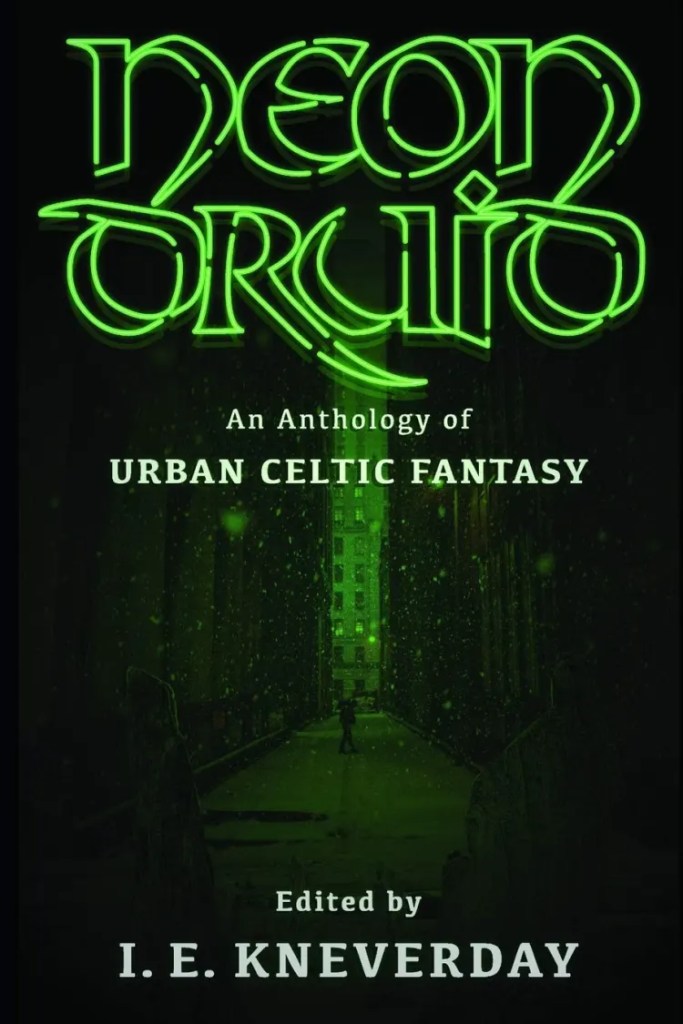
“A thrilling romp through pubs, mythology, and alleyways. NEON DRUID is such a fun, pulpy anthology of stories that embody Celtic fantasy and myth,” (Pyles of Books). Cross over into a world where the mischievous gods, goddesses, monsters, and heroes of Celtic mythology live among us, intermingling with unsuspecting mortals and stirring up mayhem in cities and towns on both sides of the Atlantic, from Limerick and Edinburgh to Montreal and Boston. Learn more…
Samhain in Your Pocket

Perhaps the most important holiday on the ancient Celtic calendar, Samhain marks the end of summer and the beginning of a new pastoral year. It is a liminal time—a time when the forces of light and darkness, warmth and cold, growth and blight, are in conflict. A time when the barrier between the land of the living and the land of the dead is at its thinnest. A time when all manner of spirits and demons are wont to cross over from the Celtic Otherworld. Learn more…
Irish Monsters in Your Pocket

In the Ireland of myth and legend, “spooky season” is every season. Spirits roam the countryside, hovering above the bogs. Werewolves lope through forests under full moons. Dragons lurk beneath the waves. Granted, there’s no denying that Samhain (Halloween’s Celtic predecessor) tends to bring out some of the island’s biggest, baddest monsters. Prepare yourself for (educational) encounters with Irish cryptids, demons, ghouls, goblins, and other supernatural beings. Learn more…
 Folklore in Film
Leave a comment