
Folklore in Film is reader-supported. When you buy through links on our site, we may earn a small affiliate commission.
From its opening scene, The Princess Bride shows its cards:
This movie is based on a much older story.
And no, I’m not talking about screenwriter William Goldman’s 1973 novel of the same name.
Although in a way, I guess I am?
Whatever.
When the grandfather tells Boy Meets World’s sick brother:
“This is a special book. It was the book my father used to read to me when I was sick, and I used to read it to your father. And today, I’m gonna read it to you.”
He is likely referencing the ancient Greek story Daphnis and Chloe, which famously begins with a promise from its author, Longus, that the story will:
“cure the sick, comfort the distressed, stir the memory of those who have loved, and educate those who haven’t.”
But this is far from the only parallel between The Princess Bride and Daphnis and Chloe.
We’ll get into it.
What’s more, there are references to several other ancient and medieval stories sprinkled throughout the movie, which we will explore.
And at the end of this video, I will be grading the Rob Reiner-directed The Princess Bride on its folklorical accuracy.
FYI: I just gave Leprechaun a B+.
Pssst. You can watch a video adaptation of this essay right here. Text continues below.
Daphnis and Chloe
This story begins in earnest with a pair of young lovers living out a pastoral romance.
The young woman, who is greatly admired by the locals, spends her time admiring a young farmhand…
…who gets abducted by pirates and is assumed dead.
Womp. Womp.
But twist! He’s not dead. And the young lovers are reunited.
This is the plot of 1987’s The Princess Bride and it’s also the plot of the Hellenistic romance Daphnis and Chloe, which debuted some 1700 years earlier in the second century.
Yes, it’s a simplified summary.
But when you combine those shared plot points with other little details, it’s obvious writer William Goldman was inspired by this archetypal Greek love story.
Exhibit A: the aforementioned fact that both stories open with narrators making dubious medical claims.
Exhibit B: kissing.
The Princess Bride, as you know, has a lot of fun with kissing as a concept.
“Is this a kissing book?” the grandson famously asks up front.
And later, the grandfather reads:
“And now, they begin to kiss; it’s a tender kiss, tender and loving and gentle and — “
With the kid interrupting:
“Oh no. No, please…They’re kissing again, do we have to hear the kissing part?”
Of course, the movie culminates with the grandson wanting to hear the kissing parts.
Why is there such an emphasis on kissing in the film?
Maybe William Goldman liked getting his lips wet.
And/or maybe he was paying homage to Daphnis and Chloe, which not only features kissing quite prominently, but also features a character who, at first, doesn’t really understand what kissing is all about.
To quote Daphnis contemplating his first ever smooch:
“What on earth has Chloe’s kiss done to me? Her lips are tenderer than roses, her mouth is sweeter than a honeycomb, but her kiss is sharper than the sting of a bee… My pulse beats high: my heart leaps: my soul melts: and yet I wish to kiss again. O bitter victory! O strange disease, the name of which I cannot even tell! Can Chloe have tasted poison before she kissed me?”
The Poison Damsel
Speaking of a woman tasting poison and then passing that poison to a man by way of a kiss…
That idea actually predates Daphnis and Chloe by a thousand years or so.
The Viṣakanya or “Poison Damsel” is a figure first described in the ancient Sanskrit treatise, Arthashastra.
Originally serving as assassins, poison damsels would be dosed with various poisons in the hopes that tolerances or immunities could be built over time.
Thus allowing the damsels to dispatch unsuspecting gentlemen via the exchange of saliva—or other bodily fluids.
No, The Princess Bride doesn’t show any of that.
Iocane Powder and the Mythology of Mithridatism
But it does famously feature a battle of wits.
Which Westley wins by poisoning himself and Vizzini with iocane powder—a fictional substance.
After Vizzini succumbs to the poison, Westley, who is unphased, explains to the Princess Buttercup that he “spent the last few years building up an immunity to iocane powder.”
Turns out this practice of poison acclimation has a name:
Mithridatism.
It was named for Mithridates VI, who was king of Pontus from 120 to 63 BCE.
Following the assasination of his father Mithridates V by way of poisoning, the younger Mithridates began to suspect his mother had been poisoning his own food.
So he fled to the woods, where, according to legend, he microdosed all of the things and developed a universal anecdote that could counteract any poison.
All this to say, Westley developing an immunity to poison is 100% folklorically accurate.
But if I had to guess where William Goldman got the idea of having his protagonist face off against a foe in a poisoned chalice chess match of sorts, it had to be…
The Court Jester (1955)
The Court Jester, released in 1955.
I remember my dad watching this once and calling me over so I could witness Danny Kaye reciting the famed tongue twister:
“The pellet with the poison’s in the vessel with the pestle; the chalice from the palace has the brew that is true!”
Now, the confusion over the poisoned cup in The Court Jester seems, in turn, to be a sendup of Shakespeare.
Specifically, Hamlet Act 5, scene 2, wherein Queen Gertrude drinks from a poisoned cup that had been intended for her son Hamlet.
Honestly, we could spend a whole video on the poisoned cups that appear in literature and folklore, starting with the hemlock cocktail Socrates is forced to drink in Plato’s Phaedo, which dates to the 4th century BCE.
But with so many folklorical references to get to, we must continue on our journey.
A journey that will inevitably bring us through the Fire Swamp.
Into the Fire Swamp (Will-o’-wisps)
Surely, Goldman made this one up.
Because of course there are no folktales that tell of such ghastly terrain, where plumes of fire shoot up from the soggy ground…right?
Not only do such places appear in folk tales, they exist in real life, too.
Reports of fireballs hovering above marshes, boglands, and swamps and causing people strife date back centuries.
The 14th-century Welsh poet Dafydd ap Gwilym called them canwyll corff or “corpse candles.”
But you might know the phenomena by one of its many other names, such as:
- will-o’-the-wisps,
- ignis fatuus (meaning “foolish fire”),
- marsh lights,
- friar’s lanterns, and, get this…
- jack-o’-lanterns.
Yeah, so before the term came to describe a carved pumpkin with a lit candle inside, “jack-o’-lantern” referred to this atmospheric ghost light.
There’s even an Irish folk tale that explains its origin:
The story of Stingy Jack.
It’s about a fella who, after being denied entry into heaven and hell, is cursed to an eternity of haunting Ireland’s bogs with only a lantern to light his way.
Scientifically speaking, it’s likely that the combustion of marsh gas (a.k.a. swamp gas or bog gas), which is composed primarily of methane, is responsible for producing these fascinating fireballs.
In 1783, George Washington and Thomas Paine famously tested this theory by stirring up some swamp bubbles and igniting them with torches.
No, seriously.
A few months after signing the Treaty of Paris, Washington and his revolutionary pal celebrated by going to a swamp and proving that the will-o’-the-wisp phenomenon had a scientific origin.
To quote Paine writing in 1806.
“When the mud at the bottom was disturbed by poles, the air bubbles rose fast, and I saw the fire take from General Washington’s light and descend from thence to the surface of the water…”
Okay, enough of this boring history stuff.
Lightning Sand
In folklore, will-o’-the-wisps often lead people to their dooms.
Their soggy dooms, I should say.
Because victims of the will-o’-the-wisp will, inevitably, sink into the bogs, which, in places, can act a lot like quicksand.
In the movie, the Fire Swamp’s flame spurts don’t hover above the ground and lead people places (this was 1987, remember).
But it is noteworthy that after encountering these fiery threats, Westley and Buttercup’s very next obstacle is the lightning sand, into which the latter accidentally sinks.
After the lightning sand, comes the obstacle you’ve all been waiting for:
The R.O.U.S.’s.
Rodents of Unusual Size
And right off the nutcracker, it’s obvious that having to contend with giant, bloodthirsty rodents, is a pretty universal fear.
In German folklore, that fear manifests as the seven-headed Mouse King.
In Japanese folklore, when a rat turns 1,000 years old it becomes a kyūso:
A massive rat that reverses the natural order by hunting and eating cats.
Japanese folklore also boasts the so-called iron rat, Tesso, who begins life as a monk but is transformed into a giant rat with claws and teeth as strong as iron.
Tesso famously summons an army of rats to eat the religious texts and belongings of his former monk coworkers.
See, this is why I work alone.
In a shed.
But I think the closest parallel to the R.O.U.S.’s in folklore is the Welsh Afanc, or Addanc (athanc).
The giant beaver monster.
In the Mabinogion, which collects the earliest Welsh myths and legends, the Afanc regularly emerges from its cave to kill the three sons of the king, who are repeatedly resurrected.
Alas, a brave knight of the Round Table, Sir Peredur, comes forth and dispatches the murderous rodent.
The Six-Fingered Man
As for the six-fingered fiend who killed Inigo Montoya’s father, Count Tyrone Rugen.
Look no further than the Hebrew Bible, or the Old Testament of the Christian Bible, for his mythical precursor.
Specifically, in Second Samuel 21 and First Chronicles 20, we learn about a war at Gath, where a man with six fingers on each hand (and six toes on each foot) taunts King David’s army.
King David’s nephew Jonathan, known for his skills as a warrior, exacts his revenge on the six-figured man, striking him down.
It should also be noted that in this biblical story, the six-figured man is “of great stature,” on account of him being “descended from the giants.”
The Giant
I think Goldman was right to eschew this detail in favor of having an entirely separate character represent the giants of myth and legend.
Namely, Fezzik.
And when Fezzik throws those big rocks at our hero Westley…
I mean, this is classic folklorical giant behavior.
From the Cyclops Polyphemus chucking boulders at Odysseus in Homer’s Odyssey…
…to the giant Cormoran throwing boulders in the Cornish fairy tale Jack the Giant Killer…
…to the Scottish giant Benandonner and Irish giant Finn McCool exchanging boulder volleys, which results in the creation of the Isle of Man…
…there are tons of tall tales featuring giants hurling stony projectiles.
And when we take all of these details into account—the kissing, the pirates, the poison, the fire swamp and its fantastical obstacles, the six-fingered man, the giant…
There is only one folklorical accuracy grade worthy of the masterpiece that is The Princess Bride—and that’s an A+.
Yes, this is the first A+ I’ve ever given out on this channel.
But what do you think?
Share your grade in the comments below.
Thanks for reading.
Fan of folk horror?
You might be interested in my short film Samhain, available over on the Irish Myths channel.
More the reading type?
Check out…
Neon Druid: An Anthology of Urban Celtic Fantasy
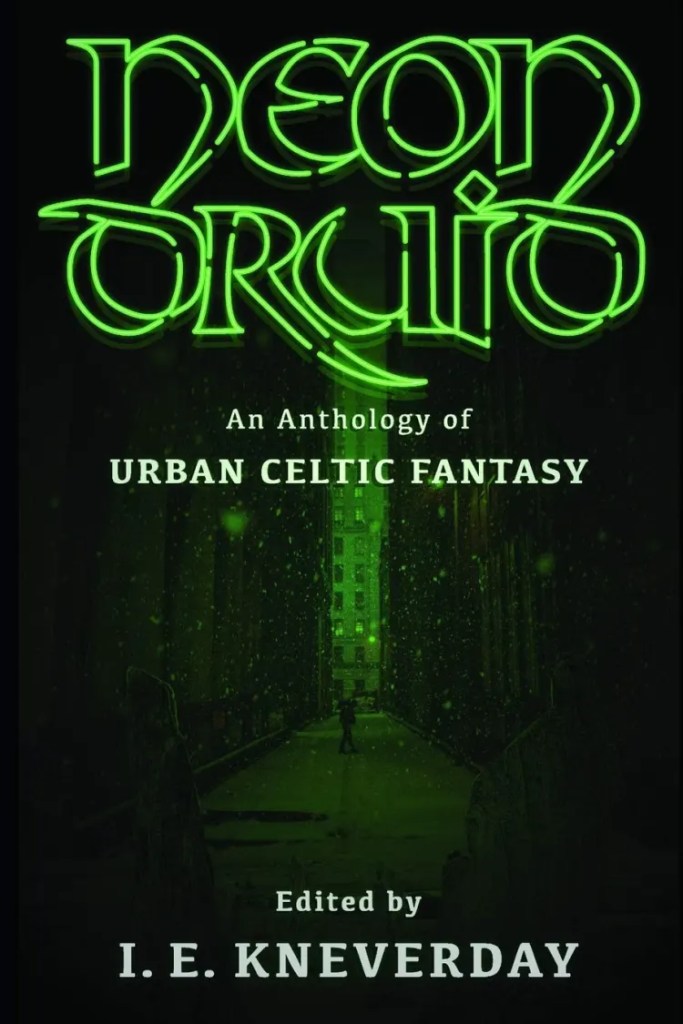
“A thrilling romp through pubs, mythology, and alleyways. NEON DRUID is such a fun, pulpy anthology of stories that embody Celtic fantasy and myth,” (Pyles of Books). Cross over into a world where the mischievous gods, goddesses, monsters, and heroes of Celtic mythology live among us, intermingling with unsuspecting mortals and stirring up mayhem in cities and towns on both sides of the Atlantic, from Limerick and Edinburgh to Montreal and Boston. Learn more…
Samhain in Your Pocket

Perhaps the most important holiday on the ancient Celtic calendar, Samhain marks the end of summer and the beginning of a new pastoral year. It is a liminal time—a time when the forces of light and darkness, warmth and cold, growth and blight, are in conflict. A time when the barrier between the land of the living and the land of the dead is at its thinnest. A time when all manner of spirits and demons are wont to cross over from the Celtic Otherworld. Learn more…
Irish Monsters in Your Pocket

In the Ireland of myth and legend, “spooky season” is every season. Spirits roam the countryside, hovering above the bogs. Werewolves lope through forests under full moons. Dragons lurk beneath the waves. Granted, there’s no denying that Samhain (Halloween’s Celtic predecessor) tends to bring out some of the island’s biggest, baddest monsters. Prepare yourself for (educational) encounters with Irish cryptids, demons, ghouls, goblins, and other supernatural beings. Learn more…
 Folklore in Film
Leave a comment