
Folklore in Film is reader-supported. When you buy through links on our site, we may earn a small affiliate commission.
“[L]eprechauns were shoemakers and pranksters, but they were sometimes so evil in their pranks that they killed people.”
That’s a direct quote from Mark Jones, writer and director of the 1993 horror-comedy, Leprechaun.
And before you dismiss this movie as a low-budget, bastardized, plasticized vision of Irish folklore, consider, for a moment, that Leprechaun is more self-aware than you might be giving it credit for.
What’s more, the film’s inciting incident, the leprechaun ransom, has a connection to the first ever story to feature a leprechaun:
The Adventure of Fergus mac Léti, which dates back to at least the 8th century.
But for my crock of gold, Jones relied more heavily on Irish folktales recorded in the 19th-century, including the aptly titled “Haunted Cellar,” which appears in Thomas Crofton Croker’s 1825 book Fairy Legends and Traditions of the South of Ireland.
I would also venture to guess that Jones read William Allingham’s 1865 poem The Leprechaun; or Fairy Shoemaker, which would later be collected in a book of Irish folktales by none other than famed Irish poet, W. B. Yeats.
Look, I know what you’re thinking:
The dude who wrote 1993’s Leprechaun did research?
And to his credit, Jones seems to understand the skepticism.
And I quote:
“In those days, there was no internet. I had to go to the library, and I actually got books on fairies and gnomes.”
Pssst. You can watch a video adaptation of this essay right here. Text continues below.
Rise of the Leprecahun: The Saga of Fergus mac Léti
The first time leprechauns appear in literature, they bear little resemblance to the modern green-clad, orange-haired, buckle-covered, happy-go-lucky figures we know today.
For starters, they live under the sea.
Under the—
And while not many details are given as to their appearance, apart from their diminutive stature, the Adventure of Fergus mac Léti does give us some insight into their demeanor:
They’re conniving.
The leprechauns, or Lúchorpáin as they were originally styled, try to kidnap (kingnap?) the Ulster king Fergus mac Léti and drag him beneath the waves.
But Fergus ends up capturing three of his would-be captors, who are quick to strike a deal.
And I quote:
“[Fergus] caught hold of three of them, one in each hand and one on his breasts.
“‘Life for life!’ [said the chief dwarf].
“‘Let my three wishes be granted to me,’ said Fergus.
“‘Thou shalt have anything that is not beyond our power,’ said the dwarf.
“So Fergus chose to ask from him a charm for passing under seas and pools and lakes.”
To recap:
After a reverse kidnapping, Fergus asks the chief leprechaun for some scuba equipment.
And he effectively wastes two wishes by specifying the bodies of water he can use it in.
Anyway, the leprechauns give Fergus some magic herbs for sticking in his ears and a magic cloak for wrapping around his head.
Then, while traveling underwater, he enters an area the leprechauns had told him to stay away from…
…and, he’s attacked by a muirdris, or water monster, which leaves Fergus’s face permanently disfigured.
Years later, Fergus successfully kills the water monster but it costs him his life.
This is a foundational bit of leprechaun lore.
And it’s one the movie certainly taps into:
If you catch a leprechaun, you can ransom it for something magical.
Only, your luck won’t last.
For Dan O’Grady (that Irish fella we meet at the beginning of the film), the cost of capturing a leprechaun and ransoming him for gold…
…is that the leprechaun follows him back to North Dakota and knocks his wife down the stairs.
O’Grady does successfully trap the leprechaun using a four-leaf cover (more on those later), but this ends up being the Irishman’s final act.
I’m not saying there’s a perfect parallel here; just some nuggets of inspiration, perhaps.
The Leprechaun’s Watery Origins Reflected…in a Well?
Because of course, the aquatic nature of Irish mythology’s very first leprechauns, or lúchorpáin, isn’t acknowledged at all in the film.
Or is it?
Let’s dive in.
The film’s setting, New Mexico…I mean North Dakota is landlocked to say the least.
Wherever you stand in the Peace Garden State, the nearest ocean is more than 1,500 miles away.
Meanwhile, you can’t stand anywhere in Ireland that’s more than, say, 75 miles away from the sea.
So for the film’s leprechaun, played by Warwick Davis, this is a fish out of water story.
And bearing that in mind, isn’t it convenient that the film opens with the leprechaun soliloquizing over the sound of dripping water…
…and ends with the leprechaun in a well, submerged in water.
Of course, it would be ridiculous to hold the entire movie to the standard of the very first myth to feature leprechauns.
Especially since leprechauns evolved significantly in their characterizations over the centuries.
That being said, I will be grading Leprechaun on its folklorical accuracy at the end of this video.
FYI: I recently gave 1999’s The Mummy an A-.
Now, back to the gold. And the shoes.
Funnily enough, both of these leprechaun tropes can trace their roots back nearly to the very beginning of leprechaun lore as well.
The Leprechaun’s Twin Obsessions—Gold and Shoes—Explained
In a retelling of the aforementioned, original Fergus mac Léti saga, the roles of the wee folk are hugely expanded, giving us figures like King Iubdan and Queen Bebo.
And instead of Fergus ransoming a trio of leprechauns for some wishes, like he does in the original, here he intends to ransom Iubdan, king of the wee folk, for some gold.
To quote King Iubdan talking to his wife Queen Bebo:
“O fair-haired woman, and O woman with fair hair! gyves hold me captive in a viscous mass nor, until gold be given for my ransom, shall I ever be dismissed.”
What the king ends up accepting instead of gold, however, is a pair of shoes.
Iubdan’s magic shoes, to be precise. To quote Iubdan:
“Take my shoes, my shoes, O take, brogues of the white bronze, of virtue marvellous! alike they travel land and sea, happy the king whose choice shall fall on these!”
And yes, Fergus takes the shoes, uses them to travel underwater so he can kill a monster, then he dies.
Is the Leprecahun Named Lubdan in the 1993 Film?
Wait, what’s that?
Yes, for all of you Leprechaun franchise superfans out there, I am aware that in a tie-in comic series the leprechaun is given a name.
And that name is Lubdan.
Which is only one letter away from Iubdan.
It’s likely that what happened here is someone mistook that capital “I” in Iubdan for a lowercase “l,” hence, Lubdan. (I actually see this happening in texts online.)
Although, if we really want to get into the mythological weeds, it’s possible someone deliberately switched the name to Lubdan because it sounds more like Lugh, who, in Irish mythology, is the god of many talents.
And there is a popular (but dubious) etymology of “leprechaun” that claims the god Lugh devolved in the popular imagination into a fairy craftsman named “little stooping Lugh” or Lugh-chromain, which was later anglicized as leprechaun.
But I digress.
This video isn’t about the sequels or spinoffs or tie-ins.
It’s about our pal the OG, 1993 leprechaun, trapped in a crate in the basement.
Or as we say where I’m from—he’s down cellar.
Which brings us to…
“The Haunted Cellar”: Meet the Leprechaun’s Crankier Cousin, the Clurichaun
“The Haunted Cellar” is the definitive Irish folktale about not a leprechaun but its arguably more evil cousin, the clurichaun.
The story begins with young Jack Leary seizing an employment opportunity in the house of the reputable MacCarthy family.
You see, butler after butler has quit the service of the family on account of being afraid to go down into the wine cellar.
Leary is determined to break this trend, but when he goes to open the cellar door, he hears a “strange kind of laughing,” followed by “a roaring and bellowing like a mad bull, and that all the pipes and hogsheads and casks in the cellar went rocking backwards and forwards.”
But because our stalwart protagonist is brave enough to…
No, only kidding: Leary hightails it up the cellar stairs—without the wine his boss had requested.
So Mr. MacCarthy himself goes down into his wine cellar. Here’s what happens next:
“When he arrived at the door, which he found open, he thought he heard a noise, as if of rats or mice scrambling over the casks, and on advancing perceived a little figure, about six inches in height, seated astride upon the pipe of the oldest port in the place, and bearing the spigot upon his shoulder. Raising the lantern, Mr. Mac Carthy contemplated the little fellow with wonder: he wore a red nightcap on his head; before him was a short leather apron, which now, from his attitude, fell rather on one side; and he had stockings of a light blue colour, so long as nearly to cover the entire of his legs; with shoes, having huge silver buckles in them, and with high heels (perhaps out of vanity to make him appear taller). His face was like a withered winter apple; and his nose, which was of a bright crimson colour, about the tip wore a delicate purple bloom, like that of a plum: yet his eyes twinkled and his mouth twitched up at one side with an arch grin.”
So right off the hurl, this clurichaun is a lot shorter than the movie’s leprechaun.
But other aspects of his appearance are spot on.
We also have a character thinking: oh, it sounds like rats.
Which is paralleled in the movie.
And overall, when you consider that the movie spends a lot of its first act having characters go up and down the stairs to the spooooky basement, and the ultimate source of that spookiness is revealed to be a tiny Irish person with vague telekinetic abilities…
I can’t help but think:
Writer/director Mark Jones read “The Haunted Cellar.”
And if you want a cherry on top, I give you the folktale’s closing paragraph:
“Some…believe that [the Clurichaune] turned brogue-maker, and assert that they have seen him at his work, and heard him whistling as merry as a blackbird on a May morning, under the shadow of a brown jug of foaming ale, bigger—ay bigger than himself; decently dressed enough, they say;—only looking mighty old. But still ’tis clear he has his wits about him, since no one ever had the luck to catch him, or to get hold of the purse he has with him, which they call spré-na-skillinagh, and ’tis said is never without a shilling in it.”
I mean, come on.
Not only am I convinced that Jones was familiar with this Irish folktale, I am also convinced that he read it in this book:
Thomas Crofton Croker’s Fairy Legends and Traditions of the South of Ireland, first published in 1825.
Fairy Legends and Traditions of the South of Ireland (1825) by Thomas Crofton Croker
There are a lot of gems in here, including a definition of “leprechaun” that was allegedly given in a courtroom after someone used it in their testimony.
“[I]t is a little counsellor man in the fairies, or an attorney that robs them all, and he always carries a purse that is full of money, and if you see him and keep your eyes on him, and that you never turn them aside, he cannot get away, and if you catch him he gives you the purse to let him go, and then you’re rich.”
There’s also the folktale, “The Little Shoe”, which features a clurichaun “hammering, hammering, hammering, just for all the world like a shoemaker making a shoe, and whistling all the time the prettiest tune he ever heard in his whole life before.”
The “he” here is a fella who ends up catching the “Cluricaune” in his hand and demanding its purse.
So the clurichaun says “sure, no problem, just open your hand and I’ll go get it.”
You’ll never guess what happens next.
The clurichaun…it runs away.
In the movie, when human characters do manage to gain possession of some of the leprechaun’s gold, weird and horrific stuff often ensues.
Turns out, this phenomenon exists in folklore and mythology.
To quote Croker:
“The circulation of money bestowed by the fairies or supernatural personages, like that of counterfeit coin, is seldom extensive. See [the] story, in the Arabian Nights, of the old rogue whose fine-looking money turned to leaves. When Waldemar, Holgar, and Grœn Jette in Danish tradition, bestow money upon the boors whom they meet, their gift sometimes turns to fire, sometimes to pebbles, and sometimes is so hot, that the receiver drops it from his hand, when the gold, or what appeared to be so, sinks into the ground.”
Croker also asserted that “leprechaun” and “clurichaun” were regional names for the same being.
And while the latter moniker is featured more prominently in Croker’s book, it’s clear that by the second half of the 19th century, “leprechaun” had become the more popular form.
Behold, exhibit A:
The Leprechaun; or Fairy Shoemaker (1865) by William Allingham
William Allingham’s 1865 poem, The Leprechaun; or Fairy Shoemaker.
And can I just say? I f*cking love this poem.
I even tracked down a book from 1928 that features the poem with these incredible illustrations.
I read it to my kids every St. Patrick’s Day. They love it.
And here, arguably, in this poem, is where the modern, shoe-loving, gold-hoarding, buckle-covered leprechaun really comes into his own.
In part one of the poem, we learn how the leprechaun uses “[s]carlet leather, sewn together” to make a shoe, and how it’s possible to hear the “[b]usy click of an elfin hammer,” and the “voice of the Lepracaun singing shrill.”
In part two of the poem we find out that the leprechaun has “Nine-and-ninety treasure-crocks” that he’s hidden all over the landscape, each of them “[f]ull to the brim / With gold!”
Then in part three, a cowboy catches the leprechaun and demands that he hand that gold over.
But alas, the leprechaun pulls out a snuff box, i.e., a container of powdered tobacco, and flings the dust in the cowboy’s face, causing him to sneeze and facilitating the leprechaun’s escape.
It’s a pretty devilish if understandable maneuver on the part of the leprechaun.
Nothing as extreme as what we see in the film, but the groundwork is there.
What’s more, the description of the leprechaun we get in part three of the poem hews quite closely to the movie version.
“A wrinkled, wizen’d, and bearded Elf,
Spectacles stuck on his pointed nose,
Silver buckles to his hose,
Leather apron—shoe in his lap.”
No, it isn’t exactly the same, but close. Wrinkled and wizened for sure.
It’s also worth noting that this poem sets the action in the countryside.
Which is what the movie does as well.
But before potentially influencing writer/director Mark Jones, Allingham’s leprechaun poem caught the eye of famed Irish poet W. B. Yeats, who reprinted it in full in his 1888 book, Fairy and Folk Tales of the Irish Peasantry.
Fairy and Folk Tales of the Irish Peasantry (1888) by W. B. Yeats
And it is here where Yeats asserts that the leprechaun is a solitary fairy, as opposed to a trooping fairy.
This definitely tracks with the leprechaun we see in the movie, who operates as a lone wolf.
But there’s more to being a solitary fairy than simply living alone.
To quote Yeats:
“The Lepracaun, Cluricaun, and Far Darrig. Are these one spirit in different moods and shapes? Hardly two Irish writers are agreed. In many things these three fairies, if three, resemble each other. They are withered, old, and solitary, in every way unlike the sociable spirits of the first sections. They dress with all unfairy homeliness, and are, indeed, most sluttish, slouching, jeering, mischievous phantoms. They are the great practical jokers among the good people.”
I mean, that’s our guy.
Only, I’m not sure Warwick Davis’ costume qualifies as “homely.”
We’ll get into it.
Speaking of fairies in general, Yeats notes:
“They have only one industrious person amongst them, the lepra-caun—the shoemaker. Perhaps they wear their shoes out with dancing. Near the village of Ballisodare is a little woman who lived amongst them seven years. When she came home she had no toes—she had danced them off.”
Cool.
But Yeats wasn’t the only one writing about leprechauns in 1888.
Irish Wonders (1888) by D. R. McAnally, Jr.
Beating him to the presses was D. R. McAnally, Jr., whose book Irish Wonders: the ghosts, giants, pookas, demons, leprechawns, banshees, fairies, witches, widows, old maids, and other marvels of the Emerald Isle, is listed by Yeats as an authoritative source on Irish folklore.
McAnally spends a lot of time pondering the morality of the leprechaun, ultimately concluding that the being is “not wholly good nor entirely evil, but balanced between the two, sometimes doing a generous action, then descending to a petty meanness, but never rising to nobility of character nor sinking to the depths of depravity; good from whim, and mischievous from caprice.”
Imagine Jones reading this and thinking:
Yeah, but what if a leprechaun did sink to the depths of depravity?
Then there are the details from the book that made it directly into the movie.
Including the leprechaun being “about three feet high” and having “red breeches buckled at the knee,” and “a little, old, withered face,” and “frills of lace…at his wrists.”
As far as the leprechaun’s behavior is concerned, that little dude is a certified d*ckhead.
“In Clare and Galway, the favorite amusement of the Leprechawn is riding a sheep or goat, or even a dog, when … [he] has been going on some errand that lay at a greater distance than he cared to travel on foot. Aside from riding the sheep and dogs almost to death, the Leprechawn is credited with much small mischief about the house.”
This passage immediately makes me think of the scenes where the leprechaun rides the tricycle and drives that little kid car.
As for all of the gratuitous murdering we see in the movie—I’d argue it’s really not that far of a stretch from what we see in McAnally’s Irish Wonders.
Just read to this:
“Sometimes [the Leprechawn] will make the pot boil over and put out the fire, then again he will make it impossible for the pot to boil at all. He will steal the bacon-flitch, or empty the potato-kish, or fling the baby down on the floor, or occasionally will throw the few poor articles of furniture about the room with a strength and vigor altogether disproportioned to his diminutive size.”
I’m sorry, “fling the baby down on the floor”?
Meanwhile, in Monaghan, the clurichaun is prone to—checks notes—poking peoples eyes out.
“When greatly provoked, [the Cluricawne] will sometimes take vengeance by suddenly ducking and poking the sharp point of his hat into the eye of the offender.”
But perhaps the most telling evidence we have for Jones having relied on Irish Wonders, at least in part, for his script, is this description of the aforementioned clurichaun:
[He] is a little dandy, being gorgeously arrayed in a swallow-tailed evening coat of red with green vest, white breeches, black stockings, and shoes that ‘fur the shine av ’em ‘ud shame a lookin’-glass.’”
This, as far as I can tell, is the oldest reference to a leprechaun or clurichaun being concerned with the shininess of his shoes.
Was the Film’s Leprechaun Inspired by Abhartach the Irish Vampire?
And I love how the movie makes this one of the leprechaun’s weaknesses:
Just like vampires are compelled to untie the knots, the movie’s leprechaun is compelled to shine shoes.
Which reminds me:
Who does Jennifer Anniston name-drop in the basement at the beginning of the film while the leprechaun is next to her in a crate?
Another dude who famously has to stay in a crate.
But what makes this an especially juicy connection is that Dracula’s creator, the Irish author Bram Stoker, was likely inspired by an Irish legend about a bloodthirsty vampire chieftain who can only be killed by way of wooden sword through the heart.
And this vampire chieftain’s name is Abhartach, which, in Old Irish, means dwarf.
No, I don’t think Jones actually knew all that.
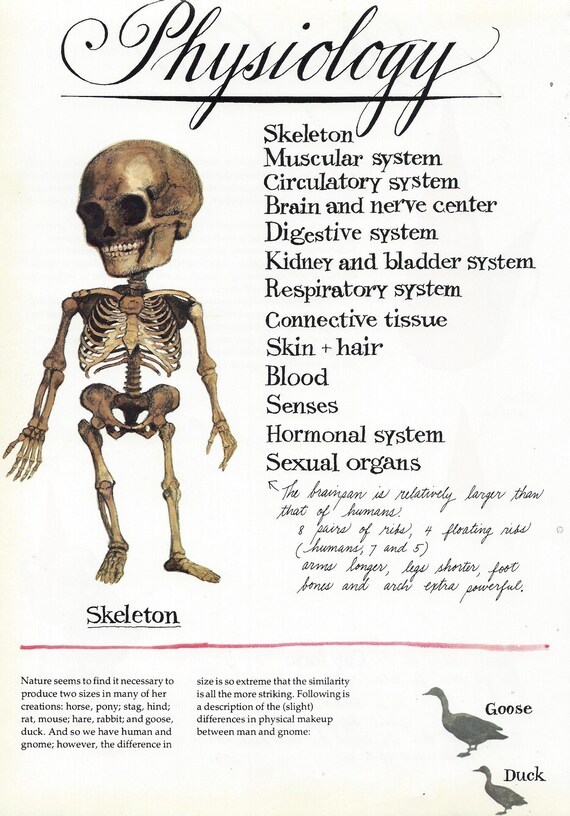
But I do think his closing scene with the leprechaun skeleton was inspired by a book about gnomes.
Gnomes (1977) by Wil Huygen, illustrated by Rien Poortvliet
Think of this as the equivalent to that dream James Cameron had where he saw the metallic skeleton emerging from the fire.
What happened here is that Jones opened a copy of the 1977 English translation of the Dutch book Gnomes, written by Wil Huygen and illustrated by Rien Poortvliet…
…and he saw this skeleton.
Are Four-Leaf Clovers Really Leprechaun Kryptonite in Irish Folklore?
Finally, as for four-leaf clovers being leprechaun kryptonite…
Jones made that up.
“I did create [the idea that] you can only kill a leprechaun with a four-leaf clover. A lot of people think that’s folklore. But that was me.”
That’s right: there is no connection between leprechauns and four-leaf clovers in Irish folklore.
Despite all of the St. Patrick’s Day decorations and cereal boxes that might lead you to believe otherwise.
Jones acknowledges this commercialization of Irish symbols in the film, and even has the leprechaun try a handful of a Lucky Charms-esque cereal.
Which he promptly spits out.
Folklorical Accuracy Score for Leprechaun (1993)
But because the plot does rely quite heavily on the one thing Jones made up wholesale—namely, leprechauns being allergic to four-leaf clovers—I have to drop my grade from would have been A, to a B+
But what do you think?
Drop your grade in the comments below.
Thanks for reading.
Fan of Irish folklore?
You might be interested in…
Neon Druid: An Anthology of Urban Celtic Fantasy
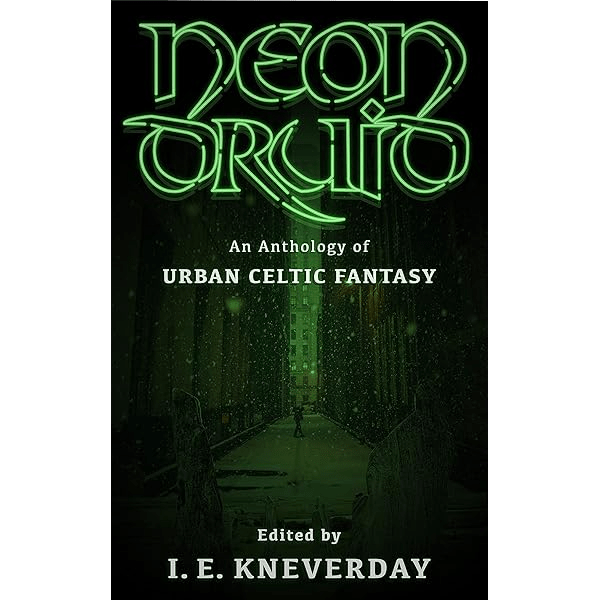
“A thrilling romp through pubs, mythology, and alleyways. NEON DRUID is such a fun, pulpy anthology of stories that embody Celtic fantasy and myth,” (Pyles of Books). Cross over into a world where the mischievous gods, goddesses, monsters, and heroes of Celtic mythology live among us, intermingling with unsuspecting mortals and stirring up mayhem in cities and towns on both sides of the Atlantic, from Limerick and Edinburgh to Montreal and Boston. Learn more…
 Folklore in Film
Leave a comment