

Folklore in Film is reader-supported. When you buy through links on our site, we may earn a small affiliate commission.
I’m on a quest to discover just how folklorically accurate the third entry in the Indiana Jones franchise really is.
The Cross of Coronado.
The Holy Grail.
Joseph of Arimathaea.
The Knights of the First Crusade.
Charlemagne and his war birds.
I’m gonna analyze all of it.
And at the end, I’ll give the film a grade.
Also at the end, I’m just letting you know up front, I will be making the case that one of The Last Crusade’s final scenes directly inspired one of the most popular Disney movies and songs of the modern era.
Pssst. You can watch a video adaptation of this essay right here. Text continues below.
Is the Cross of Coronado Real? Uncovering a Mythic McGuffin
So if River Phoenix Indy is to be believed, this golden, jewel-encrusted crucifix originally belonged to the conquistador Hernando Cortés…
Who, in 1521, gifted it to the conquistador Francisco Vásquez de Coronado…
Who brought it with him on an expedition to what would become the Southwestern United States…
Where he’d leave it or lose it in a cave in the vicinity of Moab, Utah.
Now, there is no evidence that Cortés owned a gold cross, let alone gave one to Coronado.
And if you’re thinking, well, maybe Cortés didn’t have one just like the one in the film, but it’s possible he wore a gold cross on a necklace…
Actually, we have it on good authority that Cortés was more of an amulet guy.
To quote one of his soldiers, Bernal Diaz del Castillo, writing in 1568:
“[Cortés wore] just a thin chain of gold of a single pattern and a trinket with the image of Our Lady the Virgin Saint Mary with her precious Son in her arms.”
Okay, but what about Cortés giving something to Coronado in 1521?
That’s tricky because in 1521, Coronado was still a boy living in Spain while Cortés was busy conquering the Aztec Empire.
Also there’s no record indicating the two ever met, even when they were both in the New World.
All this being said:
Coronado did go on an expedition to what is now the southwestern and midwestern United States between 1540 and 1542.
So maybe River Phoenix Indy simply got the date wrong.
Maybe Cortés sent Coronado a valuable religious artifact in 1539 or 1540 ahead of his journey.
Only, that doesn’t really make sense.
The whole reason Coronado went on this expedition in the first place was to find the fabled Seven Cities of Gold, collectively known as Cíbola.
Coronado was looking for treasure; he wasn’t hiding treasure he brought with him.
Did Coronado’s search ever bring him up to the vicinity of Moab, Utah, which is where The Last Crusade’s prologue is set?
No. Probably not.
But the idea that Coronado could have gone off the map, so to speak, is certainly intriguing.
Whoever wrote this opener, be it George Lucas, Menno Meyjes, Jeffrey Boam, or some combination thereof, they were expanding the lore.
And adding embellishments to the lore.
That’s the basis of every Indiana Jones film.
1981’s Raiders of the Lost Ark based its opening sequence on the same folktale.
Anyway, my best guess as to why the Cross of Coronado was invented for The Last Crusade’s prologue is that it’s partly because…
…of a monument:
The Coronado Cross.
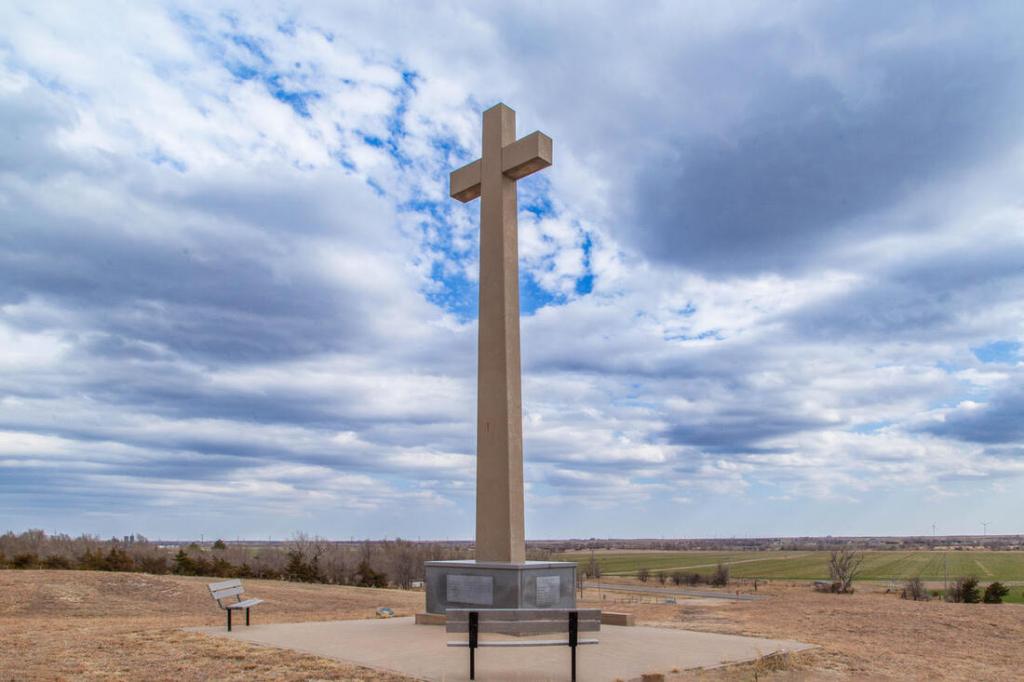
This nearly 40-foot tall concrete cross was constructed in 1975 ahead of the United States Bicentennial, but a smaller, wooden iteration of the monument had been on the spot since 1940.
It allegedly marks the location where Coronado’s priest, Juan de Padilla, held a mass for the Cities of Gold search party after they’d crossed what is now the Arkansas River.
So yeah, the monument isn’t in Utah, it’s in Kansas.
But still, the connection between Coronado and the symbol of the cross was there.
And ultimately, the filmmakers wanted the MacGuffin (although is this not technically a MacGuffin?) to be something related to Christianity, foreshadowing the main MacGuffin, which, incidentally, happens to be one of the earliest examples of a MacGuffin in all of literature.
The Holy Grail: Biblical, Legendary, or Both?
“The Holy Grail…
“The chalice used by Christ during the Last Supper. The cup that caught His blood at the Crucifixion and was entrusted to Joseph of Arimathaea…
“Eternal life…The gift of youth to whoever drinks from [it].”
This is the definition of the Holy Grail given by the film’s villain, Walter Donovan.
And if you’re wondering what his source is—it’s not the Bible.
True, the synoptic Gospels and First Corinthians describe Jesus holding a cup of wine while establishing the new covenant.
But the cup itself isn’t presented as having special properties. Nor is it mentioned ever again after that.
Which leads us to Joseph of Arimathea, whom the Gospels describe as a rich guy who gets Jesus’s body from Pilate, wraps it up in a shroud, and places it in a nice new tomb.
But that’s it.
There’s no catching blood in the cup under the crucifix.
There’s no drinking from the cup and gaining eternal life.
So where is Donovan pulling this from?
No, not there.
It’s from Arthurian legend.
Perceval, the Story of the Grail: The First Grail Quest in Literature
The earliest description of a grail quest in literature appears in the chivalric romance Perceval, the Story of the Grail, written by Chrétien de Troyes in the late twelfth century.
Perceval, our brave but naive knight, is invited to the castle of the ailing Fisher King, where he observes a spear that is perpetually dripping blood (which in later lore will be identified as the Spear of Longinus), and… a grail, amongst other sacred objects.
Only, de Troyes’ grail is more like a big fancy serving dish than a cup. And it holds a single communion wafer.
This (and other details) has led some to speculate that de Troyes relied on earlier, Celtic sources for his grail legend, as both Irish mythology and Welsh mythology feature cauldrons that are capable of producing life… in some capacity.
The Dagda’s Cauldron, for example, the coire ansic, or “undry cauldron,” never runs empty, meaning the Irish all-father, the Dagda (or anyone, I guess), could live off the cauldron’s abundance forever.
In Welsh mythology, meanwhile, you can chuck dead warriors into the Pair Dadeni (Cauldron of Rebirth) and they’ll come back to life.
Look, I could go down these Celtic origins for Arthurian legend rabbit holes forever, and I do, on my other website/channel, Irish Myths.
Back to the quest at hand:
Perceval sees all this crazy shit, but he thinks it would be rude to ask questions about it, so he just keeps quiet.
And just like that: test failed.
He was one step away, and the ground fell out from underneath his feet.
He was meddling in powers he could not possibly—
You get the idea.
Turns out, Perceval should have asked about the grail, and who it served, and if it could heal the ailing Fisher King.
Because apparently the grail had the power to do that.
But, and this is a big but, de Troyes never wrote that the grail had a holy origin.
His grail is golden and covered in precious stones and it glows—it’s certainly not the cup of a carpenter.
But overall, I’d say The Last Crusade does a decent job of paying homage to this original grail tale.
With the old knight at the end taking the place of the Fisher King.
And Indy having to prove himself worthy.
And just look at those fancy golden serving dishes in the Temple of the Sun.
How Did Joseph of Arimathaea Become Associated With the Grail?
The next writer to pick up the grail quest narrative was Robert de Boron, whose late 12th-century romance, Joseph d’Arimathie, established the titular tomb-provider as the Holy Grail’s first guardian.
Thus, De Boron was the first person to link the Biblical chalice used by Jesus during the Last Supper to the mystical grail legend.
Remember that bit about Joseph of Arimathaea catching the blood of Jesus in the grail during the Crucifixion?
Yeah, this is where that comes from.
De Boron was the first to write about it.
And in the rest of his celebrated trilogy, which consists of Joseph d’Arimathie, Merlin, and Perceval, de Boron reinforces both the Grail’s Christian origins and its connection to Arthurian legend.
Notably, the wizard / druid? Merlin can look back in time and confirm that, yep, Joseph of Arimathea was the first Grail guardian.
And that he passed the Grail to his brother-in-law Bron, the “rich fisher,” a name he earned by preparing a really nice fish at the Grail Table.
This was a table Joseph had built especially to commemorate the Last Supper.
And apparently it was round, because in de Boron’s telling, Merlin instructs Arthur’s father, Uther Pendragon, to build a table just like it.
Back to the past:
Joseph of Arimathaea sends his bro-in-law Bron away with the Grail, telling him to go to the far west.
To Avalon.
A location that would later be associated with England’s Glastonbury Tor.
Bron, the Rich Fisher, has twelve sons, one of whom is Alain le Gros: the Fisher King.
And ultimately it is Alain’s son Perceval who is destined to take over the role of Grail guardian.
No, the movie doesn’t get into all this, opting instead for a different family to take over grail guardianship rights…
The Knights of the First Crusade: Fact vs. Folklore
The three brothers, Sir Richard, the Grail Knight, and the unarmed other one (I’m guessing he’s the middle child), are presented as knights of the First Crusade.
Now, the First Crusade began in the late 11th century.
Meanwhile, most of the Arthurian legends are set in the fifth century.
So if the Grail is lost for a thousand years after Joseph of Arimethaea gets it, as Donovan asserts, then the Knights of Round Table never interact with the Grail at all in this movie universe.
Which is kind of a weird choice, especially since Indy refers to this “bedtime story” as the “The Arthur Legend.”
But there is no Arthur in this legend.
At best, the three knights of the First Crusade are meant to be reflections of Sir Percival, Sir Galahad, and Sir Bors, who, in the 13th-century Lancelot-Grail Cycle a.k.a. Vulgate Cycle are the only three knights who achieve the Grail quest.
A detail I do appreciate is that when Indy and co. go to the Canyon of the Crescent Moon and into the Temple of the Sun, which of course is actually a rock-cut tomb in Petra, there are a whole bunch of false grails in addition to the genuine item.
Something I alluded to earlier with the dishes.
I think these are a nod to all of the claims that have been made about the Grail over the centuries.
Yes, including those found in The Matter of Britain.
But also earlier accounts.
Will the Real Holy Grail Please Stand Up?
A fella from Piacenza in Northern Italy made a pilgrimage to Jerusalem in the year 570 and saw “the onyx cup which [Jesus] blessed at the supper, and many other wonders.”
Another pilgrim, the Frankish churchman Arculf, writing in the 7th century, reported seeing that same cup.
But it’s important to remember that at this time, before the Arthurian grail quest legends had been written, the Last Supper cup, while venerated, wasn’t considered magical.
Nor was it believed that Joseph of Arimethaea had anything to do with it.
What’s more, as our aforementioned pilgrims pointed out, the Holy Land was awash with “sacred relics” at this time, including, amongst other items, the nut-wood cross Jesus was crucified on and the blessed Mary’s headband and girdle.
Such relics amounted to tourist attractions; their authenticity never proven.
Then there are the grails that popped up after the grail quest legends were written.
Like the so-called Holy Chalice of Valencia a.k.a. the Santo Cáliz.
Putting aside its later medieval adornments, the original cup, made of agate, a semi-precious silica mineral, does date to the right time period to be the chalice from the Last Supper.
Only it was never identified as such until the 14th century.
The Sacro Catino, or sacred basin, in Genoa is another Holy Grail contender.
Once thought to be made of emerald, the dish-like vessel is known to be made of Byzantine crystal and it dates to the 9th or 10th century.
It was only identified as the grail in the late 13th century.
But while we’re in Northern Italy…
Can someone please explain why Indy goes to Venice to find the fictional tomb of the fictional crusader Sir Richard?
Oh, right, that’s my job.
Venice: Where Grail Legend Meets the Crusades
Turns out Venice does have a connection to the grail legend. And the crusades.
Historically, we know Venice was a key logistical and financial center for crusaders.
And it was the launch point for the Fourth Crusade, which resulted in the sacking of Constantinople in 1204.
Suddenly, Europe was awash with relics stolen from Constantinople:
John the Baptist’s head. Pieces of the cross. Mary’s hair.
And if local legend is to be believed, a crusader brought the Holy Grail back to Venice and hid it inside a marble throne in the basilica of San Pietro di Castello.
No, there’s no roman numeral 10 in the middle on the floor.
Still, given its history and local folklore, Venice makes sense as a stop on Indy’s quest.
And ultimately, the writers here were following the formula laid out in Raiders of the Lost Ark.
You get the classroom scene where Indy inadvertently spoils part of the film:
“‘X’ never, ever, marks the spot.”
In Raiders, he said folklore was one the great dangers to archaeology.
Here, he says: “We cannot afford to take mythology at face value.”
Even with all of the supernatural stuff he’s experienced, something he’s reminded of while in the Venice catacombs, Indy has the same arc (pun intended) in The Last Crusade as he does in the previous two films.
And really, the formulaic nature of The Last Crusade makes me appreciate Temple of Doom more for taking bigger swings.
The Wisdom of the Father: Debunking That “Charlemagne” Quote
Of course, the father-son dynamic is great.
And who doesn’t love Henry Sr.’s little secret handshake he does with Brody:
“Genius of the Restoration –”
“– aid our own resuscitation!”
Apparently this is a toast given at the University Club of New York, which is a private social club in Manhattan. But I haven’t been able to confirm that.
Then there’s this bit of wisdom Henry Sr. drops, after successfully warding off a fighter plane:
“I suddenly remembered my Charlemagne. Let my armies be the rocks and the trees and the birds in the sky.”
The only thing is, there is no record of the 8th-century King of the Franks, Charlemagne, ever having said this.
Nor did he write it down because the consensus seems to be that while he may have learned how to read, Charlemagne never learned how to write.
This quotation is a complete and total fabrication.
And coincidentally, or perhaps not, the closest thing I could find to this bogus quote—“Let my armies be the rocks and the trees and the birds in the sky”—comes from Irish mythology.
Specifically, during the lead up to the second battle of Mag Tuired, Lugh, the Irish god of many talents, asks his enchantresses, Bé Chuille and Dianann, how they will help in the battle against their foes, the Fomorians.
The enchantresses reply:
“We will enchant the trees and the stones and the sods of the earth so that they will be a host under arms against them; and they will scatter in flight terrified and trembling.”
And speaking of Irish enchantresses…
Did The Last Crusade Inspire Frozen and “Let It Go”?
Did you know that the love interest of Henry Jones Jr. and Sr., the Austrian professor Elsa Schneider, was played by an Irish actress, Alison Doody?
But that’s not the only bit of Elsa trivia I have to share.
Because I noticed something during the climactic collapse of the Temple of the Sun.
While the ground is breaking apart, Elsa, with her shock of blonde hair, and bright blue eyes, falls into a chasm.
Indy catches her, but Elsa’s desire for the Grail leads to her demise.
Indy himself nearly makes the same mistake as Elsa, until Henry Sr. delivers this line:
“Let it go.”
Elsa. The unstable ground. Let it go.
Is this the biggest coincidence of all time?
Remember, Frozen was based on Hans Christian Andersen’s fairy tale, The Snow Queen.
But Andersen’s snow queen doesn’t have a name, nor is she blonde—her hair is white like snow.
The name. The look. The song.
Did Indiana Jones and the Last Crusade inspire one of the most popular Disney movies—and songs—of the modern era?
Or am I officially losing it?
Let me know in the comments below.
As for a folklorical accuracy grade: I’m giving Indiana Jones and the Last Crusade a B.
It probably would have been an A, but I don’t love how the Knights of the Round Table were effectively written out of their own legend.
What’s more, that made-up Charlemagne quotation, which continues to circulate online, bugs me to no end.
But what do you think? Drop your grade in the comments.
Thanks for reading.
Fan of folk horror?
You might be interested in my short film Samhain, available over on the Irish Myths channel.
More the reading type?
Check out…
Neon Druid: An Anthology of Urban Celtic Fantasy
“A thrilling romp through pubs, mythology, and alleyways. NEON DRUID is such a fun, pulpy anthology of stories that embody Celtic fantasy and myth,” (Pyles of Books). Cross over into a world where the mischievous gods, goddesses, monsters, and heroes of Celtic mythology live among us, intermingling with unsuspecting mortals and stirring up mayhem in cities and towns on both sides of the Atlantic, from Limerick and Edinburgh to Montreal and Boston. Learn more…
Samhain in Your Pocket

Perhaps the most important holiday on the ancient Celtic calendar, Samhain marks the end of summer and the beginning of a new pastoral year. It is a liminal time—a time when the forces of light and darkness, warmth and cold, growth and blight, are in conflict. A time when the barrier between the land of the living and the land of the dead is at its thinnest. A time when all manner of spirits and demons are wont to cross over from the Celtic Otherworld. Learn more…
Irish Monsters in Your Pocket

In the Ireland of myth and legend, “spooky season” is every season. Spirits roam the countryside, hovering above the bogs. Werewolves lope through forests under full moons. Dragons lurk beneath the waves. Granted, there’s no denying that Samhain (Halloween’s Celtic predecessor) tends to bring out some of the island’s biggest, baddest monsters. Prepare yourself for (educational) encounters with Irish cryptids, demons, ghouls, goblins, and other supernatural beings. Learn more…
 Folklore in Film
Leave a comment