
Folklore in Film is reader-supported. When you buy through links on our site, we may earn a small affiliate commission.
Did you know the mythical horned figure Pan doesn’t actually appear in Pan’s Labyrinth?
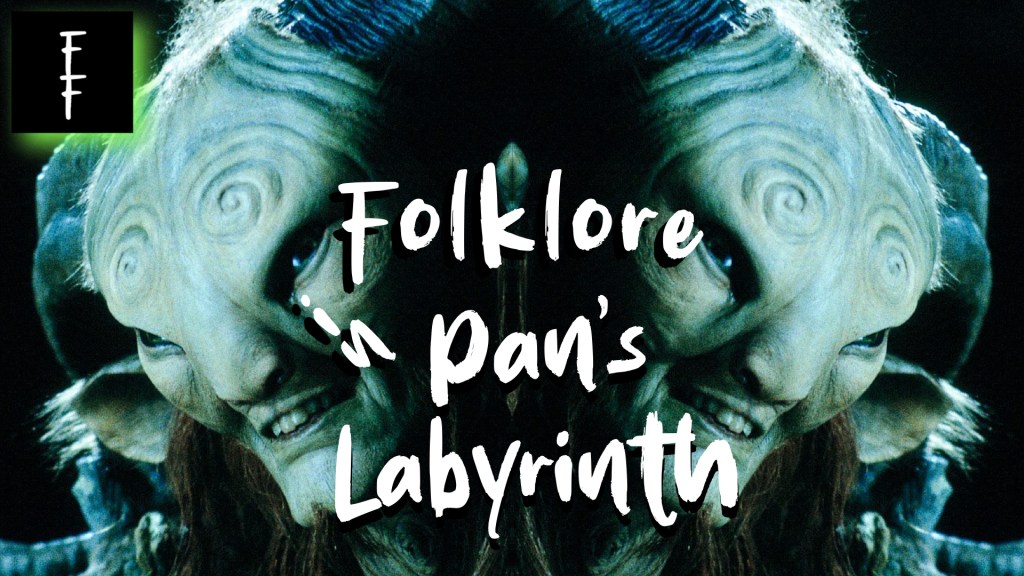
Yeah, turns out that fella with the horns and the goatee and the forehead swirls isn’t based on the Greek god of the wild Pan, but a human/goat hybrid from Roman mythology, the faun.
To quote writer/director Guillermo del Toro:
“[T]he character of the faun is essentially the trickster.
“He is a character that is neither good nor bad… that’s why I chose a faun.
“Not ‘Pan.’ Pan is just the translation, which is not accurate.
“It’s a faun, because the faun in Classical mythology was at the same time a creature of destruction, and a creature of nurturing and life.”
Okay, so now it makes a lot more sense why the film’s Spanish title is El laberinto del fauno.
But is del Toro just splitting goat-hairs here?
Because aren’t fauns and Pan—and satyrs for that matter—all essentially the same thing?
We’ll get into it.
And what about labyrinths?
Are fauns and/or Pan and/or satyrs even associated with labyrinths in the Classical accounts?
And while we’re at it, what’s the deal with those stick-bug fairies?
And that dude with his eyes in his hands?
And that giant toad?
And that squirmy little root?
Do all of the creatures in Pan’s Labyrinth have a basis in folklore or mythology?
The answer might surprise you.
Pssst. You can watch a video adaptation of this essay right here. Text continues below.
Celtic Fairies in Pan’s Labyrinth?
First things first.
The mystical, magical world of Pan’s Labyrinth initially reveals itself when Ivana Baquero’s Ofelia discovers a cool looking stone with an eye carved into it.
Turns out it’s the missing piece of “an ancient stone monolith incised with Celtic lettering.”
That’s a direct quote from the English translation of the script.
And what crawls out of that Celtic-looking monolith?
One of those stick-bug fairies.
And I think it’s safe to say that Guillermo del Toro turned to Celtic mythology for inspiration for these fairies.
Specifically Irish mythology, where we can find several characters capable of therianthropy, or the ability to shapeshift into animals.
Exhibit A:
The goddess Étaín of the Irish story The Wooing of Étaín, who famously gets transformed into a scarlet fly.
And I quote:
“This fly was the size of the head of the handsomest man in the land, and the sound of its voice and the beating of its wings were sweeter than pipes and harps and horns, its eyes shone like precious stones in the dark, and its colour and fragrance could sate hunger and quench thirst in any man; moreover, a sprinkling of the drops it shed from its wings could cure every sickness and affliction and disease.”
Cool.
Of course, Pan’s Labyrinth is set in Spain, so I’m tempted to draw comparisons to fairies from the Celtic regions of Spain, such as the Anjanas from Cantabria and the Xanas from Asturias and Galicia.
Buuut I think the Korrigans from Brittany in Northwestern France more closely resemble what we find in the film.
Just listen to this description from American anthropologist Walter Evans-Wentz:
“[Korrigans] are little beings not more than two feet high, and beautifully proportioned, with bodies as aerial and transparent as those of wasps. And like all fairy, or elvish races, and like the Breton Morgans or water-spirits, they are given to stealing the children of mortals.”
No, not exactly the same.
Notably, del Toro’s fairies don’t steal Ofelia—they guide her.
That being said, the fairies in Pan’s Labyrinth operate in conjunction with the faun, who according to del Toro is neither good nor bad:
He’s a trickster with transient morals.
But is that actually an accurate description of a mythical faun?
Differences Between Satyrs & Fauns / Pan & Faunus
To quote Geoffrey Miles’ 1999 book Classical Mythology in English Literature:
“Satyrs and fauns are both half man, half goat, like the god Pan, but fauns tend to be shy woodland creatures; satyrs are more boisterous, drunken, and lecherous.”
Miles definitely seems to be drawing inspiration from the Hypnerotomachia Poliphili here.
Which was kind of like a Renaissance-era graphic novel, first printed in Venice in 1499.
And I quote:
“Amongst them were the horned faunes, and lascivious satyres, solemnising their faunall feasts.”
Now, the fauns perhaps come off looking slightly better than the satyrs in this passage.
They’re not labeled “lascivious.”
Buuut if we go back to the year 8 C.E., to Ovid’s retelling of the Roman myth Vertumnus And Pomona, from the Fourteenth Book of Metamorphoses…
It’s the opposite. The fauns get singled out:
Her private orchards, wall’d on every side,
To lawless sylvans all access denied.
How oft the Satyrs and the wanton Fauns,
Who haunt the forests or frequent the lawns.
Conclusion:
Fauns and satyrs are interchangeable.
Only, it’d be more accurate to say that they became interchangeable.
Because if we go back to Greek mythology, in which Roman mythology is (to a large extent) rooted, we find that satyrs have equine features.
And other—shall we say prominent—features as well.
First documented in Hesiod’s Catalogue of Women, written in the late 8th or early 7th century BCE, satyrs are described as “good-for-nothing pranksters.”
At least according to the translation in M. L. West’s 2007 book Indo-European Poetry and Myth.
But this is not a great translation.
The good-for-nothing part, sure.
But a translation out of Harvard, also from 2007, more accurately describes the satyrs as a “worthless and frivolous” race.
This doesn’t sound anything like a “trickster” or “a creature of destruction, and a creature of nurturing and life,” as del Toro described his Faun.
In fact, del Toro’s description more closely aligns with the Roman god Faunus, namesake of—but a distinct entity from—the fauns.
To quote the Aeneid, which Virgil wrote between 29 and 19 BCE:
Within the space, an olive tree had stood,
A sacred shade, a venerable wood,
For vows to Faunus paid, the Latins’ guardian god.
Only here’s the thing:
In his earliest depictions, Faunus doesn’t have horns.
It’s only later when he’s conflated with Pan—the Greek god of the wilderness, flocks, shepherds, and pastoral music—that Faunus gets his horns.
Which means despite del Toro claiming that the Pan in Pan’s Labyrinth is merely a translation, the Greek god’s hoof prints are all over this character.
What’s more, on his own website, del Toro stated (before the film’s release) that he was inspired by stories written about Pan.
And I quote:
“Pan’s [Labyrinth] is an original story. Some of my favorite writers (Borges, Blackwood, Machen, Dunsany) have explored the figure of the God Pan and the symbol of the labyrinth.
“These are things that I find very compelling (Remember the labyrinth (s) image (s) on HELLBOY??) and I am trying to mix them and play with them.”
For those interested, the works being referenced here are:
- Jorge Luis Borges’s short story collection Ficciones.
- Algernon Blackwood’s Pan’s Garden.
- Arthur Machen’s The Great God Pan, and…
- Lord Dunsany’s The Blessing of Pan.
A History of Horned Monsters: From Krampus and the Minotaur to Satan and Hellboy
All this being said, del Toro’s Faun isn’t a photocopy of any single mythical figure.
Case in point:
If you zoom in on this dude’s legs, you’ll see that he has one cloven foot or hoof and one slightly more humanoid foot (granted it seems to be made of tree roots).
But this detail immediately made me think of another horned being, the Krampus:
The Yuletide bugaboo from Alpine folklore who is sometimes depicted with one hoof and one clawed foot.
And as I explored in my video on the 2015 film Krampus, it’s possible that many of the horned beings we find in folklore and mythology are all rooted in the same Proto-Indo-European figure.
This includes Pan, Faunus, fauns, satyrs, Krampus, the Celtic-Gaulish Cernunnos, the Hindu Pashupati, and a monster from Greek mythology that I’m sure many of you are familiar with:
This “part man, part bull” (as Ovid describes him) is famously placed in the center of a labyrinth at the request of King Minos of Crete.
Of course, that story comes with a lot of narrative baggage, so I get why del Toro would want to avoid using the Minotaur as his film’s labyrinth guardian.
Plus, there is some connective tissue between fauns and labyrinths — sort of.
In Pompeii, the House of the Faun, home to a famous faun/satyr statue, is directly adjacent to the House of the Labyrinth.
Meanwhile, the Villa Pisani at Stra, known for its garden hedge maze, boasts at least one faun sculpture.
There’s symbolism at play here, of course:
The horned being represents the wilderness and chaos, while the labyrinth represents civilization and order.
And if you’re thinking to yourself, wait a minute:
The Devil a.k.a. Satan in Christian mythology is a horned being who hangs out in the wilderness and is an agent of chaos, welp:
It’s well established that the Devil was only depicted with horns starting in the Medieval period.
And a main source of inspiration for his look was the Greek god Pan.
Which means that other horned figure del Toro helped bring to the big screen, Hellboy, is also based, at least in part, on Pan.
But enough about horny dudes.
A Sight to Behold: Does the Pale Man Have Folkloric Origins?
Despite having the title Pan’s Labyrinth, this film’s most popular monster is, arguably, the Pale Man.
Yeah, he’s the one with the eyes in his hands who gobbles up fairies in a manner reminiscent of Goya’s Saturn Devouring His Son.
The folkloric origins of the Pale Man, however, are…non-existent.
Del Toro’s original concept art for the creature involved a screaming horse skull coming out of his mouth.
But that was deemed too difficult to achieve, so del Toro said, “Ok, how about we just remove the eyes from his face and put them in his hands and his fingers will look like bony eyelashes.”
Thus, the Pale Man was born — a random invention resulting from creative restraint.
I mean, either that or del Toro was familiar with the Japanese Yōkai (spirit) called the Tenome, meaning “hand eyes.”
But it’s possible the similarities are just a coincidence.
Japanese Folklore in Pan’s Labyrinth? The Great Toad Explained
It’s also possible that del Toro’s inclusion of a giant toad that resembles the Japanese Yōkai called Ōgama (Great Toad) is a coincidence.
In Japanese folklore, any toad can attain this magical form after growing for a thousand years.
At which point the hungry, hungry Ōgama may develop a taste for human flesh.
Given that we know del Toro has long been a fan of Japanese manga and anime, many of which feature Yōkai and other supernatural beings from Japanese folklore, I think it’s likely that he was inspired by the Ōgama and the Tenome, even if it was subconscious.
Mandrake Roots in Folklore: Do These Plants Drink Blood?
Now, for the creepy root thing that feeds on Ofelia’s blood:
That’s a real plant!
The mandrake.
And stories of pouring blood onto mandrake roots can be found all the way back in the writings of Josephus (who famously was the only historian operating in the 1st century CE to write about Jesus).
Flash forward to medieval times and both German and French folklore record that mandrakes would grow beneath gibbets.
Gibbets being those structures dead or dying pirates and other criminals would be hung from to serve as a warning.
And the idea is that the bodily fluids dripping down from gibbets would feed the mandrakes.
Lovely.
So there you have it:
We’ve traced all of the major monsters and other supernatural creatures in Pan’s Labyrinth back to their folkloric roots.
Which origin story surprised you the most?
Comment below and let me know your thoughts.
Thanks for reading.
Fan of folk horror?
You might be interested in my short film Samhain, available over on the Irish Myths channel.
More the reading type?
Check out…
Neon Druid: An Anthology of Urban Celtic Fantasy
“A thrilling romp through pubs, mythology, and alleyways. NEON DRUID is such a fun, pulpy anthology of stories that embody Celtic fantasy and myth,” (Pyles of Books). Cross over into a world where the mischievous gods, goddesses, monsters, and heroes of Celtic mythology live among us, intermingling with unsuspecting mortals and stirring up mayhem in cities and towns on both sides of the Atlantic, from Limerick and Edinburgh to Montreal and Boston. Learn more…
Samhain in Your Pocket

Perhaps the most important holiday on the ancient Celtic calendar, Samhain marks the end of summer and the beginning of a new pastoral year. It is a liminal time—a time when the forces of light and darkness, warmth and cold, growth and blight, are in conflict. A time when the barrier between the land of the living and the land of the dead is at its thinnest. A time when all manner of spirits and demons are wont to cross over from the Celtic Otherworld. Learn more…
Irish Monsters in Your Pocket

In the Ireland of myth and legend, “spooky season” is every season. Spirits roam the countryside, hovering above the bogs. Werewolves lope through forests under full moons. Dragons lurk beneath the waves. Granted, there’s no denying that Samhain (Halloween’s Celtic predecessor) tends to bring out some of the island’s biggest, baddest monsters. Prepare yourself for (educational) encounters with Irish cryptids, demons, ghouls, goblins, and other supernatural beings. Learn more…
 Folklore in Film
Leave a comment