
Folklore in Film is reader-supported. When you buy through links on our site, we may earn a small affiliate commission.
Did you know people have been telling stories about the Krampus for hundreds if not thousands of years?
Meaning the horned, hooved, and clawed figure, who takes a starring turn in the eponymous 2015 film, perhaps predates St. Nicholas himself.
We’ll get into it.
Of course, the Krampus, who originated in Alpine folklore, isn’t the only evil Christmas monster spirit to appear Krampus.
We’ve also got Yule Lads from Icelandic folklore.
Gingerbread men from British and American folklore.
A witch goddess named Perchta from Germanic folklore.
And Yule Goats from Scandinavian folklore.
Yeah, turns out there’s a whole lot of folklore in Krampus everyone missed.
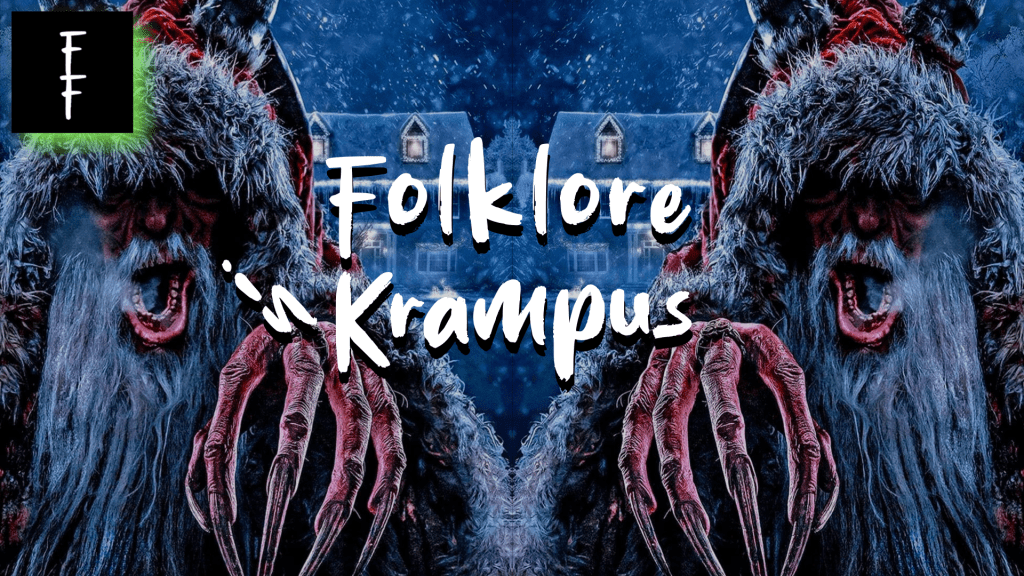
Pssst. You can watch a video adaptation of this essay right here. Text continues below.
Krampus (2015) = Christmas Vacation + Home Alone + Folklore
In 2015’s Krampus, the titular demon descends upon an unassuming neighborhood with many creepy companions in tow.
The film starts out as a somewhat earnest homage to National Lampoon’s Christmas Vacation, with Adam Scott stepping into the Chevy Chase/Clark Griswold role, Toni Collete taking on Beverly D’Angelo’s Ellen Griwold, and David Koechner putting in just a fantastic performance as an internet-era Randy Quaid/Cousin Eddie.
However, Krampus pretty quickly devolves into a chaotic holiday horror-comedy creature feature.
This movie doesn’t take itself too seriously, which was a good choice on the part of writer/director Michael Dougherty.
But it does have an emotional core, with Emjay Anthony playing the film’s young protagonist, Max, who kickstarts the plot by telling his family that he hates all of them.
So basically Krampus is Christmas Vacation meets Home Alone meets folklore.
And at its core, the film is rooted in Alpine folklore.
Specifically, the Krampus character comes from a tradition that seems to have originated in the alpine regions of what are now Austria and Germany.
And right off the birch rod, we’ve got a major problem with the film’s depiction of this folkloric figure:
The Krampus in Folklore
In Central and Eastern Europe, Saint Nicholas (a.k.a. Santa Claus) and the Krampus don’t show up on Christmas Eve; they instead come on St. Nicholas Day Eve:
December 5th.
Thus, the night of December 5th is also known as Krampusnacht:
To quote George H. McKnight’s 1917 book St. Nicholas: His Legend and His Rôle in the Christmas Celebration and Other Popular Customs:
“The function of St. Nicholas is a double one, to bring pleasing rewards to good children, but also to bring fear to children whose conduct has been bad…
“As a means of exciting fear in the ill-behaved children, the friendly bishop was often accompanied on his rounds by a children’s bugaboo, a frightful figure with horns, black face, fiery eyes, and long red tongue, variously called Klaubauf, Krampus, Rumpanz, and the like.”
This description aligns pretty closely with what we find in the story “Nicolo in Vienna,” which was published in a 1905 issue of the children’s magazine Chatterbox:
“Behind the kind Nicolo stands another gentleman, dressed in scarlet and black.
“He does not look either good or kind, and carries a number of birch-rods under his arm.
“On his back a large basket is strapped; it is made of wood instead of wicker, and is deep and large.
“This gentleman is the most terrible person in Austria [ummmm]—the much-dreaded ‘Krampus.’ [oh, right]
“Fearful stories are told of his dark deeds, and naughty children try to hide themselves when they see the Krampus.”
The birch-rods can be seen as equivalents to lumps of goal, only they come with an implied threat of violence as well.
The large wooden basket, of course, is designed specifically for the task of hauling away naughty children.
And to catch those children, the Krampus uses shiny bait.
As noted in O. M. Spencer’s article “Christmas throughout Christendom,” which was published in an 1873 issue of Harper’s Magazine:
“[T]he frightful Krampus, with his clanking chains and horrible devil’s mask, who, notwithstanding his gilded nuts and apples, gingerbread and toys, which he carries in his basket, is the terror of the nursery.”
I should also note that in some Krampus depictions, he’s got one human foot and one cloven hoof.
In other cases, two hooves.
And overall, appearance-wise, I’d say the film nails it.
No, not all of those aforementioned details are present, but the dude is sufficiently scary.
And he’s supposed to be scary.
The Etymology of Krampus
Those long claws are an especially nice touch given that the name Krampus might be derived from the German word krampen, meaning claw, but other Krampus etymologies have been proposed.
For example, in the Bavarian dialect there’s this word gramp, a pejorative reference to a naughty child, which in turn comes from the Middle High German krimpfen or grimpfen, meaning crooked.
There’s also the word grampen, from the Swiss dialect, meaning to snatch or grab.
Only, Switzerland doesn’t have the Krampus, does it?
Yes and no.
Krampus Clones: Schmutzli, Klaubauf, Bartel, Klapperbock
The Swiss version of Krampus is Schmutzli, a name that comes from the German word for dirt.
A reference to the creature’s dark face.
Following the Alps across Central Europe, we find a host of Krampus clones.
Not that we can be sure the Krampus is the original.
In fact, going by Clement A. Miles’ 1912 book Christmas In Ritual and Tradition, Christian and Pagan, Krampus is clearly just one of many regional names for the same Alpine figure.
In Tyrol, a region that covers parts of northern Italy and western Austria, Saint Nicholas is famously flanked by…
“ …the hideous Klaubauf, a shaggy monster with horns, black face, fiery eyes, long red tongue, and chains that clank as he moves.
“In Lower Austria the saint is followed by a similar figure called Krampus or Grampus;
“in Styria [in southeastern Austria,] this horrible attendant is named Bartel;
“all are no doubt related to such monsters as the Klapperbock.
“Their heathen origin is evident though it is difficult to trace their exact pedigree.”
The Klapperbock is an interesting reference here, because unlike the other examples, it’s more of a folkloric object or decoration than a folkloric figure—if that makes sense.
Found on the island of Usedom in the Baltic Sea, which is off the coasts of Germany and Poland, a Klapperbock consists of buckskin stretched over a pole with a ram’s head mounted at the end.
A rope is then passed through the jaws and down the throat of the ram’s head so the bearer of the Klapperbock can make the jaws rattle.
Lovely.
In Denmark, a similar symbol, which today is usually made of straw, goes by the name Julbock, the Yule buck-goat.
As Spencer explained back in 1873, these decorations are “unfailing accompaniment[s] of the Yule-time,” which are used to “threaten and frighten the children.”
A quick aside:
This sounds similar to the Welsh wassailing tradition known as Mari Lwyd. Only instead of ram or goat heads, you’ve got people carrying around horse heads.
FYI: Author Jennifer Lee Rossman wrote a short story about the Mari Lwyd, which you can find in my Celtic fantasy short story anthology Neon Druid.
The Krampuslauf or Krampus Run, it should be noted, typically consists of people dressed up as the Krampus.
They’re not parading around his head on poles.
So while there could be some connective tissue here, I think you’d probably have to go back to a Proto-Germanic mythology to find it.
Which we will do—later.
Right now, we must return to the matter at hoof:
The Krampus as he appears in Krampus.
Does the Krampus Film Accurately Reflect Krampus Folklore?
Traditionally, the Krampus and his equivalents always appear in conjunction with Jolly Old Saint Nick or Nicolo or whatever you want to call him.
The Krampus is a shadow, standing behind the Big Man.
He’s also The Muscle.
Prepared to do the dirty work that his boss, St. Nicholas, will not.
But in the film, St. Nicholas isn’t part of the equation at all.
He never physically appears.
Granted, there is a theory circulating that his face appears…as a mask being worn by the Krampus.
I mean, as we’ve already established, an 1873 issue of Harper’s magazine described the Krampus as wearing a “horrible devil’s mask.”
But I digress.
The absence of St. Nicholas or Santa in this film actually makes a lot of narrative sense.
Because this isn’t meant to be a typical St. Nick-visit with Krampus lurking in the background.
This is a special circumstance.
Something that only occurs every few generations:
The Krampus is let off-leash.
He’s allowed to step out from St. Nicholas’ shadow and into the spotlight.
The results…are terrifying.
Because at its core, The Krampus is St. Nicholas’s inverse.
He’s “Bizzaro Santa,” if you will.
Not warm and jolly but cold and angry.
And it turns out writer/director Michael Dougherty had already been interested in this Bizzaro Santa concept before learning about the existence of the Krampus in folklore.
To quote the man himself (via Bloody Disgusting):
“I’ve always wanted to do a creepy Christmas movie. It’s always been in the back of my mind.
“Then, I discovered Krampus in 2004 via the greeting cards.
All of the greeting cards that they used to send out in the 1800s/early 1900s started popping up online, and I just fell in love with it.
“The idea that there really was this dark, devilish Santa Claus-esque figure from European folklore, it was just irresistible.”
I think it’s noteworthy that in this interview, Dougherty doesn’t refer to Krampus as a figure from Austrian folklore, or German folklore, or even Alpine folklore, like I’ve been doing.
He goes broad:
European folklore.
And it’s clear from the film that he did indeed pull broadly from European folklore.
A Guide to the Krampus’s Companions: Yule Lads, Gingerbread Men, Perchta, Yule Goats
Know those little evil elf guys who appear in the film?
They are meant to be representations of the thirteen Jólasveinar or Yule Lads from Icelandic folklore.
Traditionally, each Yule lad arrives on a specific date leading up to Christmas and is associated with a specific prank, like stealing milk, licking your dishware, or slamming doors.
They don’t usually kidnap people though. Not anymore, anyway.
In the folk tales, the mother of the Yule Lads is the ogress Grýla, who notoriously lives in a cave where she cooks up naughty children in a big pot and eats them.
Moving on.
Gingerbread men date to 16th-century England.
Or at least that’s when they were first documented.
Queen Elizabeth I had her bakers create gingerbread biscuits in the shapes of important guests.
However, it’s in American folklore where we find the first tales of these cute little anthropomorphic cookies coming to life and making mischief.
The tale first appeared in print in 1875 under the title “The Gingerbread Boy,” which, appropriately, was featured in St. Nicholas Magazine.
In the American folktale, the cookie boy famously runs away from people, taunting them.
You can’t catch me.
It’s the opposite in the film, where we find a trio of gingerbread baddies—Lumpy, Dumpy, and Clumpy—doing the chasing.
But a huge tip of the hat to Michael Dougherty for having the dog gobble up the last surviving member of this cookie crew.
Because in the folktale, a fox famously devours the gingerbread man.
Now, for that creepy flying bird doll puppet cherub angel thing.
You know the one.
Her name is Perchta.
A name chosen very specifically because Perchta in Alpine folklore is a witch who performs a very Krampus-like function.
Between Christmas on December 25th and the Epiphany on January 6th, Perchta roams around the mountains of Austria and Bavaria and evaluates the productivity of the local children.
The hard workers get coins.
Slackers get ritually sacrificed.
Jeez, that’s kinda grim. Who’s my source on this?
Oh.
According to Jacob Grimm, Perchta is essentially a spinoff of the pre-Christian German figure Holda, as both oversee spinning and both are considered “guardians of the beasts.”
Perchta’s beasts are known as Perchten, and to this day there are folks in Austria and Bavaria who participate in the Perchtenlauf (Perchten Run), dressing as either Schönperchten, beautiful Perchten, or Schiachperchten, ugly Perchten.
Those ugly Perchten often have scary masks as well as protruding tusks, fangs, and/or horns.
Which leads me to…
The Yule Goats.
These big furry fellas show up toward the end of the film pulling Krampus’s sleigh.
And if you’re thinking to yourself, wait a minute…
Yule Goat…
That’s the Jolbock!
Correct.
It’s the Yuletide symbol Clement A. Miles connected to the Klapperbock and ultimately the Krampus.
The Pagan Origins of St. Nicholas?
Granted, it’s possible the Yule Goat actually arose in Norse mythology, as two goats—Tanngnjóstr (teeth-grinder) and Tanngrisnir (teeth barer)—famouly pull Thor’s chariot.
Meanwhile, you’ve got Thor’s dad Odin a.k.a. Jólnir, the Jule one, cruising around on an eight-legged horse, Sleipnir.
Suddenly, a lot of St. Nicholas’s attributes seem to be rooted in traditions that are older than the historical saint.
In fact, we know that the story about the three dowries—in which St. Nicholas famously tosses some coins into some stockings—has a parallel in the earlier Life of Apollonius, which concerns itself with the wonderworkings of a first-century CE Neopythagorean philosopher.
As historian Jona Lendering explained:
“It is not unusual that a Christian saint adorns himself with stories that belonged to the pagan cults.”
Maybe stories of the Germanic Perchta helped round out St. Nicholas’s Yuletide character, as someone who both rewards and punishes children come midwinter?
The Pagan Origins of Krampus?
As for the Krampus, ancient pagan traditions are rife with horned beings, many of whom were—and in some cases still are—worshipped as gods.
The most notable being the Gaulish-Celtic Cernunnos.
There’s also the Greek Pan, of course.
And the Hindu Pashupati.
And given that the German, Celtic, Greek, and Hindi languages all branched off from Proto-Indo-European, it’s possible that the Krampus is related to all of these other horned figures.
Of course, as Christianity spread across Europe, horned deities were quite literally demonized.
Starting in the Middle Ages, Satan, a.k.a the Devil, is depicted with horns.
Krampus lore no doubt evolved in response to this.
Whatever his role was in the ancient paganism of the European Alps, it was adapted to fit the new religious system.
Whereas horned gods like Cernunnos, Pan, and Pashupati were traditionally associated with the wilderness and fertility, the Krampus has shed any such associations and is now only remembered as a bogeyman.
A beast who is hidden away in the shadow of St. Nicholas.
Unless, of course, he’s starring in a film.
Thanks for reading.
Fan of folk horror?
You might be interested in my short film Samhain, available over on the Irish Myths channel.
More the reading type?
Check out…
Neon Druid: An Anthology of Urban Celtic Fantasy
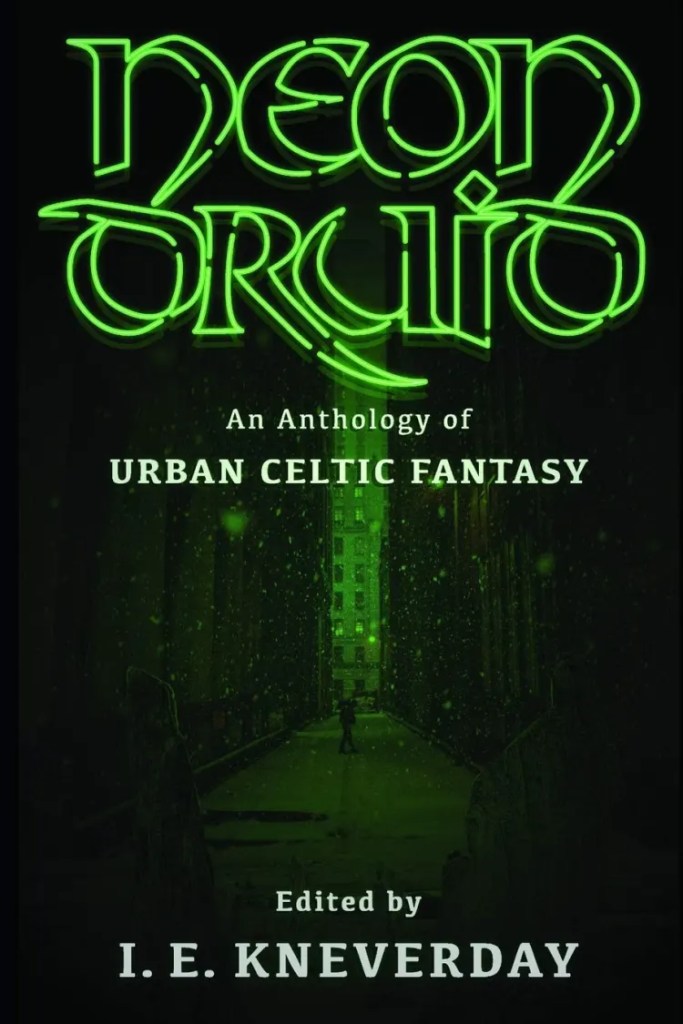
“A thrilling romp through pubs, mythology, and alleyways. NEON DRUID is such a fun, pulpy anthology of stories that embody Celtic fantasy and myth,” (Pyles of Books). Cross over into a world where the mischievous gods, goddesses, monsters, and heroes of Celtic mythology live among us, intermingling with unsuspecting mortals and stirring up mayhem in cities and towns on both sides of the Atlantic, from Limerick and Edinburgh to Montreal and Boston. Learn more…
 Folklore in Film
Leave a comment