
Folklore in Film is reader-supported. When you buy through links on our site, we may earn a small affiliate commission.
Watch till the end of Robert Eggers’ The Witch, and you’ll be treated to a block of text that reads, in part:
“This film was inspired by many folktales, fairytales, and written accounts of historical witchcraft…”
To which I say…
Oh, really?
Which ones?
Which folktales, fairytales, and other accounts specifically inspired 2015’s The Witch?
The answer:
These ones.
The ones in this book.
I’m I. E. Kneverday, let’s take a look.
Pssst. You can watch a video adaptation of this essay right here. Text continues below.
The Salem Witch Trials (1692-93)
First published in 1884, A Book of New England Legends and Folk Lore in Prose and Poetry by Samuel Adams Drake is the holy bible of New England folklore.
Especially New England folklore from before the American Revolution.
For those familiar with this period of history, it should come as no surprise that this book is full of witches.
The Salem witch trials of 1692 and 1693—during which hundreds of alleged witches and wizards were imprisoned and twenty were executed—rightfully gets a lot of attention.
Drake reiterates in his book that while the Salem trials were a tragedy, the existence of witches was widely accepted as fact throughout the 17th century—at least among the English.
“Had the conviction that witches existed not been universal, public sentiment would never have countenanced the executions that took place in New England…
“Indeed, the most exalted personages in Church and State yielded full credence to all those marvels, the bare mention of which now calls up a smile of incredulity or of pity. New England was the child of a superstitious mother.”
Back then, witches weren’t seen as conceptual representations of evil, but as physical actors—in league with Satan—who interfered with people’s everyday lives, either directly or through the help of agents (more on those later).
Eggers has made those beliefs a reality in this film.
When Is The VVitch Set? (1630s)
The world of The VVitch is a dark reflection of New England in the early 17th century—the 1630s to be precise.
Putting our main characters smack-dab in the middle of the Great Puritan Migration, the peak of which lasted from 1629-1640.
So this family is setting up shop in the deep woods of New England only a few years after Salem is even settled (in 1626).
For context, the Massachusetts Bay Colony was founded in 1628.
And if you’re wondering how the Pilgrims and the Mayflower and Plymouth fit into this timeline, that was in 1620.
All this to say:
The VVitch is set during a liminal time.
A time when New England’s European population is just starting to boom (Salem will grow from a community of dozens to a community of hundreds in the 1630s) buuut the majority of the land is still considered wild.
Clearly what Eggers is going for here is this primordial or foundational New England witch folk tale, hence the film’s subtitle (A New-England Folktale).
Or as the man himself phrased it in an interview with Criterion:
“I thought that I could make an archetypal New England horror story.”
I’d say he succeeded.
But to do it, he needed Drake’s book.
Not to copy it.
But to draw inspiration from it.
The Tragical Story of Urbain Grandier (1634)
For example, there could be another reason Eggers set The VVitch in the 1630s:
Because he read about Urbain Grandier, the French priest-turned-alleged sorcerer, who was burnt alive in 1634.
Here’s Drake comparing the episode to the Salem trials that are to come later:
“The tragical story of Urbain Grandier develops the same characteristics. His popularity as a preacher having excited the envy of the monks, they instigated some nuns to play the part of persons possessed, and in their convulsions to charge Grandier with being the cause of their evil visitation. This horrible though absurd charge was sanctioned by Cardinal Richelieu on grounds of personal dislike. Grandier was tried, condemned, and burnt alive, April 18, 1634, more than half a century earlier than the proceedings occurring at Salem.”
Okay, now I’m wondering:
What if the witch, as in the film’s main witchy woman in the woods, is actually someone from the village who followed Ralph Ineson’s William and his family to torment them for their insubordination?
It’s a stretch.
Regardless, the kernel of The VVitch’s inciting incident is still there:
A dispute amongst the ranks of a devoutly religious group.
A man removed from that group.
We’ve also got possessions.
We’ve got convulsions.
But believe me, that’s just the tip of the witch’s hat.
Time to Make the Magical Flying Ointment
In Drake’s summary of how people thought about witchcraft in 17th-century New England, we can find the building blocks of writer/director Robert Eggers’s world and the worldview of his characters.
To quote Drake:
“Witches, according to popular belief, had the power to ride at will through the air on a broomstick or a spit, to attend distant meetings or sabbaths of witches ; but for this purpose they must first have anointed themselves with a certain magical ointment given to them by the Fiend.
“This is neither more nor less than what our forefathers believed, what was solemnly incorporated into the laws of the land, and what was as solemnly preached from the pulpit. A perusal of the witchcraft examinations shows us how familiar even children of a tender age were with all the forms of this most formidable and fatal, but yet not unaccountable, superstition.”
Almost all of this shows up in The VVitch in one way or another.
Eggers’s story is essentially bookended by a witch making the aforementioned magic flying-ointment and a whole coven of witches enjoying some ointment together during a… let’s call it a business meeting.
Kids Say the Darndest Things: VVitch Edition
Ellie Grainger’s Mercy, who I think qualifies as being of “a tender age,” certainly utilizes her knowledge of witch lore to frightening effect in the film when she intones:
“I be The Witch of the Wood. I have come to steal ye! Hear me stick a-flying through the trees: clickety-clackety-clicketyclakety!”
But of course Mercy’s older sister, Anya Taylor-Joy’s Thomasin, outpranks the prankster when she declares herself the witch who stole their baby brother Samuel.
“Twas I what stole him. I’m the witch of the wood. I am that very witch. When I sleep my spirit slips away from my body and dances naked with The Devil. That’s how I signed his book…
“He bade me bring him an unbaptized babe, and I stole Sam, and I gave him to my master. And I’ll make any man or thing else vanish I like…
“And I’ll vanish thee too if thou displeaseth me…
“Or perchance I’ll boil and bake thee since we are lack of food…
“How I crave to sink my teeth into thy pink flesh…
“I’ll make thee afraid before I have done with thee!…
“If ever thou tellst thy mother of this, I will witch thee and thy mother! And Jonas too!”
Ummm is it just me or does Thomasin know a witch-ton about witches?
But again, that’s historically accurate.
Witch Familiars: Animal Friends With Benefits
Given her knowledge of witch lore, it’s likely Thomasin wouldn’t have been too surprised to see a witch subcontracting her scares to hares and ravens (scared, yes, but not surprised).
To be fair, I did not not find a hare in Drake’s book.
But I did find two passages that deal with witches taking the forms of various animals (or possessing said animals, it’s not really specified) in order to spy or send messages.
And I quote:
“In the course of those remarkable trials at Salem, several of the accused persons, in order to save their lives, confessed to having signed their names in the Devil’s book, to having been baptized by him, and to having attended midnight meetings of witches, or sacraments held upon the green near the minister’s house, to which they came riding through the air. They admitted that he had sometimes appeared to them in the form of a black dog or cat, sometimes in that of a horse… “[I]t was in the orchard here that the alleged midnight convocations of witches met to celebrate their unholy sacraments, and to renew their solemn league and covenant with Satan, in draughts of blood, by partaking of the Devil’s bread, and by inscribing their names in his fatal book.”
So we’ve got a book-signing scene in The VVitch, of course.
The orchard reference here is interesting given the role apples end up playing in the film.
The draughts of blood and Devil’s bread references are a bit more… on the nose.
And as for the animal appearances, we’ve got ourselves an alleged wizard appearing to a bunch of alleged witches as a black dog (remember that for later), a cat, and a horse.
Meanwhile, the second and arguably more intriguing passage on that subject describes a sort of adopt-a-demonic-pet program, enrolling in which was apparently part of the process if one wanted to become a witch or wizard in 17th-century New England.
To quote Drake:
“The fatal compact was consummated by the victim registering his or her name in a book or upon a scroll of parchment, and with his own blood… The bargain being concluded, Satan delivered to his new recruit an imp or familiar spirit, which sometimes had the form of a cat, at others of a mole, of a bird, of a miller-fly, or of some other insect or animal. These were to come at call, do such mischief as they should be commanded, and at stated times be permitted to suck the wizard’s blood. Feeding, suckling, or re-warding these imps was by the law of England declared Felony.”
This passage makes me think immediately of the scene where Harvey Scrimshaw’s Caleb is in bed and starts rattling off animal names:
“A toad. A cat. A crow. A raven. A great black dog. A wolf… She desires of my blood. She sends ‘em upon me. They feed upon her teats, her nether parts. She sends ‘em upon me.”
And lookie what we have here: a “black dog” just like in the passage from earlier.
And a cat—color unspecified, same as before and in the passage we just looked at.
Birds we’ve got covered too: a crow, a raven.
And the feeding part, although it’s not exactly the same.
Look, I’m not saying Eggers copied this.
I just think he read this book, these passages in particular, and it helped inspire his story.
And I think that’s cool…because I’m a huge nerd.
What’s My Prayer Again?
Okay, more evidence.
Remember when the twins “forget” the words to their prayers?
A variation of that also appears in Drake’s book:
“It was generally held to be impossible for a witch to say the Lord’s Prayer correctly ; and it is a matter of record that one woman, while under examination, was put to this test, when it was noticed that in one place she substituted some words of her own for those of the prayer. Such a failure of memory was considered, even by some learned judges, as a decisive proof of guilt.”
No, not the same thing, but similar.
And the deeper we go down the rabbit hole, the more…uh… carrots we find
The Case of Mistress Ann Hibbins
One of those carrots being The Case of Mistress Ann Hibbins from 1656.
This tale of witchcraft accusations appears under Drake’s section on Boston Legends, and it includes the following gem of a line:
“[T]he notion of a witch was like that of a serpent in the house whose sting is mortal.”
What does that remind me of?
Right, when William is grilling his daughter Thomasin:
“I saw The Serpent in my son. You stopped their prayer Thomasin.”
Okay, yes, I’m getting hung up on the word serpent.
But then there’s this line from a little later in that same retelling of the 1656 account.
“No wife or mother believed herself or her infant for one moment safe from the witch’s detestable arts, since she might take any form she pleased to afflict them.”
The Witch of Hampton, Goody Cole
Also in 1656, the good wife Eunice Cole a.k.a. Goody Cole of Hampton, New Hampshire was formally accused of witchcraft for the first time.
To quote Drake:
“The witch of Hampton, was for a quarter of a century or more the terror of the people of that town, who believed her to have sold herself body and soul to the Devil. Whom we hate we also fear. The bare mention of her name would, it is said, hush crying children into silence, or hurry truant boys to school. Although she was repeatedly thrown into prison, she was yet unaccountably suffered to continue to live the life of an outcast, until death finally freed the community from their fears.
“Goody Cole lived alone in a hovel… and in this wretched hut, without a friend to soothe her last moments, she miserably died… [S]uch was the fear her supposed powers had inspired, that it required a great deal of courage on the part of the inhabitants to force an entrance into her cabin, where she lay dead. When this had been done, the body was dragged outside, a hole hastily dug, into which it was tumbled, and then — conformably with current superstition — a stake was driven through it, in order to exorcise the baleful influence she was supposed to have possessed.”
Yikes.
Goody Cole’s influence would indeed persist for centuries after her demise thanks in part to poet John Greenleaf Whittier’s 1864 ballad The Wreck of Rivermouth —an excerpt of which is included in Drake’s book.
Here’s a taste:
“Fie on the witch!” cried a merry girl,
As they rounded the point where Goody Cole
Sat by her door with her wheel atwirl,
A bent and blear-eyed poor old soul.
[…]
“She’s cursed,” said the skipper; “speak her fair:
I’m scary always to see her shake
Her wicked head, with its wild gray hair,
And nose like a hawk, and eyes like a snake.”
Okay, admittedly this one’s more about vibes.
Just a solid example of an archetypal New England witch—the type of character Eggers set out to create.
She lives away from the community.
She’s got her little witch hut.
And while Whittier turns her into a storm-conjuring supervillain in his poem two centuries after the fact, it’s clear from Drake’s account that at the time, Hampton residents believed Goody Cole was literally in league with Satan.
They genuinely feared her.
Hence, the staking.
Old Mammy Redd of Marblehead
Of all the witch-filled tales showcased in A Book of New England Legends and Folk Lore, the one that seems to have most directly inspired Eggers’s film The Witch concerns a one Mrs. Old Mammy Redd of Marblehead, Massachusetts.
A witch so renowned that she has her own nursery rhyme:
Old Mammy Redd,
Of Marblehead,
Sweet milk could turn
To mould in churn.
Wait a minute.
You’re saying we’ve got a New England witch messing with the milk supply?
Drake elaborates that Old Mammy Redd could “curdle it as it came fresh from the cow’s udders, or could presently change it into ” blue wool,” which we take to be another name for blue mould.”
And while Eggers doesn’t go the mould route in his film, it’s possible this passage helped inspire the scene with Thomasin and the goat.
You know the one.
But to be sure, the story of Old Mammy Redd is about more than milk.
To quote Drake:
“The witch of Marblehead was an old crone by the name of Wilmot Redd (or Reed), but more generally known and feared as ” Mammy Redd, the witch.” This woman was believed to possess the power of malignant touch and sight, and she was able, so it was whispered, to cast a spell over those whom she might in her malevolence wish to injure. To some she sent sickness and death, merely wishing that a ” bloody cleaver ” might be found in the cradle of their infant children. Upon others she vented her spite by visiting them with such petty annoyances as occur.”
And that, my dear readers, is our witch.
Or what I mean is, I think Old Mammy Redd was one of the primary inspirations for Eggers’ creation.
The malignant touch, casting a spell that results in sickness and death, a bloody cleaver in an infant’s cradle.
Not to mention the creepy milk thing.
These powers and this imagery—is it coincidence that we can roughly map them over to the plot of The VVitch?
I mean, maybe.
The other explanation?
Eggers read this book.
And I’ll link it here if you want to read it as well: A Book of New England Legends and Folk Lore.
It’s pretty good.
Although admittedly I am a bit biased because I’m a witch.
I mean I’m from Massachusetts.
Thanks for reading.
Fan of folk horror?
You might be interested in my short film Samhain, available over on the Irish Myths channel.
More the reading type?
Check out…
Neon Druid: An Anthology of Urban Celtic Fantasy
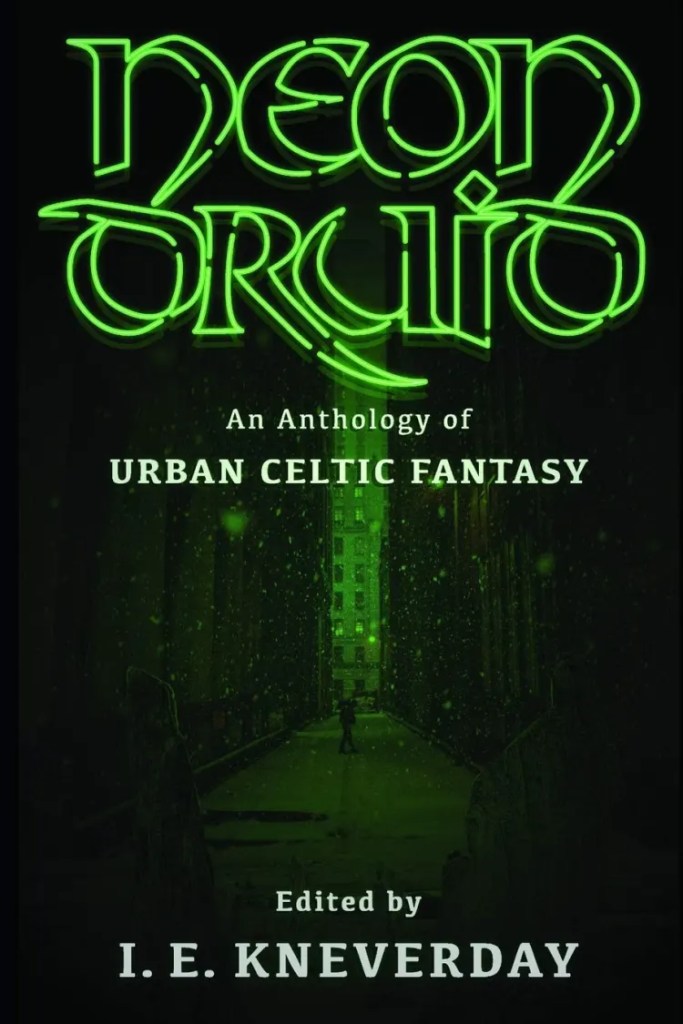
“A thrilling romp through pubs, mythology, and alleyways. NEON DRUID is such a fun, pulpy anthology of stories that embody Celtic fantasy and myth,” (Pyles of Books). Cross over into a world where the mischievous gods, goddesses, monsters, and heroes of Celtic mythology live among us, intermingling with unsuspecting mortals and stirring up mayhem in cities and towns on both sides of the Atlantic, from Limerick and Edinburgh to Montreal and Boston. Learn more…
 Folklore in Film
Leave a comment