
Folklore in Film is reader-supported. When you buy through links on our site, we may earn a small affiliate commission.
Sinners has a secret.
It’s hinted at in the opening crawl.
And as the keen-eared among you know, it is later revealed in the song choices made by writer-director Ryan Coogler.
But before we go any further:
Spoilers, obviously.
Watch a video adaptation of this essay right here. Text continues below.
Abhartach: The Irish Vampire at the Center of Sinners
So here it is:
Jack O’Connell’s Remmick, the film’s vampire-in-chief, is Abhartach from Irish folklore or, more likely, one of his vampiric descendants.
As I explored in a video/essay over on my Irish Myths YouTube channel, Abhartach is a feared chieftain and neamh-mairbh (“non-dead”), who demands blood sacrifices from his subjects and who can only be stopped by way of wooden sword-stabbing followed by an upside-down burial.
Depending on the telling, it is either a wise old druid or a wise old priest who prescribes this remedy, but ultimately, it is a local hero or sometimes the national hero Fionn mac Cumhaill (more on him later) who delivers the final blow.
If this sounds a bit like the novel Dracula, where Transylvanian peasants live in fear of a powerful count who can only be stopped with the help of the wise old Van Helsing…that makes sense.
Because Abhartach was an inspiration for Dracula.
Vlad the Impaler always gets all the credit, but remember, Bram Stoker was Irish.
And he frequented the family home of Oscar Wilde, where Lady Wilde, Oscar’s mom, would tell folk stories and that’s likely where Stoker learned about Abhartach.
I’m assuming Coogler knew that (or at least knew about Stoker being Irish), which is why he created an in-movie-universe newspaper clipping from 1911 (it’s a Spotify easter egg thing) that tells of an “immigrant ship” the Celtic Hare arriving in Boston Harbor with only one survivor who immediately flees the scene.

This is obviously meant to be part of Remmick’s backstory, but it’s also an obvious allusion to Stoker’s novel Dracula, specifically the last voyage of the Demeter bit, which got its own dedicated horror film in 2023.
And I’d be remiss not to mention that in 2020, Abhartach, the (non-dead) man himself, got his own film: Boys From County Hell, which tops my list of the best Irish horror films.
More Than a Bard: What Is a Filí?
Remmick is either Abhartach or, perhaps this is an even better fit, he’s Abhartach’s bard. A filí.
Remember the film’s opener:
“There are legends of people born with the gift of making music so true
it can pierce the veil between life and death,
conjuring spirits from the past and the future.
In ancient Ireland, they were called Filí.”
Now, is this a textbook definition of filí? Of course not.
Going with a straight translation, Ó Dónaill’s 1977 Irish-English dictionary interprets file firstly as a poet, song-maker, or lyricist, and secondly as a satirist or scold.
And if you’re wondering why Coogler didn’t use the more familiar term “bard,” which colloquially means the same thing as “filí,” the answer is…history.
Anciently and even into Medieval times, the filid were an elite class of poet, who studied for years, becoming masters of their craft.
After the arrival of Christianity, secular schools continued to train a limited number of filid, as well as senachidhe historians) and brehons (judges).
This according to Hugh Graham’s 1923 book The Early Irish Monastic Schools.
Of course, the more pertinent part of filí lore is that these prestigious poets were also believed to be seers and diviners, akin to vates or ovates.
Indeed, the etymology of filí reveals a connection to the Proto-Celtic word *welīts, meaning “seer” or “one who sees.”
What’s more, in Irish legend there is an “incantation of divination” attributed to the filid called the teinm laída, which translates to something like “opening the pith” or “breaking the marrow.”
The hero Fionn mac Cumhaill famously employs this incantation while chewing on his thumb (it’s a whole thing), thus supplying himself with hidden or prophetic knowledge.
But when Saint Patrick comes along, the Apostle of Ireland proclaims that teinm laída is akin to “giving offerings to demons,” and thus he bans the practice.
This sounds a bit like the vampire hive-mind in Sinners, no?
One bite, and you gain all of the knowledge of everyone who’s been bitten before you.
And at the risk of sounding pedantic, this is obviously an allegory for oral storytelling traditions, i.e., memorizing important cultural stories and songs so you can recite them around the fire (or wherever) for the benefit of your community.
Oral Storytellers Across (Colonized) Cultures: Filid, Firekeepers, and Griots
To bring it back to the opening crawl:
“In ancient Ireland, they were called Filí.
In Choctaw land, they call them Firekeepers.
And in West Africa, they’re called Griots.
This gift can bring healing to their communities, but it also attracts evil.”
To be clear, the “gift” Coogler is referring to here is music-making.
But like the Irish filid, Choctaw firekeepers and West African griots were more than just tribal jukeboxes.
(It’s actually unclear if the filid and firekeepers sang at all. But I digress.)
Historically, in Choctaw land, a firekeeper literally kept the fire.
And as the Mississippi Choctaw explained, this was easier said than done, because in order to cook hominy, a traditional dish, the firekeeper had to maintain a consistent cooking temperature for hours on end.
There was also a ritual component, as noted in this dissertation published at the University of New Mexico:
“[T]here used to be different clans and they would have their own fire, and the clans…had a
fire keeper and the fire keeper would take the fire along with them to the big old
festival…[they] brought in their fire, built a big old fire [joining all the clan fires into One].”
Holy hive mind.
It makes a lot more sense to me now why Remmick had been on Choctaw land.
He’d likely been trying to convert, or infect, a firekeeper—so that he could tap into their huge well of cultural wisdom.
And Remmick is driven by this same motivation when he visits the sawmill-turned-juke joint operated by brothers Smoke and Stack, both played by Michael B. Jordan.
Only instead of being after a firekeeper, Remmick has now set his sights on a griot.
Yes, the implication here is that blues guitar prodigy Sammie Moore, played (primarily) by Miles Caton, is an incarnation of a West African troubadour-historian known as a griot.
Griots, who famously play stringed instruments, were traditionally responsible for preserving important stories and genealogies, and they also performed praise songs.
However, the common thread amongst the filid, firekeepers, and griots isn’t just oral storytelling and the preservation of cultural knowledge, it’s also doing those things in the presence of colonialism.
All three groups, the Irish, the Choctaw, and West Africans had to, at various times in their histories, deal with the British Empire, which had a nasty habit of destroying indigenous culture.
A quick aside: most of the Choctaw sided with the Americans during the American Revolution, but the formation of the United States obviously didn’t put an end to…you know, all the racism.
The Choctaw were forced off their ancestral lands during the Trail of Tears.
Many West Africans and their descendants were enslaved and were then subject to Jim Crow.
And following the Great Hunger in Ireland, the Irish immigrants who came to the States weren’t exactly welcomed with open arms.
The Name “Remmick” Explained: Insult, Pseudonym, or Something More?
And that leads us to why Remmick is called Remmick in the first place.
Because that certainly isn’t an Irish name.
It’s probably German in origin.
And it’s possible Coogler chose it as a joke, since within it we can find a derogatory term for an Irish person (Remmick);
That being said, it does make sense that someone coming from Ireland to the U.S. pre-1932 (when the film is set), especially someone seeking to influence large swaths of people, would adopt a name that is perhaps more palatable to nativist ears.
So whether he was originally called Abhartach or Ó Raghallaigh, the point here is that Remmick has assimilated.
He’s fully embraced and is taking advantage of his White American identity, something that our protagonists Smoke, Stack, and Sammie will never be able to do.
And to his credit, I guess, Remmick acknowledges this injustice, pitching his vampire horde as a sort of racial utopia.
And Remmick’s song choices allude to his dream of “fellowship and love.”
The Significance of “Pick Poor Robin Clean” in Sinners
“Pick Poor Robin Clean” caps off each chorus with:
“And I’ll be satisfied having a family.”
Granted, this follows a slew of more evocative (provocative?) lyrics.
You might be surprised to learn that “Pick Poor Robin Clean” started out as a blues song. It was first recorded in 1927 by Luke Jordan.
Oh, right, and in that 1927 version, the chorus-ending line isn’t:
“And I’ll be satisfied having a family,” it’s:
“And I’ll be satisfied having your family.”
So the version we hear in Sinners is deliberately super hokey.
And when you put that song choice and that hokiness together, what you get is a scene where Remmick the Irish filí is showing off.
Showing off that he’s learned a blues song. Which maybe implies he’s feasted on a blues musician before?
But also showing off how he can take Black music and adapt it—some might say appropriate it—to fit the dominant white American culture.
To quote Delta Slim, played by Delroy Lindo:
“[W]hite folks, they like the blues just fine. They just don’t like the people who make it.”
At the end of the day, the vampires in Sinners are cultural appropriation monsters.
Think about it: they’re not out for blood, they’re out for cultural knowledge.
Remmick even admits to Sammie in the third act:
“I want your stories. And I want your songs. And you gon’ have mine.”
This kind of sounds good, on its face, like, “hey I love your stuff so much, let’s swap stories, let’s trade songs.”
But remember, Remmick isn’t giving people a choice here.
He doesn’t care if you don’t want to give him your stories and songs, he’s just gonna take them.
And he doesn’t care if you’re not interested in his stories and songs, he’s still gonna make you sing ‘em.
The Significance of “Will Ye Go, Lassie Go? / Wild Mountain Thyme” in Sinners
Like how he has Joan and Bert accompany him on “Will Ye Go, Lassie Go?,” otherwise known as “Wild Mountain Thyme.”
Take it from me, a washed up pub musician, this song is a classic of the Irish folk music genre…
…despite it being an obvious variant of an older, Scottish song, “The Braes of Balquhither.”
Assuming Coogler knew about “Will Ye Go, Lassie Go?”’s origin, we can assume Remmick knew as well, making the song choice all the more meaningful.
Because while Remmick’s crooning:
Will you go, lassie, will you go?
And we’ll all go together
To pull wild mountain thyme
He’s singing a stolen song.
Although stolen’s probably the wrong word here.
Francis McPeake I, born in Belfast in 1885, crafted the Irish version of the Scottish song.
McPeake was a renowned Uilleann pipe player.
And some might say he was a modern-day filí.
So here’s my new theory:
McPeake III was actually McPeake II and before that McPeake I.
He was doing that trick immortal beings always do where they keep adopting the identities of their hypothetical descendants.
Anyway, the McPeake family was based in Belfast. The Abhartach story comes from the outskirts of Derry. We’re in the same province at least, Ulster.
So the thing tells itself. Remmick was originally a McPeake who served the chieftain Abhartach as filí, then he got turned and became devoted to the cause of sucking up everyone’s culture.
Am I reaching? Of course I’m reaching.
But as long as we’re going down this rabbit hole, let’s do a quick date check.
How Old Is the Vampire Remmick in Sinners?
In the film, Remmick hears the opening of the Lord’s prayer and responds:
“Long ago, the men who stole my father’s land forced these words upon us. I hated those men, but the words still bring me comfort.”
So we’re talking about the arrival of Christianity in Ireland. But that doesn’t necessarily mean the 5th century when Palladius and Patrick showed up.
Conversion was a gradual process, stretching over centuries.
In an interview with GamesRadar+, actor Jack O’Connell said:
“Remmick has…600-700 years worth of heritage, just by nature of being a vampire.”
Okay, so Sinners is set in 1932, so if we subtract 600, we’re in the year 1332; subtract 700, we’re in the year 1232.
And what was happening in Ireland around that time?
Welp, a few decades earlier, Pope Adrian IV had given the King of England, Henry II, the go-ahead to invade Ireland, kicking off some eight hundred years of British rule.
A wrinkle in the idea that Remmick is a victim of this conflict is that he most likely wouldn’t have heard the Lord’s Prayer spoken in English back in the 12th or 13th century. Everything was in Latin.
The Church of England hadn’t even been founded yet.
So going with a strict interpretation of the dialogue, the words that were forced upon Remmick and his people, the words that still bring him comfort, were spoken in English, perhaps during the Cromwellian conquest of Ireland, which began in 1649.
That would make Remmick more akin to a figure like Nicholas French, the Irish activist, bishop, and pamphleteer who fled Ireland for continental Europe in 1651. Who knows where he went after that…assuming he was a vampire.
Am I overthinking everything again? That’s what I do here.
Which brings me to the coins.
The Gold Coins in Sinners Explained: Spanish Doubloons or Celtic?
Doesn’t it seem like in modern media, any Irish character with any supernatural leanings whatsoever can just—poof—produce gold coins?
There’s a technical term for this, it’s called leprechaunification.
But to be fair, Coogler includes the coins more as just a wink and a nod.
There’s no rainbow, or pot of gold, or leprechaun. Or is there? We’ll get into it.
And that scene with Hailee Steinfeld’s Mary does help establish that whatever era Remmick is from, it’s not a recent one.
To quote Remmick, talking about his money:
“It’s from a different place and a different time. But it spends just the same.”
Now, I’ve analyzed these gold coins and have concluded that they could be Spanish doubloons. Or they could be from ancient Celtic Gaul. Or ancient Celtic Britain.
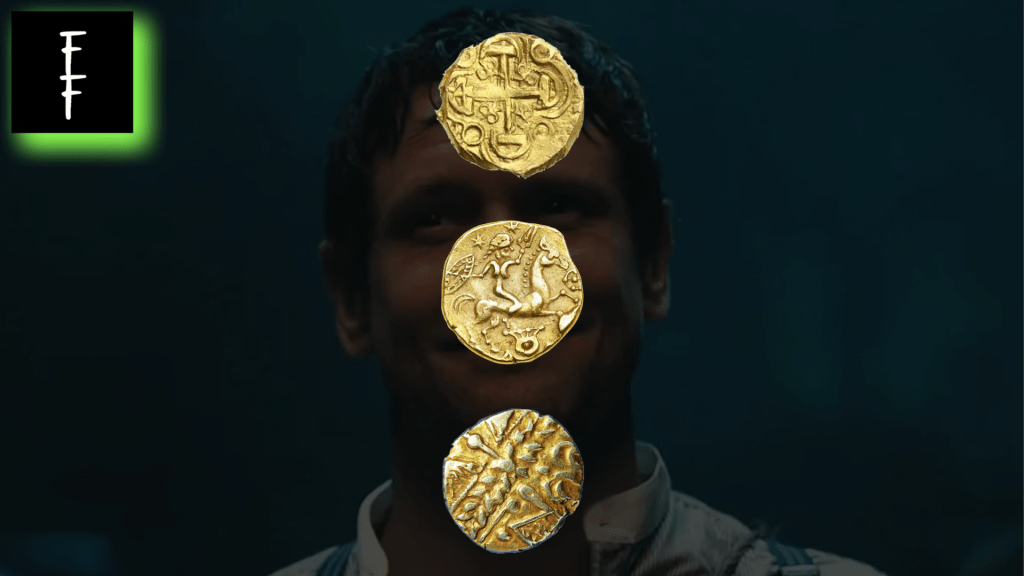
What I am 100% sure of is that they are prop coins.
And as a plot device, the gold is meant to distract Mary from the obvious creepiness of Remmick, Joan, and Bert.
It’s a test, in a way: will you silence your inner alarm bells in pursuit of money?
And maybe it’s a test for the audience as well—and for nerdy YouTube creators.
Will we get hung up on the significance of the coins, while overlooking the actual message of the film?
Not this guy.
The Significance of “Rocky Road to Dublin” in Sinners
And that brings us to “Rocky Road to Dublin,” the third song Remmick performs, now with a whole Riverdance’s worth of backup. (And yes I know Michael Flatley is an American born to parents from Ireland, I know).
“Rocky Road to Dublin” is quintessentially Irish. It was written in the 19th century by Irish poet D. K. Gavan. It’s in the style of a slip jig, so it’s in 9/8 time—nine beats per measure and the eighth note gets one beat.
And the lyrics are just perfectly suited to Remmick’s story. The song’s narrator has left his home in County Galway. He’s off to seek his fortune. But he also knows there’s a non-zero chance he could encounter ghosts and goblins along the way.
In the film, they skip over the whole middle part of the song when he’s actually in Dublin and we catch up with our narrator in Liverpool, England, where the locals label him a fool and his blood begins to boil.
Then those dastardly Liverpudlians talk some smack about Ireland itself, and the narrator starts swinging his shillelagh.
This is actually a case of Chekhov’s shillelagh because in the opening verse the narrator cuts a stout blackthorn for banishing the ghosts and goblins, which is how shillelaghs are traditionally made.
Anyway, dude is definitely getting his arse kicked when who should come to his rescue, but his own people: Irish fellas from County Galway. And together they quickly clear the way.
This is what makes Remmick such a compelling antagonist.
He understands, first-hand, what it means to be colonized. What it means to be othered. And by singing “Rocky Road to Dublin,” he’s acknowledging the strength that comes from banding together with your people.
Only now Remmick has a new people: his vampire horde.
And together they’re sucking up everyone’s culture and effectively creating one big monoculture.
Although Remmick would probably argue that they’re simply reuniting cultures. That there’s always been a monomyth connecting human beings.
And that if you go back far enough, and search deeply enough, you’ll find narratives from across the globe that are interwoven…
One Final, Little Theory: Did Abhartach Become the Kowi Anukasha?
And you’ll find figures like the Kowi Anukasha, the little people of Choctaw folklore.
Not only are the diminutive Kowi Anukasha believed to be dangerous magic-wielders, but they’re also known to bestow their powers upon deserving humans.
Which reminds me, did you know the name Abhartach comes from the Irish word for dwarf?
Yep, the assumption has always been that Abhartach the Irish “magician and dreadful tyrant” is a little person.
So maybe my Remmick-as-Abhartach theory isn’t so off-base.
Maybe Abhartach the little vampire escaped his captors, boarded a ship, and made his new home on Choctaw land. And over the years, the Choctaw people encountered him in his original, diminutive form.
Then when the Choctaw were finally able to expel him from their land, Abhartach adopted a new, taller form, and became Remmick.
But what do you think?
Are any of these theories ringing true for you?
Is there other lore hidden in Sinners that I missed?
Let me know in the comments below.
Thanks for reading.
Fan of Irish folklore?
You might be interested in…
Neon Druid: An Anthology of Urban Celtic Fantasy
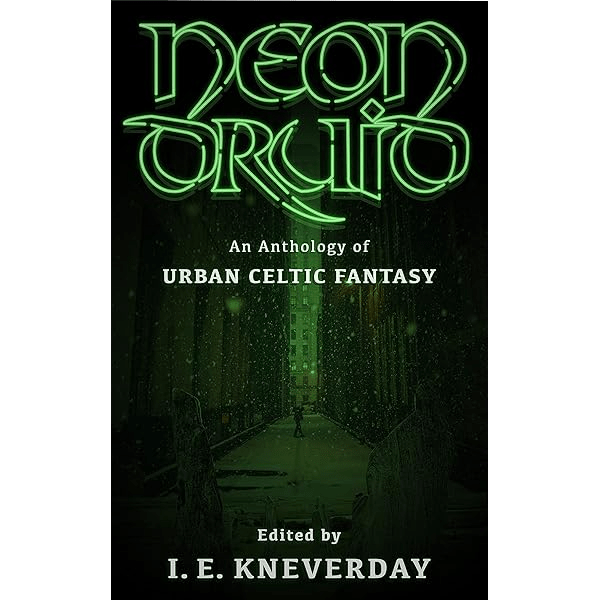
“A thrilling romp through pubs, mythology, and alleyways. NEON DRUID is such a fun, pulpy anthology of stories that embody Celtic fantasy and myth,” (Pyles of Books). Cross over into a world where the mischievous gods, goddesses, monsters, and heroes of Celtic mythology live among us, intermingling with unsuspecting mortals and stirring up mayhem in cities and towns on both sides of the Atlantic, from Limerick and Edinburgh to Montreal and Boston. Learn more…
 Folklore in Film
Leave a comment