
Folklore in Film is reader-supported. When you buy through links on our site, we may earn a small affiliate commission.
“The bear is a very important symbol in Norse mythology and in Scandinavian folklore.”
That’s a direct quote from Ari Aster, writer and director of the Sweden-set folk horror masterpiece Midsommar.
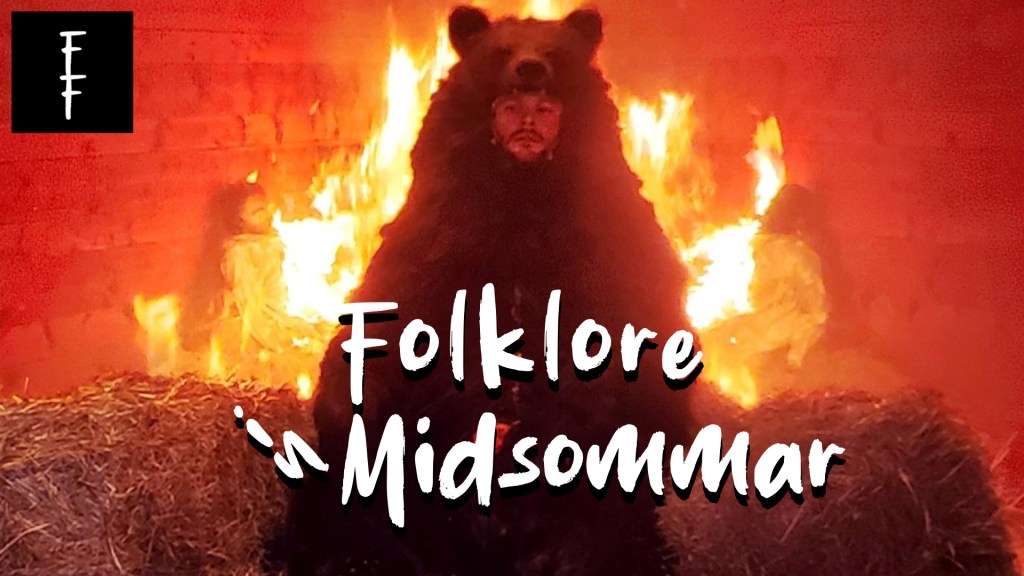
But the thing is, that infamously fiery (and furry) final scene featuring the hollowed-out body of a bear isn’t rooted in Norse mythology or Scandinavian folklore. Not solely, anyway.
Based on Aster’s own admission, I think it’s clear that he borrowed the idea of ceremonially sacrificing a caged bear from a Northeast Asian tradition.
And I found the specific book, and the specific line in that book, that proves it.
Norse Mythology in Midsommar: Týr & Fenrir
First things first: There are references to Norse mythology in 2019’s Midsommar.
The most obvious being the presence of the Tiwaz rune, which comes from the Elder Futhark, the oldest of the runic alphabets.
The rune, which symbolizes justice and sacrifice, was named for the Norse god Týr, who famously sticks his right hand in the mouth of the giant wolf Fenrir as a way to reassure the beast that the gods definitely aren’t trying to tie him up.
Of course, that’s exactly what they’re doing, and once Fenrir realizes he’s being bound, he chomps off Týr’s hand.
Now, in the film it is Jack Reynor’s character Christian who wears the Tiwaz rune, and just as Týr sacrifices his hand to a wolf, Christian sacrifices his…entire body to a fire while stuffed inside of a bear carcass. Granted, he doesn’t really have a choice in the matter.
No, it’s not even close to being a perfect parallel.
But as I alluded to in my essay/video on The Lighthouse, folk-horror screenwriters rarely rely on a single source of inspiration.
The Legend of Bödvar Bjarki
While Ari Aster species-swaps the wolf to a bear, that’s not to say Norse mythology is devoid of ursine stories.
The most notable being the Saga of King Rolf Kraki, in which we find the characters Bjorn (“man-bear”), Bera (“she-bear”), and their son Bödvar Bjarki, whose name can be translated as “fierce bear-cub” or “warlike little bear.”
Which is fitting given that Bödvar Bjarki famously shape-shifts into a bear during a battle.
Or rather he goes into a trance and the bear is a mental projection of sorts. And when he is awoken from said trance, the brawling bear disappears.
Prior to that battle, Bjarki dispatches a berserker in single combat and sends the rest of his berserker companions packing, thus earning Bjarki the title of Denmark’s greatest champion.
To quote the professor of Old Norse and Medieval Scandinavian Studies Jesse Byock:
“The berserkers of the saga…are at times reminiscent of the retinue of warriors surrounding Odin and may ultimately derive from ancient bear cults…When the ‘berserker rage’ was upon him, a berserker was thought of as a sort of ‘were-bear’ (or werewolf), part man, part beast, who was neither fully human nor fully animal. Although not specifically so called, Bodvar Bjarki is a berserker of sorts.”
And one possible etymology of “berserker,” it should be noted, is “bear-shirt,” which is either a reference to the wild, ferocious demeanors these warriors would adopt or a literal reference to the bearskins they would wear during battle.
Of course, in Midsommar, Christian wears a bear onesie (prior to being incinerated).
But he really isn’t much of a warrior or champion. If anything, Florence Pugh’s character Dani takes on that role, as she is crowned May Queen after winning a pole-dancing competition.
Wait, that’s not what I…
Granted, the Bodvar Bjarki berserker story may represent a folklore motif, known alternately as the “Three Stolen Princesses” or the “Bear’s Son Tale,” which shows up in European, American, African, and Asian storytelling traditions. To quote Byock:
“The hero of this type of tale is frequently the offspring of a human woman and a bear.”
And what does Christian do prior to becoming the human/bear equivalent of a turducken?
Welp, it’s implied that he impregnates Maja (played by Isabelle Grill), a human woman, so maybe their future offspring becomes a heroic figure?
I know, I know, like a snug bearskin suit, it’s a stretch.
But get this:
Bodvar Bjarki has a potential parallel in the legendary Geatish warrior Beowulf (a name that perhaps means “bee-wolf,” a reference to the honey-loving bear), and both figures are considered “land cleansers.”
They come from abroad to help kingdoms eliminate supernatural threats.
And in Midsommar, the whole reason the Hårga prepare an extra crispy bear is to “purge [their] most unholy affekts.”
Still not convinced?
Honestly, me neither.
Skjöldr: The Boy Who Caught a Bear
Before the Hårga banish the “mighty and dreadful beast” to the “deepest recesses” where he may reflect on his “wickedness,” they hold the bear captive in a cage. Something we see quite early in the film.
It’s your classic case of Chekhov’s bear.
And keeping bears in cages ahead of ceremonial sacrifices just isn’t something we see in Norse mythology.
The closest equivalent I could find is the story of the legendary Danish king Skjöldr, who, in his youth, is attacked by a massive bear.
And although he’s unarmed and…a child, Skjöldr manages to tie the bear up with his belt. He then hands the bear over to a hunting party to be slaughtered.
But again, this bit of bear lore lacks the ceremony—and the cage—we see in Midsommar.
So, where did writer/director Ari Aster get this idea?
James George Frazer’s The Golden Bough
As the man himself told the New York Times:
“I turned to Frazer’s ‘The Golden Bough,’ which is a treasure trove of insights into pre-Christian traditions.”
The Frazer in question, of course, is James George Frazer, the Scottish folklorist and anthropologist who helped popularize the study of comparative mythology.
And in his magnum opus, the aforementioned Golden Bough, there’s an entire chapter dedicated to “Killing the Divine Animal.”
And within that chapter there’s a section titled “Killing the Sacred Bear.”
Surely, one should be able to find accounts of Nordic peoples caging bears and ceremonially sacrificing them in that section.
Only, one cannot.
Bear Worship in Northeast Asia
Yes, there are accounts of caged bears being sacrificed in The Golden Bough, but these all take place in Northeast Asia.
Specifically, on the island of Ezo or Yezo, now known as Hokkaido; on the island of Sakhalin; and on the Kuril Islands.
These are the native lands of the Ainu people.
A people who, interestingly, use the same word for “bear” as they do for “stranger.” And that word is kamui, which literally translates to “god.”
Indeed, Frazer notes that the Ainu appear to be bear-worshippers, but at the same time, they kill and eat the animals quite frequently.
This led Frazer to conclude:
“It is not quite easy to define the attitude of the Aino towards the bear.”
What we can say for sure is that the Ainu held an annual bear festival.
A festival that took multiple years of preparation, as the Ainu first had to capture a bear cub and suckle it. Then, when it got so big as to be unruly, they’d shut it up in a “strong wooden cage.”
For the next couple years, they’d feed it fish and porridge, and when the bear was deemed plump enough, the Ainu would kill it, cook it, and eat it.
But this wasn’t merely a means to a tasty meal.
Because before ceremonially dispatching the bear, which was quite the process, involving a shower of blunt arrows and two poles between which the bear’s neck would be compressed, Ainu women would take turns weeping and moaning in front of the bear’s cage, then the entire village would gather and a specially chosen orator would address the bear.
Frazer actually included an example of one of these addresses in the Golden Bough. And I quote:
“O thou divine one, thou wast sent into the world for us to hunt. O thou precious little divinity, we worship thee; pray hear our prayer. We have nourished thee and brought thee up with a deal of pains and trouble, all because we love thee so. Now, as thou hast grown big, we are about to send thee to thy father and mother. When thou comest to them please speak well of us, and tell them how kind we have been; please come to us again and we will sacrifice thee.”
After sacrificing the bear, the Ainu would collect its blood and sometimes drink it and/or smear it on their clothes. Then they’d disembowel the bear, skin it, remove its head, and place the head atop a tall pole, where it would remain until nothing was left but the bear’s skull.
No, this isn’t precisely what we see in Midsommar. Notably, there’s a lack of fire. But it does seem like some of these details informed Aster’s script.
Still not convinced?
I’ve been saving the best piece of evidence for last.
Connections Between Nordic & Northeast Asian Folklore
As I alluded to at the beginning of this video, there is a line in Frazer’s Golden Bough that connects Northeast Asian bear festivals to Nordic maypole festivals.
The line in question references not the Ainu, but a neighboring indigenous ethnic group, the Gilyaks or Nivkh, who also engage in bear worship.
Alright, enough preamble, here it is:
“In the treatment of the captive bear by these tribes there are features which can hardly be distinguished from worship. Such, for example, the Gilyak custom of leading the living beast to the river in order to ensure a supply of fish, and of conducting him from house to house in order that every family may receive his blessing, just as in Europe a May-tree or a personal representative of the tree-spirit used to be taken from door to door in spring for the sake of diffusing among all and sundry the fresh energies of reviving nature.”
Is it just me, or can’t you picture Aster reading this and thinking to himself: “Eureka! May-trees and caged bears. Those are some powerful visuals that served similar religious purposes. Let’s put ‘em together.”
And assuming Aster read the rest of the Golden Bough, which I’m sure he did, he also knew that may-trees, the forerunners of maypoles, used to be ceremonially ignited.
FYI: The ancient Gaelic/Goidelic Celtic-speakers of Ireland, Scotland, and the Isle of Man likely engaged in a similar practice, which is why Beltane, the Gaelic May Day, is celebrated with massive bonfires.
You can learn more about that over on my other blog/channel, Irish Myths.
Now, here’s one final tidbit connecting ancient Nordic bear traditions to Northeast Asian bear traditions.
Remember how the Danish hero Bodvar Bjarki is said to be the son of a bear, and how that’s indicative of a widespread folklore motif known as the Bear’s Son Tale?
Welp, turns out the Ainu of Northeast Asia have a legend of a woman who had a son by a bear. And to this day, or at least up until the writing of the Golden Bough, which was first published in 1890, there were mountain-dwelling Ainu people who referred to themselves as Kimun Kamui sanikiri: “Descendants of the bear.”
Will Christian’s hypothetical descendants describe themselves similarly?
I guess we’ll just have to wait for the sequel.
Thanks for reading.
Fan of folklore?
You might be interested in…
Neon Druid: An Anthology of Urban Celtic Fantasy
“A thrilling romp through pubs, mythology, and alleyways. NEON DRUID is such a fun, pulpy anthology of stories that embody Celtic fantasy and myth,” (Pyles of Books). Cross over into a world where the mischievous gods, goddesses, monsters, and heroes of Celtic mythology live among us, intermingling with unsuspecting mortals and stirring up mayhem in cities and towns on both sides of the Atlantic, from Limerick and Edinburgh to Montreal and Boston. Learn more…
 Folklore in Film
Leave a comment