
Folklore in Film is reader-supported. When you buy through links on our site, we may earn a small affiliate commission.
Forget Prometheus and Proteus. Forget Neptune and Triton. Forget Greco-Roman mythology altogether.
If you really want to understand 2019’s The Lighthouse, you need to learn some Irish mythology.
Fortunately, you’ve come to the right place.
I’m I. E. Kneverday, creator of IrishMyths.com and the Irish Myths YouTube channel.
Welcome to the very first essay/video on my new channel/website, Folklore in Film.
Edgar Allan Poe’s “The Light-House”
Any self-respecting fan of Robert Eggers’ signature brand of folk-horror filmmaking already knows that his sophomore effort, The Lighthouse, was inspired by an unfinished Edgar Allan Poe story titled The Light-House.
It was the last thing Poe wrote before his death in 1849.
Structured as a series of diary entries made by the newly arrived lighthouse keeper, Poe’s tale ends abruptly after day three, but not before acknowledging a “peculiarity in the echo” of the cylindrical walls and calling the structural integrity of the lighthouse into question.
The Smalls Lighthouse Tragedy
Screenwriter Max Eggers tried (and failed) to expand Poe’s proto-story into a screenplay.
That’s when brother Robert Eggers stepped in with a seemingly historical account of a pair of quarreling lighthouse keepers, both named Thomas, who were stationed together on a small rocky island off the coast of Wales.
One of the Thomases died in a freak accident and the other, fearing he’d be accused of murder, stored the body in a makeshift coffin.
But then a storm ripped the coffin apart and the wind made it seem like the dead Thomas’s arm was waving at the alive Thomas.
As a result of this ordeal, dubbed the Smalls Lighthouse Tragedy, the surviving Thomas went insane and in 1801 British lighthouse policy was officially changed to require three keepers to be stationed at each lighthouse instead of the usual two.
Clearly such a policy had not been adopted in 1890s New England, the setting of the film.
Seagull Superstitions
In my mind, The Lighthouse hinges on a single line of dialogue.
And I think we all know what that line is:
“Yer fond of me lobster aint’ ye? I seen it — yer fond of me lobster! Say it!”
Wait, no, I meant:
“Bad luck to kill a seabird.”
Yeah, apparently killing seabirds is a major nautical no-no.
This according to…one poem by Samuel Taylor Coleridge, 1798’s The Rime of the Ancient Mariner, which details the exploits of a sailor who kills an albatross with a crossbow, an act that arouses the wrath of a Spirit “from the land of mist and snow.”
The weather takes a turn and DEATH eventually claims the souls of all the sailors, save the titular mariner whose soul is won (via dice toss) by a red-lipped, blonde-haired, pale-skinned woman dubbed “The Night-mare LIFE-IN-DEATH.”
This is the source material cited in virtually every thinkpiece/review/Easter egg video that tries to make sense of The Lighthouse’s seagull smashing incident and the resulting bad luck endured by the Thomases.
Those same thinkpieces, reviews, and Easter egg videos tend to assert that sailors have known about the seabird murder taboo for ages. And that there’s been this long-held belief that seagulls are the souls of dead sailors.
However, the Oxford Dictionary of Superstition is only able to trace the sailor-souls-in-seagulls claim back to 1969. It’s alluded to in Rummer Godden’s novel In This House of Brede.
By 1987, at least, the superstition was widespread. However, in an interview from that year featured in the aforementioned dictionary, a Londoner was unable to remember if the don’t-shoot-that-bird-because-it-contains-the-soul-of-a-sailor rule applied to seagulls or albatrosses.
Souls aside, in the earliest recording of a seabird superstition (from 1878), stormy petrels are said to be “possessed of supernatural agency in creating danger for the…mariner.”
Irish Mythology (The Sick-Bed of Cú Chulainn)
And here, dear viewer, is where I make my grand segue to Irish folklore and mythology, because it turns out that the regarding of stormy petrels as “objects of superstitious fear” is endemic to coastal Scotland and the Highlands.
Areas that were historically inhabited by Gaelic/Goidelic Celtic-speakers who came from Ireland.
And we know that along with their language they brought their stories.
Perhaps even a little story called Serglige Con Culainn—The Sick-Bed of Cú Chulainn or The Wasting Sickness of Cú Chulainn—in which the titular hero chucks a spear (or a stone, depending on the telling) at a pair of seabirds.
But oops! The seabirds, who retreat beneath the water, are actually supernatural women from the Otherworld and Cú Chulainn immediately falls ill and collapses against a stone pillar. Then the women, in their human forms, show up and laugh at the hero before beating the crap out of him with horsewhips.
Cú Chulainn is in bed for nearly a year after that until Fand, one of the Otherworldly women who beat him, says, “hey, come catch a boat with me to Mag Mell, the Plain of Delights, and help me vanquish some enemies and I’ll cure you.”
Cú Chulainn agrees. The battle is won. And to celebrate, Fand sleeps with him. Then she falls in love with him. Which is problematic because Cú Chulainn is married (to Emer) and Fand is married to… Manannán mac Lir, the Irish sea-god. Mac Lir meaning “son of the sea.”
It should also be noted that Cú Chulainn is described as follows in this story:
“[W]hen his mind was angry within him, [he] was accustomed to draw in the one of his eyes so far that a crane could not reach it in his head.”
So not only do we have some one-eyed imagery here, which also shows up in The Lighthouse, we have a reference to a bird trying to hypothetically pluck the eye of a main character.
For context, The Sick-Bed of Cú Chulainn appears in its oldest, extant form in the 12th-century Book of the Dun Cow, having been copied from the lost Yellow Book of Slane.
Irish scholar Myles Dillon dated the language used in that version of the story to the 9th century.
Best as I can tell, that makes it the oldest European story to feature a protagonist tussling with supernatural seabirds.
True, there is a folklore motif called the “Revenant as sea-gull,” but the seabirds in The Sick-Bed of Cú Chulainn aren’t revenants, i.e., people who returned from the dead, nor are they seagulls for that matter.
Based on how they’re described, I actually think the author envisioned them, funnily enough, as albatrosses, which visit Ireland only on rare occasions. But when they do visit, people notice.
Of course, in The Lighthouse, we’re dealing with seagulls, not albatrosses (they’re from entirely different bird families, I googled it).
But that’s just a detail. What matters… is this:
In both The Lighthouse and The Sick-Bed of Cú Chulainn:
- The protagonist attacks a seabird.
- Immediately after, there’s a seemingly supernatural event.
In The Lighthouse, the wind changes abruptly from Westerly to Nor’Easterly. In Cú Chulainn’s story, the hero abruptly falls ill before…
- A mysterious woman appears from beneath the waves. She laughs at the protagonist and, more generally, torments him.
With Cú Chulainn and Fand, the latter dives into the water in bird form before emerging in human form and then proceeds with her laughing attack.
With Robert Pattinson’s Winslow/Howard, it is, of course, the mermaid who takes on the role of the mysterious, semi-aquatic woman/animal. And notably she lets out a siren call/cackle when first making the young lighthouse keeper’s acquaintance on the shore.
- The mysterious woman/animal is revealed to be connected to a sea-god.
Fand, of course, is married to Ireland’s chief sea-god, the otherworldly ruler Manannán.
As for the mermaid…Look, hear me out:
Willem Dafoe’s Thomas Wake, in addition to briefly taking on a sea god-esque appearance, makes references to Neptune, Triton, the Sea King, and the Dread Emperor. Perhaps he is deliberately name-dropping his own names in these situations? Giving hints?
Wake also mentions harpies, which, in Greco-Roman mythology (dammit I vowed not to mention that) are human/bird hybrids that personify storm winds. And what’s especially interesting is that Wake talks about harpies in the context of them feeding on his fellow lighthouse keeper’s corpse.
And we do see seagulls making a buffet of Pattinson’s character at the end of the film, implying both that Wake perhaps had a foreknowledge of his demise and that the seagulls aren’t normal gulls, but harpies. Or harpy-esque beings. Perhaps working in the service of Dafoe’s Sea God character.
And what if the mermaid is actually the same entity or soul of the seagull that Pattinson killed?
This is something that happens all the time in Irish mythology. Characters adopt the forms of different animals, extending their lives.
For example, over the course of several centuries, the mythical Tuan Mac Cairill is reborn as a stag, then a boar, then a hawk, then a salmon, then a woman eats the salmon, gets pregnant, and gives birth to Tuan as a human.
Don’t you just love Irish mythology?
But I digress.
Of course, Fand transforming between bird and woman in the The Sick-Bed of Cú Chulainn also gives off harpy vibes.
And I can’t stress enough the detail that after getting pierced through the wing with Cú Chulainn’s spear, Fand, as a seabird, dives into the water before taking on her human form.
There’s a parallel there if we assume the seagull in The Lighthouse, after getting Hulk-smashed, is reborn in her more humanoid, mermaid form, and like Fand she must emerge from the water.
Am I reaching?
Yes.
But get this:
Robert Eggers is familiar with Irish mythology. Or at least he was by the time The Northman came out, going by this interview he did with Entertainment.ie in 2022.
And he told Vox: “Folklore, mythology, fairy tales, religion, [and] at times the occult,” are the things he is most interested in.
So it’s not out of the realm of possibility that he would know The Sick-Bed of Cú Chulainn. It’s a popular story. The Pogues named a song after it, for Manannán’s sake.
So why don’t The Lighthouse’s characters make outright references to Irish mythology? Why doesn’t Wake namedrop Manannán mac Lir during his infamous, deity-laden rant?
Because that would’ve been out of character.
These lighthouse keepers probably wouldn’t have learned about Irish/Gaelic gods in school, assuming they went to school. But the Greco-Roman gods? Sure. So that’s what Eggers put in the dialogue.
New England Folklore
All this being said, we can’t forget that Eggers—who grew up in New Hampshire, and who set The Lighthouse in coastal Maine, and whose first film was 2015’s The Witch, subtitled: A New-England Folktale—has a special fondness for New England folklore.
As do I, incidentally, having grown up just outside of Boston.
So, what do the folktales of my homeland have to say about all this?
Truth be told, I didn’t find much about seagulls apart from a reference to a “spectre gull” in a legend from Lynn, Massachusetts.
But notably there is a story from further up the coast in Gloucester about a noisy crow that won’t stop pestering soldiers. Normal rocks and bullets can’t harm the bird, but silver does the trick. The soldiers shoot the bird in the leg and oh, what a coincidence, the witch up the street, Old Meg, falls and breaks her leg at exactly that same moment.
Scoot back down the coast to Salem, and you won’t be lacking for stories about witches. What I’m particularly interested in though is the local lore around witches entering into covenants with Satan.
To quote from the 1884 Book of New England Legends & Folk Lore by Samuel Adams Drake:
“The bargain being concluded, Satan delivered to his new recruit an imp or familiar spirit, which sometimes had the form of a cat, at others of a mole, of a bird, of a miller-fly, or of some other insect or animal. These were to come at call, do such mischief as they should be commanded, and at stated times be permitted to suck the wizard’s blood.”
Okay, did Eggers pull a fast one on us?
Is The Lighthouse really just The Witch Goes to Summer Camp?
With Willem Dafoe as Satan.
The mermaid, a witch who has entered into a covenant with Satan.
And the seagulls are the mer-witch’s familiars, whom she commands to do mischief.
And while they don’t suck her blood, in the end those gulls do get several billful’s of the red stuff courtesy of the aforementioned lighthouse keeper buffet.
The Fresnel Lens & Mercury Poisoning
Now, to be clear, Eggers always intended The Lighthouse to be obscure and ambiguous (he’s said that in interviews).
But having recently visited the tallest lighthouse on the West Coast of North America, I think I’ve cracked it.
I’ve concluded that many of the film’s folk-horror elements were hallucinated by one of or both of the characters.
Ya see, at the lighthouse museum, they had a gen-u-ine Fresnel lens on display. And they had a big metal tub, which used to be filled with mercury.
That was Augustin Fresnel’s huge innovation in lighthouse lens-spinning technology: floating a lens in a mercury bath, thereby creating a near frictionless environment.
The only downside to Fresnel’s mercury float is that it requires lighthouse keepers to regularly adjust the levels of the liquid mercury in the bath.
I think you see where I’m going with this.
Mercury can be absorbed through the skin. And it can rise as a vapor and be inhaled. Which means if you’re a lighthouse keeper maintaining one of these mercury flotation systems: “Mercury poisoning can easily occur.” This according to the United States Lighthouse Society.
Know the expression “mad as a hatter?”
That arose because in the 18th and 19th-centuries, hat-makers infamously used mercury in the production of felt. And as a result of the regular exposure, many of these hatters went mad from mercury poisoning, to put it crudely.
And you might be interested to know that symptoms of mercury poisoning include insomnia, paranoia, mood swings, irritability, anxiety, confusion, hallucinations, and, according to the American Journal of Psychiatry, both excessive dreaming and vivid dreams that can feel indistinguishable from real events.
The silver bullet (mercury bullet?) in all of this is that Eggers deliberately set his film in the 1890s.
Why not the 1880s?
Why not the 1870s?
Why not 1801 to coincide with the Smalls Light Tragedy?
The answer:
Because Fresnel’s mercury float technology wasn’t adopted in American lighthouses until the year 1890.
So while Eggers might not have remained faithful to any single strand of folklore in The Lighthouse, mixing and matching as he saw fit, he did remain faithful to history.
Thanks for reading.
Fan of folklore?
You might be interested in…
Neon Druid: An Anthology of Urban Celtic Fantasy
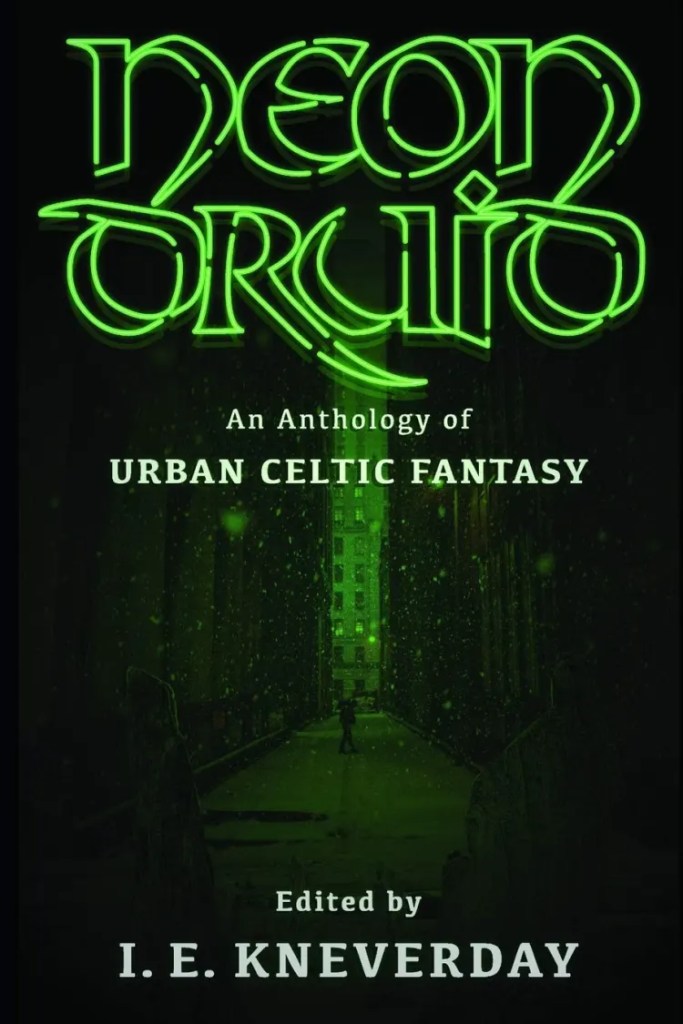
“A thrilling romp through pubs, mythology, and alleyways. NEON DRUID is such a fun, pulpy anthology of stories that embody Celtic fantasy and myth,” (Pyles of Books). Cross over into a world where the mischievous gods, goddesses, monsters, and heroes of Celtic mythology live among us, intermingling with unsuspecting mortals and stirring up mayhem in cities and towns on both sides of the Atlantic, from Limerick and Edinburgh to Montreal and Boston. Learn more…
 Folklore in Film
Leave a comment